

An Example of a One-Parameter Family of Rank-One Convex Stored Energies for Isotropic Compressible Solids
Abstract This research investigates the hyperbolicity of the time-dependent governing equations for isotropic hyperelastic solids, considering a one-parameter family of stored-energy functions that includes generalized neo-Hookean materials. Building on the mathematical criterion established in earlier research by Ndanou, Favrie, and Gavrilyuk (2014), the study demonstrates the hyperbolicity of the governing system for the proposed family..
Read more- 8 vues
Criterion of Hyperbolicity in Hyperelasticity in the Case of the Stored Energy in Separable Form
Abstract We investigate the equations governing hyperelasticity for isotropic solids expressed in Eulerian coordinates, focusing on a particular formulation in which the specific stored energy can be separated into two components. The first component, representing the hydrodynamic energy, depends exclusively on the material density and entropy. The second component, corresponding to the shear energy, depends..
Read more- 0 vues
Mathematical and Numerical Study of Hyperelastic and Viscoplastic Models: Applications to Hypervelocity Impacts
Abstract A mathematical diffuse-interface model describing the interaction of an arbitrary number of elastoplastic solids has been developed. This model extends the framework introduced by Favrie and Gavrilyuk (2012) for fluid-solid interactions. Despite the large number of governing equations, the proposed model exhibits two fundamental mathematical and physical properties: Hyperbolicity: The governing system remains hyperbolic..
Read more- 0 vues
The piston problem in hyperelasticity with the stored energy in separable form
Abstract The piston problem for a hyperelastic hyperbolic conservative model where the stored energy is given in separable form is studied. The eigenfields corresponding to the hyperbolic system are of three types: linearly degenerate fields (corresponding to the contact characteristics), the fields which are genuinely nonlinear in the sense of Lax (corresponding to longitudinal waves),..
Read more- 0 vues
A thermodynamically compatible splitting procedure in hyperelasticity
Abstract A material is hyperelastic if the stress tensor is obtained by variation of the stored energy function. The corresponding 3D mathematical model of hyperelasticity written in the Eulerian coordinates represents a system of 14 conservative partial differential equations submitted to stationary differential constraints. A classical approach for numerical solving of such a 3D system..
Read more- 0 vues
Multi-solid and multi-fluid diffuse interface model: Applications to dynamic fracture and fragmentation
Abstract We extend the model of diffuse solid–fluid interfaces developed earlier by authors of this paper to the case of arbitrary number of interacting hyperelastic solids. Plastic transformations of solids are taken into account through a Maxwell type model. The specific energy of each solid is given in separable form: it is the sum of..
Read more- 1 vues
Scientific Publications & Research Contributions
Serge Bertrand Ndanou, Ph.D. — Publications Computational Scientist · Numerical Simulation, Hyperelasticity, Viscoelasticity, Viscoplasticity [email protected] · +33 6 68 67 43 42 Profils : Google Scholar · Semantic Scholar · ResearchGate Peer-Reviewed Journal Articles Classés par nombre de citations décroissant. Total : 266 citations sur les cinq articles. S. Ndanou, N. Favrie, S. Gavrilyuk. “Multi-solid..
Read more- 2 vues
FDM vs. FEM vs. FVM: Choosing the Right Numerical Method
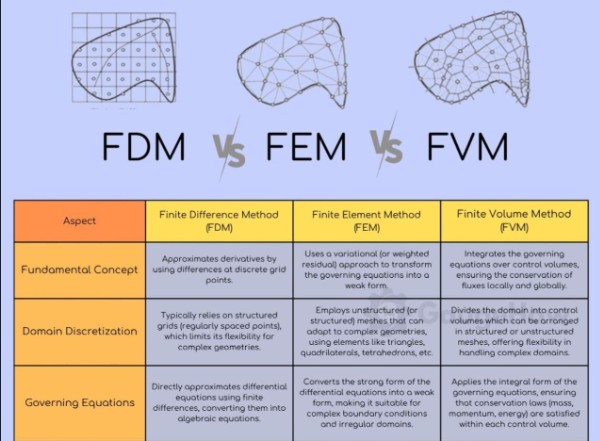
right method depends on the problem at hand
Numerical simulation plays a fundamental role in modern engineering, enabling researchers and engineers to analyze complex physical phenomena, predict material behavior, and optimize industrial processes. Three widely used approaches are the Finite Difference Method (FDM), Finite Element Method (FEM), and Finite Volume Method (FVM). Although these methods can solve many of the same partial differential..
Read more- 14 vues
