

Multi-solid and multi-fluid diffuse interface model: Applications to dynamic fracture and fragmentation
Abstract
We extend the model of diffuse solid–fluid interfaces developed earlier by authors of this paper to the case of arbitrary number of interacting hyperelastic solids. Plastic transformations of solids are taken into account through a Maxwell type model. The specific energy of each solid is given in separable form: it is the sum of a hydrodynamic part of the energy depending only on the density and the entropy, and an elastic part of the energy which is unaffected by the volume change. It allows us to naturally pass to the fluid description in the limit of vanishing shear modulus. In spite of a large number of governing equations, the model has a quite simple mathematical structure: it is a duplication of a single visco-elastic model. The model is well posed both mathematically and thermodynamically: it is hyperbolic and compatible with the second law of thermodynamics. The resulting model can be applied in the situations involving an arbitrary number of fluids and solids. In particular, we show the ability of the model to describe spallation and penetration phenomena occurring during high velocity impacts.
Introduction
Fracture and fragmentation in ductile materials undergoing impact loading is still one of the major theoretical issues in solid mechanics. Since the pioneering works by Taylor [33] and Wilkins [37], few methods were proposed for modeling fracture dynamics in solids undergoing high-velocity impacts. One can mention here an ‘Optimal Transportation Mesh Free’ method (Li et al. [24], [25]) based on the discretization of Hamilton’s action for elastic solids where a special failure algorithm is added to describe the fragmentation. Another approach was used in Barton et al. [3] where the fragmentation is governed by regularization in solving the level-set advection equations. In particular, such a regularization does not conserve the mass and the total energy on coarse grids. We will use a different approach based on the diffuse interface modeling in Eulerian formulation. Such an approach was first proposed by Karni [21], Abgrall [1] and Saurel and Abgrall [30] for modeling interfaces between ideal compressible fluids having different thermodynamic characteristics. With such an approach, the same equations are solved everywhere with the same numerical scheme. This is achieved by adding a negligible quantity of other phases into pure phases. This kind of model can describe the generation of new interfaces. The main drawback of the Eulerian diffuse interface approach compared to a Lagrangian formulation is that the interfaces are not sharp. Indeed, the ‘mixture cells’ are always present in the vicinity of moving interfaces. The thickness of ‘the mixture region’ being increased in time, the method can only be used for a short time interval. Hence, a natural application of such methods is high-velocity process (impacts, explosive phase transitions etc.). This approach has been extended in Saurel et al. [31] to fluids exhibiting phase transitions and heat exchanges. Favrie et al. [8], and Favrie and Gavrilyuk [10] extended the diffuse interface method to the case of fluid–solid interfaces. The pure solid component was described by a hyperelastic model (Miller and Colella [27], Godunov and Romenskii [15], Gavrilyuk et al. [14], Godunov and Peshkov [16], Kluth and Desprès (2008) [22], Barton et al. [3] and others). The hyperelastic models have some advantages with respect to conventional hypoelastic models [37]. The latter, even if they are widely used in industrial and commercial codes (CTH, LS-DYNA (USA), EGIDA (Russia), …) have some drawbacks highlighted, in particular, in [14] and [26]:
- •
The hypoelastic models are not in divergence form. Thus, the jump relations across a shock front cannot be written directly. Also, the convergence of numerical schemes cannot be guaranteed.
- •
The solution depends on the choice of a so-called ‘objective derivative’ governing the evolution of the deviatoric part of the stress tensor. Since there is an infinite set of ‘objective derivatives’, and the numerical results strongly depend on such a choice, the model is in somewhat not complete.
- •
The models are not thermodynamically consistent, i.e. do not respect the second law of thermodynamics.
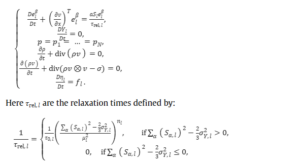
In [7], [8], [10] a diffuse interface model for solid–fluid interaction was derived. A special form of the specific energy of solids was used. The energy was taken as the sum of a hydrodynamic part depending only on the density and the entropy, and an elastic part which was unaffected by the volume change (the elastic part can also be called ‘isochoric’ part of the energy). Such a choice implies, in particular, the fact that the pressure is determined only by the hydrodynamic part of the energy, while the deviatoric part of the stress tensor is entirely determined by the elastic (isochoric) part of the energy. In particular, with such an equation of state the fluids are viewed as a particular case of solids with vanishing shear modulus. The model is hyperbolic under easily verified conditions [28]. One of these conditions is classical: the pressure should increase with the density increasing (the squared sound speed is positive). The second one is formulated in terms of the convexity of the elastic (isochoric) energy. Modelling visco-plastic transformations was done by using a Maxwell type model [15], [16], [9], [3]. When plastic deformations occured, the model [8], [10] was in agreement with the following natural requirements:
- •
Isochoricity of a plastic response (the density does not evolve during the relaxation process). This is a usual hypothesis in visco-elasticity (Godunov and Romenskii [15], Godunov and Peshkov [16]).
- •
Entropy increasing. This important property is often ignored in mathematical modeling.
- •
Shear stresses decreasing. The solids where the deviatoric part of the stress tensor is decreasing during the relaxation are often called ‘Maxwell type’ solids. The corresponding model can be called a ‘Maxwell type’ model.
- •
The plasticity yield limit is reached at the end of the relaxation process. In particular, we take the von Mises yield criteria and prove that it is compatible with the governing equations in the sense that the yield surface is an attractor for the solutions of the governing equations (a Lyapunov function can be constructed).
Organizational access
Get full-text access by signing in with your organisation
Hyperelastic diffuse interface model for interaction of N solids
Governing equations
Non-equilibrium visco-plastic model for the interaction of N solids
Numerical resolution of the visco-plastic model
Applications
Remark about higher order extension
Conclusion
Acknowledgements
- 1 vues
