

FDM vs. FEM vs. FVM: Choosing the Right Numerical Method
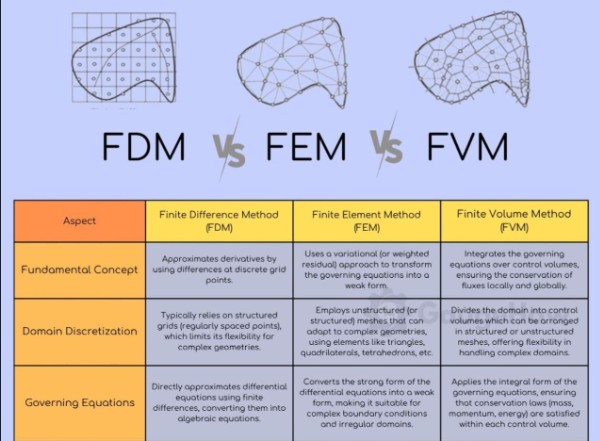
right method depends on the problem at hand
Numerical simulation plays a fundamental role in modern engineering, enabling researchers and engineers to analyze complex physical phenomena, predict material behavior, and optimize industrial processes.
Three widely used approaches are the Finite Difference Method (FDM), Finite Element Method (FEM), and Finite Volume Method (FVM).
Although these methods can solve many of the same partial differential equations (PDEs), they differ in their mathematical formulation, discretization strategies, computational requirements, and suitability for specific engineering applications.
1. Finite Difference Method (FDM)
The Finite Difference Method approximates derivatives using differences between values at discrete points on a computational grid.
Key Advantages
- Straightforward mathematical formulation and implementation.
- Particularly efficient on structured grids and regular geometries.
- Well suited to problems involving heat transfer, diffusion, and fluid dynamics.
- Supports high-order discretization schemes.
Main Considerations
Handling highly irregular geometries or complex boundaries may require specialized techniques.
2. Finite Element Method (FEM)
The Finite Element Method divides the computational domain into smaller elements and constructs an approximate solution using basis functions and a variational or weighted-residual formulation.
Key Advantages
- Excellent flexibility for complex geometries and unstructured meshes.
- Widely used in structural mechanics, elasticity, viscoelasticity, and multiphysics simulations.
- Supports different element types and approximation orders.
- Well established for stress analysis, deformation prediction, and material modeling.
Main Considerations
Mesh quality, element selection, numerical conditioning, and solver performance significantly influence accuracy and computational efficiency.
3. Finite Volume Method (FVM)
The Finite Volume Method integrates conservation equations over discrete control volumes and calculates numerical fluxes across their boundaries.
Key Advantages
- Naturally supports discrete conservation of mass, momentum, and energy when implemented consistently.
- Widely applied in Computational Fluid Dynamics (CFD).
- Suitable for compressible flows, heat transfer, and multiphase systems.
- Compatible with structured and unstructured meshes.
Main Considerations
Accurate reconstruction of interface fluxes, numerical stability, and treatment of complex flow phenomena require careful selection of numerical schemes.
4. How to Choose the Right Method
The choice between FDM, FEM, and FVM depends on several important factors:
- Physical Problem: Structural deformation, fluid flow, heat transfer, or coupled multiphysics phenomena.
- Geometry and Mesh: Regular domains, complex boundaries, or unstructured computational grids.
- Conservation Requirements: Whether strict discrete conservation of physical quantities is essential.
- Accuracy and Stability: Desired numerical precision, approximation order, and stability constraints.
- Computational Performance: Memory requirements, solver scalability, parallel computing capabilities, and available HPC resources.
No single method is universally superior. The most appropriate approach depends on the governing equations, physical constraints, numerical requirements, and available computational resources.
5. Applications in Scientific Computing
At TCHIKOU-R CONSULTING, numerical modeling and computational mechanics are central to our scientific expertise.
Our areas of interest include elasticity, viscoelasticity, computational fluid and solid mechanics, scientific software development, and high-performance computing.
Understanding the strengths and limitations of different numerical methods is essential for designing reliable computational approaches to complex scientific and engineering challenges.
Let’s Discuss Your Numerical Simulation Challenges
Are you working on a project involving computational mechanics, finite element analysis, CFD, or advanced material modeling?
Connect with TCHIKOU-R CONSULTING to explore how numerical simulation and scientific computing expertise can support your research or engineering objectives.
See more on LinkedIn- 14 vues
