

1. Introduction to Polymer Injection into Viscoelastic Flow
Polymer injection into viscoelastic flow represents a challenging computational fluid dynamics (CFD) problem involving multiple fluid materials, transient injection, nonlinear stresses, and evolving fluid interfaces.
Understanding how one polymer is injected into another is relevant to research in polymer processing, complex fluid mechanics, and multiphase numerical simulation.
Unlike Newtonian fluids, viscoelastic materials exhibit both viscous dissipation and elastic energy storage. Their response depends on deformation history, material relaxation times, and nonlinear stress evolution.
When two polymeric fluids interact, differences in their rheological properties may influence the resulting flow structures and the evolution of their interface.
This numerical project investigates the direct injection of a secondary polymer into an existing viscoelastic flow through a periodically activated injection orifice.
The computational configuration includes a cylindrical obstacle located within the primary flow, with an injection opening that periodically introduces a second polymer into the surrounding material.
The simulation provides a framework for investigating pulsed injection dynamics, Level Set interface tracking, velocity evolution, and viscoelastic stress distributions.
2. Numerical Configuration and Physical Modeling
A. Primary Polymer Flow Around a Cylinder
The starting configuration consists of a primary polymer flowing around a centered cylindrical obstacle.
The cylinder modifies the surrounding velocity field and creates spatial variations in pressure and local deformation rates.
Depending on the fluid properties and operating conditions, the flow around the cylinder may also exhibit recirculation regions and complex stress distributions.
This configuration provides a useful computational foundation for introducing an additional polymer phase.
The numerical model must represent the solid boundary, the surrounding fluid motion, and the relevant constitutive stresses.
B. Pulsed Injection of a Secondary Polymer
A distinctive feature of the project is the introduction of a second polymer through an orifice located on the cylindrical obstacle.
The injection is controlled periodically, producing successive intervals of polymer delivery.
This creates a time-dependent interaction between the primary flow and the injected material.
The secondary polymer enters the surrounding fluid with a prescribed injection velocity that is controlled independently of the main channel velocity.
As a result, the numerical configuration allows the investigation of interactions between:
- The primary polymer flow velocity.
- The secondary polymer injection velocity.
- The timing of the injection pulses.
- The geometry and position of the injection orifice.
- The rheological properties of the fluid materials.
These parameters influence the flow configuration and provide opportunities for systematic numerical investigation.
C. Two-Polymer Flow Representation
The model distinguishes between the primary and secondary polymer regions through a numerical phase representation.
In the indicator convention described for this project:
- Phi = 1: Primary polymer.
- Phi = 0: Secondary injected polymer.
This phase indicator helps visualize the spatial distribution of the two polymer materials throughout the computational domain.
Its evolution provides information about how the injected material moves and deforms under the influence of the surrounding flow.
The indicator convention should be distinguished from the underlying signed-distance Level Set function, whose numerical values depend on the formulation used.
3. Level Set Method and Interface Tracking
A. Understanding the Level Set Method
The Level Set method is a numerical technique commonly used to represent and track evolving interfaces in fluid mechanics.
It describes an interface implicitly through a scalar field defined over the computational domain.
The method is particularly relevant when the interface undergoes complex deformation, stretching, or topological changes.
For polymer injection simulations, Level Set techniques can support the representation of the moving boundary between different material regions.
B. Evolution of the Polymer Interface
As the secondary polymer enters the main flow, the surrounding velocity field transports and deforms the injected material.
The resulting interface may develop elongated structures, curved boundaries, or other complex geometric features.
The evolution depends on the relative fluid velocities, material properties, injection timing, and numerical treatment of the interface.
Tracking this interface accurately is important for understanding the transport and spatial distribution of the injected polymer.
C. Numerical Interface Accuracy
Accurate interface representation is one of the main challenges in multiphase CFD.
Numerical transport can introduce artificial diffusion, distort interface geometry, or affect the conservation of material volume.
Important numerical considerations include:
- Spatial resolution near the interface.
- Time-step selection during transient injection.
- Consistency of interface advection.
- Control of numerical diffusion.
- Monitoring of phase-volume conservation.
- Appropriate treatment of the injection boundary.
These aspects must be evaluated through numerical verification to establish the reliability of the simulated interface evolution.
4. Velocity, Pressure, and Viscoelastic Stress Analysis
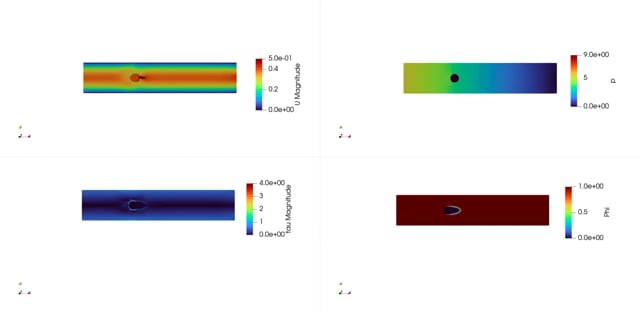
The numerical simulation provides access to several physical fields used to investigate polymer injection into viscoelastic flow.
A. Velocity Field (U)
The velocity field describes the motion of the primary polymer and the injected secondary material.
Its evolution reflects the interaction between the main channel flow, the cylindrical obstacle, and the imposed injection conditions.
The velocity distribution can help identify:
- Regions of flow acceleration.
- Strong velocity gradients near the injection orifice.
- Changes in the downstream wake.
- Transport of the injected polymer.
- Transient flow structures generated by the injection pulses.
These observations provide a basis for analyzing the kinematic behavior of the coupled fluid system.
B. Pressure Distribution (p)
The pressure field provides information about the mechanical conditions associated with the flow.
Local pressure variations may develop around the cylindrical obstacle and near the injection region.
The imposed secondary flow can also modify the surrounding pressure distribution.
Numerical pressure analysis can help investigate the interaction between the primary flow and transient injection conditions.
C. Viscoelastic Extra-Stress Tensor (Tau)
Viscoelastic fluids exhibit additional constitutive stresses associated with their time-dependent mechanical response.
The extra-stress tensor provides information about the internal stresses generated during fluid deformation.
Depending on the constitutive models employed, these stresses may reflect elastic memory, shear-dependent behavior, and relaxation processes.
During polymer injection, significant stress variations may develop near the injection opening and in regions of strong deformation.
Analyzing the extra-stress tensor can help characterize the interaction between transient motion and nonlinear rheological behavior.
D. Phase Indicator (Phi)
The phase indicator provides a visual representation of the distribution of the two polymer materials.
Combining this field with velocity, pressure, and stress visualizations offers a more complete understanding of the simulated interaction.
The numerical results can be used to examine the relationship between fluid transport, interface deformation, and viscoelastic stresses.
5. Main Computational Challenges
A. Transient Injection Boundary Conditions
One of the central challenges is representing the periodic activation of the polymer injection.
The numerical implementation must account for changes in the prescribed injection conditions while maintaining a consistent flow solution.
Rapid variations in injection velocity may introduce additional transient structures and strong local gradients.
Suitable temporal resolution is therefore important for accurately representing the injection cycle.
B. Coupling Between Polymer Materials
When different polymeric materials are present in the same computational domain, their interaction may require special treatment of the interface and constitutive behavior.
The numerical formulation must account for the material properties assigned to each region.
Depending on the physical assumptions, additional effects such as interfacial tension, diffusion, or material compatibility may also need to be considered.
These effects should only be included when supported by the selected physical model.
C. Nonlinear Viscoelastic Stresses
Viscoelastic constitutive equations introduce additional numerical variables and nonlinear coupling with the fluid motion.
Strong velocity gradients near the injection opening may produce elevated stress concentrations.
Accurately representing these effects requires appropriate constitutive discretization, solver strategies, and spatial resolution.
Numerical stability may become more challenging when elastic effects are significant.
D. Interface Transport and Conservation
The evolving polymer interface must be transported consistently with the surrounding velocity field.
Inaccurate numerical advection can affect the predicted geometry and distribution of the injected material.
Conservation of total fluid mass and consistency of material-volume transport are important numerical objectives.
However, exact conservation is not automatically guaranteed by a conventional Level Set formulation.
Suitable corrections or conservative interface methods may be required depending on the numerical implementation.
E. Numerical Verification
Reliable predictions should be supported by systematic numerical verification.
Relevant assessment criteria include:
- Mesh convergence: Evaluating sensitivity to spatial resolution.
- Temporal convergence: Assessing time-step dependence.
- Interface accuracy: Examining the representation of polymer boundaries.
- Mass conservation: Monitoring numerical consistency.
- Stress resolution: Evaluating localized viscoelastic gradients.
- Injection consistency: Checking the prescribed injection flow conditions.
- Solver stability: Monitoring convergence during successive injection cycles.
These procedures provide a foundation for evaluating the numerical framework and its suitability for more complex applications.
6. Scientific and Industrial Applications
Numerical simulation of polymer injection and multiphase viscoelastic flows is relevant to several areas of research and engineering.
A. Polymer Processing and Manufacturing
Industrial polymer processing frequently involves fluid materials interacting under complex flow conditions.
Numerical models can help investigate the transport and deformation of different polymer phases during selected manufacturing operations.
B. Multi-Material Processing
Processes involving multiple polymer materials may require accurate representation of fluid interfaces and material distribution.
Computational investigations can support research into injection conditions, interface evolution, and processing sensitivity.
C. Mixing and Material Distribution
The interaction between an injected material and a surrounding fluid is relevant to studies of flow-driven mixing and material transport.
Numerical simulations can provide information about interface stretching and the distribution of different fluid regions.
However, prediction of molecular mixing or material compatibility requires appropriate physical models beyond geometric interface tracking alone.
D. Microfluidic and Multiphase Systems
Controlled injection of one fluid into another is also relevant to microfluidic research and multiphase transport problems.
CFD models can help analyze transient injection, interface deformation, and the influence of material rheology.
E. Scientific Software Development
Simulations combining pulsed injection, multiphase transport, nonlinear constitutive behavior, and interface tracking require advanced numerical methods.
These capabilities are valuable for the development of specialized CFD tools and multiphysics simulation frameworks.
The project therefore illustrates expertise relevant to computational physics, numerical analysis, and scientific engineering software.
7. Conclusion and Research Perspectives
The study of polymer injection into viscoelastic flow provides a valuable numerical framework for investigating complex interactions between multiple polymer materials.
By introducing a secondary polymer through a periodically activated orifice on a cylindrical obstacle, this project combines moving fluid interfaces, transient injection conditions, and nonlinear fluid dynamics.
The computational approach uses Level Set interface tracking to represent the evolution of the two polymer regions.
Analysis of velocity, pressure, viscoelastic stresses, and phase distribution provides complementary information about the resulting flow behavior.
The numerical challenges include transient boundary conditions, accurate interface transport, localized stress gradients, and solver stability.
Future investigations may consider the influence of injection frequency, relative flow velocities, polymer rheology, and interface properties, together with systematic numerical verification.
TCHIKOU-R CONSULTING applies expertise in computational fluid dynamics, viscoelastic constitutive modeling, multiphase simulation, and scientific software development to investigate complex engineering problems.
Discover more scientific simulations, computational research, and engineering applications in our Research & Projects collection.
