

1. Introduction to Poiseuille Flow Around a Cylinder
Poiseuille flow around a cylinder provides an interesting numerical configuration for investigating transient fluid dynamics, evolving geometries, and the interaction between fluid motion and solid boundaries.
Poiseuille flow is a classical fluid mechanics configuration characterized by pressure-driven motion through a channel or pipe.
For a fully developed laminar Newtonian flow in a straight channel, the velocity distribution has a characteristic parabolic profile.
Introducing an obstacle modifies this initial configuration by generating local variations in velocity, pressure, and mechanical stresses.
This numerical project investigates the dynamic appearance and progressive growth of a cylindrical obstacle within a Poiseuille flow.
The objective is to examine how the fluid responds as the cylinder diameter increases over time.
A central feature of the simulation is the use of the Level Set method to represent the evolving geometry without requiring a new computational mesh at each time step.
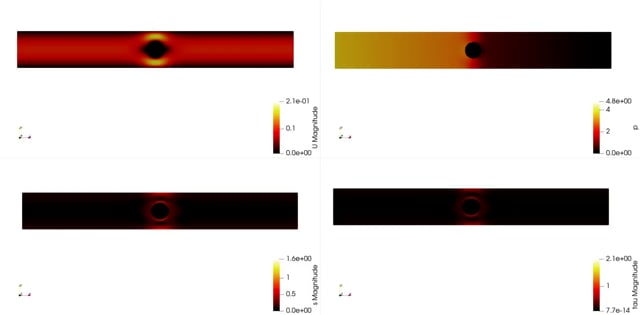
The accompanying video illustrates the resulting flow evolution, including changes in velocity and stress distributions around the growing cylinder.
This investigation highlights numerical techniques relevant to computational fluid dynamics (CFD), moving-boundary problems, and complex fluid simulations.
2. Physical Configuration and Flow Evolution
A. Initial Poiseuille Flow
The starting point of the simulation is a pressure-driven channel flow, commonly referred to as Poiseuille flow.
This classical configuration provides a useful reference for studying how an evolving obstacle affects fluid motion.
Before the obstacle modifies the flow, the channel geometry and imposed conditions determine the initial velocity distribution.
The subsequent evolution depends on the changes introduced by the cylindrical boundary.
B. Appearance of a Cylindrical Obstacle
In the numerical experiment, a cylindrical obstacle is introduced into the fluid domain.
Its appearance changes the geometry available to the flowing material.
The fluid must adjust to the presence of the solid boundary, producing a transient redistribution of velocity and pressure.
This configuration is particularly useful for investigating the response of a numerical solver to changing geometric constraints.
C. Progressive Increase in Cylinder Diameter
The distinguishing feature of this simulation is the gradual increase in the cylinder diameter over time.
As the obstacle grows, the available flow passage becomes more restricted.
This geometric evolution modifies the local fluid motion and may create stronger velocity gradients around the obstacle.
The resulting response depends on the prescribed growth rate, flow conditions, boundary constraints, and material properties.
The growing-cylinder configuration therefore provides a useful numerical test for analyzing fluid motion around evolving solid boundaries.
3. Level Set Method for Evolving Geometries
A. Understanding the Level Set Method
The Level Set method is a numerical technique used to represent and track evolving interfaces and boundaries.
Instead of describing a moving boundary exclusively through explicit mesh connectivity, the method represents its position using a scalar function defined over the computational domain.
The boundary is typically associated with a selected level of this function.
By updating the scalar field, the computational model can represent changes in the position or shape of an obstacle.
This approach is relevant to simulations involving moving interfaces, evolving geometries, and complex boundary motion.
B. Representing Cylinder Growth
In the present study, the evolving cylindrical geometry is represented using the Level Set approach.
As the cylinder diameter increases, the boundary representation is updated to reflect the changing obstacle size.
The numerical formulation must also account for the influence of this changing boundary on the surrounding fluid.
This makes it possible to investigate the interaction between evolving geometry and fluid motion.
C. Simulation Without Remeshing
A particularly important characteristic of the numerical experiment is that the cylinder growth is represented without remeshing the computational domain.
Traditional body-fitted methods may require mesh deformation or regeneration when solid boundaries move.
In the approach demonstrated here, the evolving geometry is represented through the Level Set description while the computational mesh remains unchanged.
Avoiding repeated remeshing can simplify certain aspects of the numerical workflow.
However, accurate simulation still requires suitable treatment of the moving solid boundary, sufficient spatial resolution, and consistent numerical discretization.
The absence of remeshing does not automatically guarantee accuracy or conservation.
D. Advantages for Computational Research
Level Set representations provide a flexible framework for studying geometric evolution.
Potential advantages include:
- Implicit representation of moving boundaries.
- Ability to describe evolving obstacle shapes.
- Reduced dependence on repeated mesh reconstruction.
- Convenient visualization of geometric changes.
- Potential extension to more complex interface-tracking problems.
The actual numerical performance depends on the underlying fluid solver and its treatment of the represented boundaries.
4. Velocity, Pressure, and Stress Evolution
A. Dynamic Velocity Field
The numerical simulation illustrates how the velocity field changes as the cylinder grows within the channel.
As the available passage becomes more restricted, the fluid motion adjusts to the evolving geometry.
The video highlights regions of increased flow velocity around the obstacle.
The magnitude and distribution of these changes depend on the prescribed flow and boundary conditions.
Visualizing the evolving velocity field provides valuable information about the transient response of the fluid.
B. Pressure Redistribution
The changing cylindrical geometry also modifies the pressure field.
Pressure redistribution occurs as the fluid adapts to the changing obstruction.
Numerical pressure analysis can provide information about the mechanical conditions associated with the evolving flow.
Important quantities include local pressure gradients, upstream and downstream pressure variations, and their evolution over time.
Quantitative conclusions require examination of the computed pressure field and appropriate numerical verification.
C. Mechanical Stress Development
The original simulation demonstrates an increase in mechanical stresses around the growing cylinder.
This behavior is associated with changes in fluid deformation and local velocity gradients.
For viscoelastic materials, the stress response may additionally depend on the deformation history and relaxation characteristics of the fluid.
Analyzing the stress field is therefore important for understanding the interaction between geometric evolution and complex material behavior.
The precise interpretation of the stresses depends on the constitutive model used in the simulation.
D. Time-Dependent Flow Structures
The appearance and growth of the obstacle create a transient fluid mechanics problem.
The flow evolves as the geometric configuration changes from one time step to the next.
Potential quantities of interest include:
- Evolution of the velocity distribution.
- Changes in pressure gradients.
- Development of localized stress concentrations.
- Flow acceleration near the obstacle.
- Possible changes in recirculation regions.
- Sensitivity to the prescribed cylinder growth rate.
These quantities provide a basis for studying the dynamic response of the fluid to an evolving boundary.
5. Numerical Challenges and Solver Convergence
A. Moving-Boundary Representation
Accurately representing a moving or growing obstacle requires consistency between the geometric description and the fluid equations.
The computational method must account for the updated boundary while solving the governing equations of fluid motion.
Any inconsistency may introduce artificial numerical effects or reduce accuracy near the obstacle surface.
B. Resolution of Localized Gradients
As the cylinder grows, the fluid domain available around it becomes more constrained.
Strong velocity and stress gradients may develop in the remaining flow passages.
The fixed computational mesh must provide adequate resolution for these evolving structures.
Although remeshing is avoided, spatial convergence remains an important consideration.
C. Convergence at Each Time Step
One of the main advantages emphasized in this project is the ability to focus on numerical convergence without introducing repeated mesh reconstruction.
For a transient simulation, the numerical solution must evolve consistently from one time step to the next.
The convergence assessment depends on the solver formulation and may involve nonlinear iteration residuals, conservation checks, and monitoring of relevant physical quantities.
Reliable convergence analysis is important for distinguishing genuine physical evolution from numerical artifacts.
D. Numerical Verification
Important numerical assessment criteria include:
- Temporal convergence: Evaluating the influence of time-step size.
- Spatial convergence: Assessing the adequacy of mesh resolution.
- Geometric accuracy: Checking the represented cylinder position and diameter.
- Boundary consistency: Evaluating how the evolving solid boundary is imposed.
- Mass conservation: Monitoring consistency of the fluid solution.
- Stress resolution: Examining mechanical gradients close to the obstacle.
- Solver stability: Monitoring convergence throughout the transient simulation.
These procedures are essential for evaluating the reliability of moving-boundary numerical methods.
6. Scientific and Industrial Applications
Numerical techniques developed for evolving boundaries have potential applications across several areas of computational science and engineering.
A. Fluid-Structure Interaction Research
Moving-boundary simulations are relevant to fluid-structure interaction problems.
When boundary motion is prescribed, the numerical model provides information about the fluid response to the evolving geometry.
Extending the formulation to fully coupled fluid-structure interaction requires additional equations describing the mechanical response of the solid.
B. Flow Around Moving Obstacles
Many engineering configurations involve fluid motion around components whose positions or shapes change with time.
Level Set and related interface methods provide useful tools for investigating such problems.
C. Industrial Flow Control
Geometric restrictions and evolving boundaries can influence fluid transport in industrial systems.
Numerical models may support research into valves, adjustable flow passages, and other configurations involving changing flow domains.
D. Complex Fluid Mechanics
For viscoelastic and non-Newtonian materials, evolving geometry can introduce additional complexities associated with nonlinear stresses and material memory.
Moving-boundary CFD frameworks can provide a foundation for investigating these phenomena.
E. Scientific Software Development
The ability to represent changing solid boundaries without repeated remeshing is an important capability in scientific computing.
Such developments are relevant to numerical algorithm design, computational geometry, CFD solver integration, and transient simulation methods.
They also provide useful benchmark configurations for evaluating solver accuracy, stability, and convergence.
7. Conclusion and Research Perspectives
The dynamic evolution of Poiseuille flow around a cylinder provides an instructive benchmark for studying fluid motion in the presence of an evolving solid boundary.
In this numerical experiment, the cylinder is introduced into the flow and its diameter progressively increases over time.
The Level Set method provides the geometric representation needed to follow this evolution without reconstructing the computational mesh at every time step.
The simulation illustrates the resulting changes in velocity and mechanical stress around the obstacle.
This approach highlights the importance of combining geometric representation, fluid mechanics, and numerical convergence analysis in transient CFD simulations.
Further investigations may include variations in cylinder growth rate, flow conditions, constitutive behavior, and spatial resolution.
TCHIKOU-R CONSULTING applies expertise in computational fluid dynamics, numerical methods, nonlinear material modeling, and scientific software development to investigate challenging engineering problems.
Discover more computational research, numerical simulations, and fluid mechanics projects in our Research & Projects collection.
