

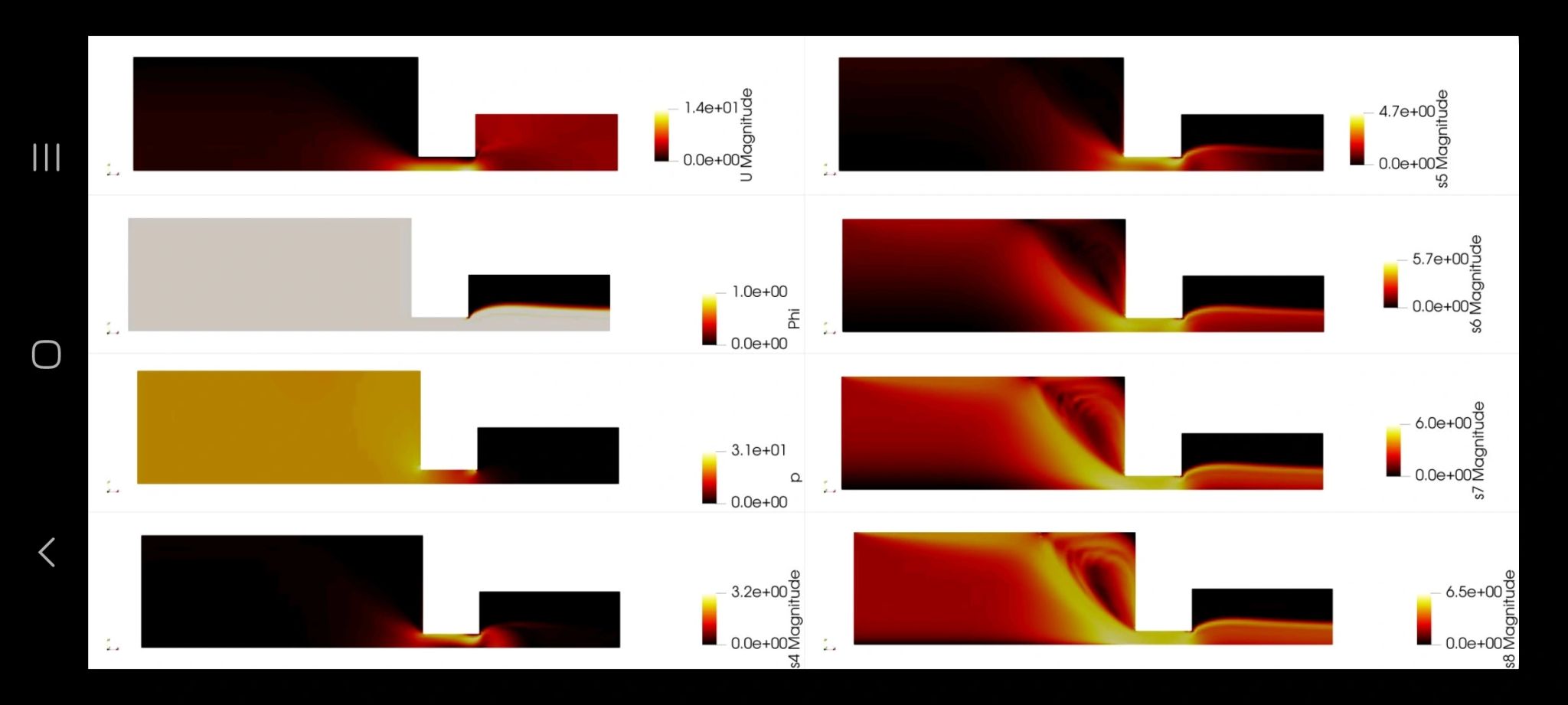
1. Introduction to the Eight-Mode EPTT Model
The eight-mode EPTT model provides an advanced constitutive framework for investigating nonlinear viscoelastic fluid behavior in complex flow geometries.
Understanding the response of polymeric materials during contraction and extrusion is a major challenge in computational fluid dynamics (CFD) and computational rheology.
Unlike Newtonian fluids, viscoelastic materials exhibit both viscous dissipation and elastic energy storage. Their mechanical response depends on deformation history, relaxation times, and nonlinear stress evolution.
This numerical project investigates two important phenomena:
- Contraction flow: The acceleration and deformation of a viscoelastic fluid through a narrowing channel.
- Extrudate swell: The expansion of the material after leaving a confined extrusion die.
The computational study uses an eight-mode Phan-Thien–Tanner constitutive representation to investigate the influence of multiple relaxation mechanisms on the flow.
These coupled phenomena represent challenging numerical problems involving nonlinear material behavior, strong stress gradients, and evolving free surfaces.
The project demonstrates the importance of combining advanced constitutive modeling, numerical fluid mechanics, and scientific computing to investigate complex polymeric flows.
2. Multi-Mode Exponential PTT Constitutive Modeling
A. The Phan-Thien–Tanner Constitutive Framework
The Phan-Thien–Tanner (PTT) model is a widely studied constitutive framework for representing the nonlinear rheological behavior of polymeric fluids.
The exponential PTT formulation, commonly referred to as EPTT, introduces an exponential constitutive function associated with the polymeric stress response.
Depending on the constitutive parameters, the formulation can describe important rheological phenomena, including:
- Shear-dependent viscosity and shear-thinning behavior.
- Normal stress differences.
- Nonlinear extensional response.
- Elastic energy storage and relaxation.
- Time-dependent stress evolution.
These characteristics are relevant to polymer melts and solutions subjected to complex deformation histories.
B. Why Use Eight Relaxation Modes?
Real polymeric materials may exhibit multiple relaxation mechanisms associated with their molecular structure and relaxation spectrum.
A single-mode constitutive model represents the material using one characteristic relaxation process.
A multi-mode formulation extends this representation by combining several constitutive contributions.
In the present numerical framework, eight viscoelastic relaxation modes contribute to the total polymeric stress response.
Each mode is associated with its own relaxation characteristics and constitutive parameters.
This representation enables the investigation of how different relaxation times influence stress development, flow behavior, and elastic recovery.
The predictive accuracy of a multi-mode model depends on suitable parameter calibration and numerical validation rather than the number of modes alone.
C. Nonlinear Constitutive Coupling
Numerical implementation of an eight-mode EPTT model requires solving the fluid conservation equations together with multiple nonlinear constitutive equations.
The contribution of each relaxation mode must be evaluated consistently with the evolving velocity and deformation fields.
The exponential constitutive nonlinearity can increase the difficulty of obtaining stable numerical solutions under strong deformation conditions.
Robust discretization and nonlinear solver strategies are therefore essential components of the computational framework.
3. Contraction Flow and Stress Development
A. Flow Through a Geometric Contraction
A contraction flow occurs when a fluid passes from a wider region into a narrower channel.
For an incompressible flow with a maintained volumetric flow rate, the reduction in cross-sectional area produces an increase in average velocity.
The geometric transition generates changes in the local deformation rates and modifies the distribution of mechanical stresses.
For viscoelastic fluids, the resulting behavior depends on the interaction between viscosity, material elasticity, relaxation times, and flow geometry.
B. Elastic Stress Concentrations
As the fluid approaches the contraction, strong shear and extensional deformation may develop near the geometric transition.
These deformation mechanisms can generate elevated polymeric stresses.
For multi-mode viscoelastic models, each relaxation mode contributes differently to the stress response.
The resulting stress distribution provides information about the influence of the material relaxation spectrum on the flow.
Accurate representation of these localized stresses is one of the principal numerical challenges of contraction-flow simulations.
C. Pressure and Velocity Evolution
The contraction geometry also modifies the pressure and velocity fields.
Important numerical quantities include:
- Velocity field: Characterizing flow acceleration and redistribution.
- Pressure drop: Evaluating pressure variations across the contraction.
- Shear stresses: Describing local deformation near channel walls.
- Normal stresses: Investigating elastic effects associated with deformation.
- Recirculation regions: Identifying upstream vortex structures where present.
These quantities provide a basis for interpreting viscoelastic behavior and assessing the performance of the numerical solver.
4. Extrudate Swell and Elastic Recovery
A. Understanding Extrudate Swell
Extrudate swell, also called die swell, is a characteristic phenomenon observed when certain viscoelastic materials exit an extrusion die.
After leaving the confined geometry, the fluid may expand beyond the dimensions of the die opening.
This behavior is associated with the relaxation of elastic stresses accumulated during the confined flow.
The resulting deformation depends on the material properties, flow conditions, geometry, and free-surface behavior.
B. Role of the Relaxation Spectrum
The eight-mode EPTT formulation provides a framework for investigating the contribution of different relaxation mechanisms to the recovery process.
Modes with different characteristic relaxation times may influence how polymeric stresses evolve as the material exits the die.
The combined stress response affects the subsequent material deformation.
Investigating these contributions can help explain the relationship between upstream deformation history and downstream swelling.
The relative influence of each mode must be determined from the selected constitutive parameters and computed solution.
C. Free-Surface Evolution
Numerical simulation of extrudate swell requires an appropriate representation of the moving boundary between the extruded material and the surrounding environment.
This introduces additional numerical challenges because the interface position evolves with the fluid motion.
Depending on the chosen formulation, free-surface calculations may involve interface tracking, interface capturing, or adaptive computational meshes.
Accurate representation of the interface is essential when evaluating the predicted extrudate geometry.
D. Swelling Ratio
The swelling ratio is commonly defined as the ratio between a characteristic dimension of the extrudate and the corresponding die dimension.
For a circular die, a diameter-based swelling ratio can be expressed as:
B = D_extrudate / D_die
This quantity provides a practical indicator of the dimensional expansion occurring after extrusion.
Predicting the swelling ratio is important for understanding the relationship between viscoelastic material properties and final product dimensions.
Quantitative predictions require suitable constitutive calibration, numerical convergence studies, and comparison with reference data.
5. Main Computational Challenges
A. High Weissenberg Number Problem
One of the major numerical difficulties in viscoelastic CFD is the High Weissenberg Number Problem (HWNP).
Strong elastic stresses and nonlinear constitutive coupling can produce convergence difficulties as elasticity becomes significant.
With eight relaxation modes, the numerical solver must resolve several constitutive contributions while maintaining a consistent fluid solution.
Numerical stability depends on the rheological parameters, spatial discretization, time integration, and nonlinear solution strategy.
B. Sharp Geometric Transitions
Contraction geometries may contain sharp corners where strong velocity and stress gradients develop.
These localized features can be difficult to resolve with insufficient computational resolution.
Appropriate mesh refinement and numerical discretization are important for reducing numerical errors.
Special attention must be given to the interpretation of stress concentrations near idealized sharp corners.
C. Coupled Contraction and Free-Surface Dynamics
The simultaneous representation of contraction flow and extrudate swell introduces additional computational complexity.
The upstream flow determines the deformation history entering the die, while downstream free-surface evolution depends on the resulting fluid stresses and boundary conditions.
A reliable numerical framework must represent these interconnected physical mechanisms consistently.
D. Eight-Mode Constitutive Calculations
Each viscoelastic relaxation mode introduces additional constitutive variables and numerical calculations.
The computational cost generally increases with the number of modes, although the actual impact depends on solver architecture and implementation.
Efficient algorithms are therefore important for managing memory requirements and computational time.
These considerations are particularly relevant to high-resolution and transient CFD simulations.
6. Numerical Verification and Industrial Applications
A. Numerical Verification
Reliable numerical predictions require systematic verification of the computational solution.
Important evaluation criteria include:
- Mesh convergence: Assessing sensitivity to spatial resolution.
- Temporal accuracy: Evaluating time-step dependence in transient calculations.
- Constitutive convergence: Monitoring nonlinear stress calculations across all eight modes.
- Mass conservation: Checking numerical consistency of the flow solution.
- Free-surface accuracy: Assessing the representation of the evolving extrudate boundary.
- Swelling ratio: Comparing quantitative predictions with suitable reference or experimental data.
These procedures help establish confidence in the numerical framework and identify its limitations.
B. Polymer Extrusion
Understanding contraction flow and die swell is important in polymer extrusion processes.
Numerical simulations can contribute to the investigation of processing conditions, material rheology, and dimensional changes in extruded products.
C. Die Design and Process Development
Complex constitutive models can support research into the influence of die geometry and operating conditions on polymer deformation.
Such investigations may help engineers evaluate design alternatives and identify parameters influencing the extrusion process.
D. Coating and Advanced Manufacturing
Selected coating and polymer manufacturing processes involve viscoelastic materials subjected to strong deformation and free-surface motion.
Multi-mode rheological models can provide a framework for investigating complex flow behavior in these applications.
E. Scientific Software Development
The integration of eight constitutive relaxation modes, nonlinear stress calculations, and free-surface modeling represents a demanding scientific computing problem.
These developments are relevant to advanced CFD solver design, numerical rheology, and computational methods for nonlinear materials.
7. Conclusion and Research Perspectives
The eight-mode EPTT model provides a sophisticated computational framework for investigating nonlinear viscoelastic contraction flow and extrudate swelling.
By combining multiple relaxation mechanisms with complex flow geometry, this approach supports the analysis of polymeric stress development, deformation history, and elastic recovery.
The coupling between upstream contraction and downstream free-surface evolution introduces significant numerical challenges involving strong stress gradients, constitutive nonlinearity, and interface tracking.
Understanding these phenomena is relevant to computational rheology, polymer extrusion, advanced materials research, and industrial fluid dynamics.
Further investigations may focus on relaxation-spectrum sensitivity, mesh convergence, constitutive parameter calibration, and comparison with suitable experimental swelling measurements.
TCHIKOU-R CONSULTING applies expertise in computational fluid dynamics, viscoelastic constitutive modeling, numerical methods, and scientific software development to investigate complex material behavior and engineering challenges.
Discover additional scientific simulations, computational research, and engineering applications in our Research & Projects collection.
Scientific References
Phan-Thien, N. and Tanner, R. I. (1977). A new constitutive equation derived from network theory. Journal of Non-Newtonian Fluid Mechanics, 2(4), 353-365.
Dhadwal, R., Banik, S., Doshi, P. and Pol, H. (2017). Effect of viscoelastic relaxation modes on stability of extrusion film casting process modeled using multi-mode Phan-Thien-Tanner constitutive equation. Applied Mathematical Modelling, 47, 487-500.
