

1. Introduction to Multiphase Bearing Lubrication
Multiphase bearing lubrication represents a challenging application of computational fluid dynamics (CFD), combining rotating mechanical components, narrow lubricant films, strong velocity gradients, and potentially complex fluid interfaces.
Hydrodynamic bearings are widely used in mechanical engineering to support rotating shafts and reduce direct contact between moving surfaces.
Their operation depends on the development of a lubricating film capable of transmitting hydrodynamic forces under appropriate operating conditions.
When lubricant behavior involves multiple fluid phases or nonlinear rheological properties, the numerical problem becomes more complex.
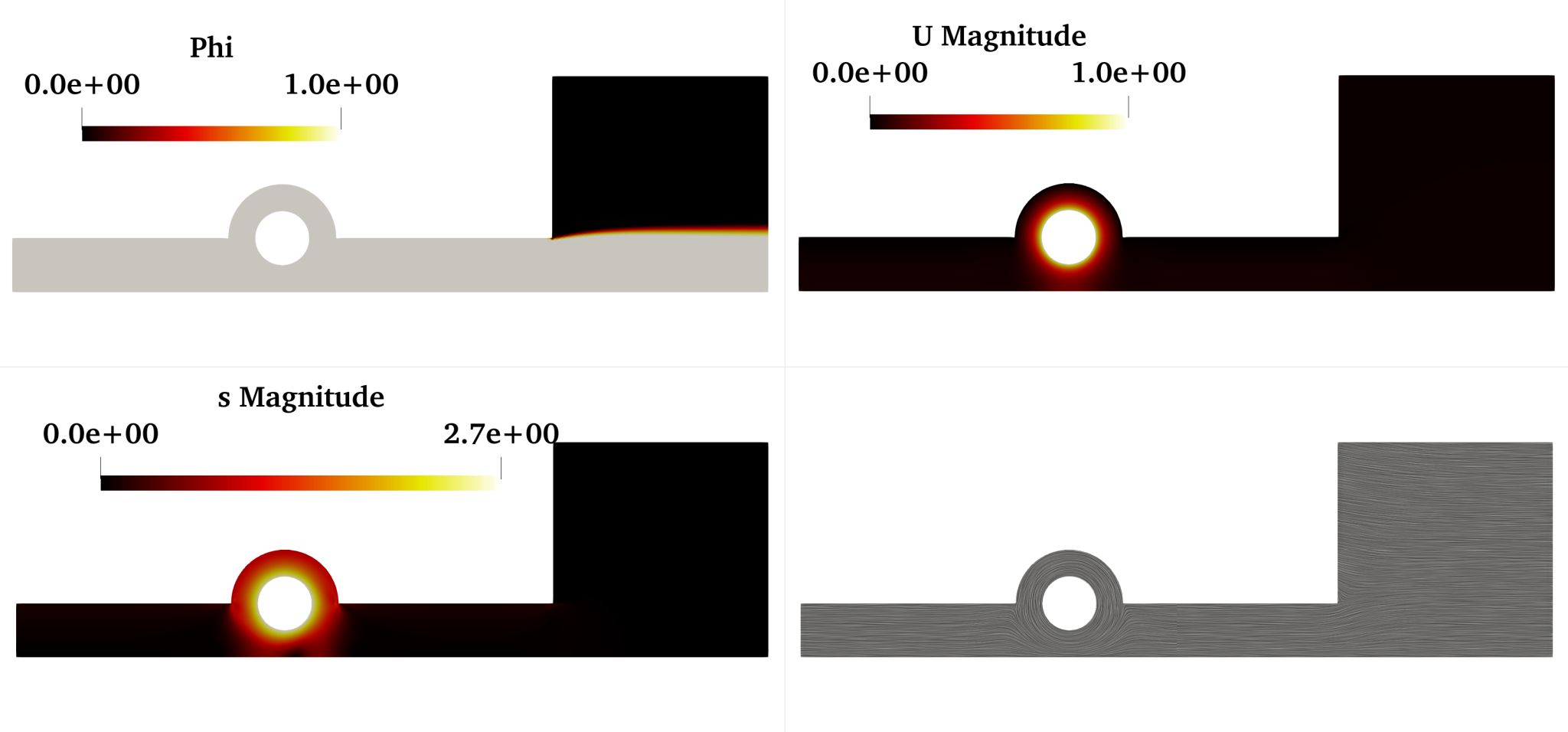
This computational benchmark investigates the numerical representation of a rotating cylindrical geometry under narrow-clearance and high-shear conditions.
The study focuses on three major challenges:
- Accurate representation of velocity and pressure fields around a rotating cylinder.
- Tracking fluid interfaces and localized stress gradients.
- Maintaining numerical stability and physical consistency during computational field transfer.
These challenges are relevant to computational fluid dynamics, numerical lubrication, tribology, and advanced scientific software development.
2. Physical Configuration of the Bearing Benchmark
A. Rotating Cylinder and Lubricant Film
The benchmark considers a cylindrical component rotating within a confined fluid domain.
The imposed rotation generates relative motion between the cylindrical surface and the surrounding fluid boundaries.
Under narrow-clearance conditions, substantial velocity gradients may develop across the lubricant film.
The resulting flow depends on the rotational velocity, domain geometry, fluid properties, and selected boundary conditions.
Accurate numerical representation of these effects is essential for studying hydrodynamic lubrication behavior.
B. High-Shear Flow Conditions
The narrow gap between moving and stationary boundaries generates high local shear rates.
These conditions can create strong spatial variations in velocity and mechanical stresses.
For non-Newtonian lubricants, the flow response may also depend on shear-dependent viscosity, elastic effects, or other rheological characteristics.
The specific response must be determined using a constitutive model appropriate to the material being investigated.
Important physical quantities include:
- Velocity field (U): Describing lubricant motion.
- Pressure field (p): Representing hydrodynamic pressure variations.
- Stress tensor: Characterizing internal mechanical stresses.
- Lubricant film thickness: Describing geometric clearance.
- Fluid interface position: Identifying phase boundaries where applicable.
C. Geometric Restrictions and Sharp Corners
The original benchmark also considers a geometry containing a step-down region or abrupt change in clearance.
Such geometric transitions can produce localized variations in flow velocity, pressure, and stress.
Sharp corners may introduce steep numerical gradients that require careful spatial discretization.
The resulting behavior depends on the detailed geometry, operating conditions, and physical model.
3. Multiphase CFD Modeling and Interface Tracking
A. Representation of Multiple Fluid Phases
In multiphase bearing lubrication, the computational model may need to distinguish between different fluid regions.
For example, numerical representations may consider a lubricant phase interacting with another fluid phase, depending on the physical configuration.
A phase-indicator function, commonly represented by phi, can be used to distinguish different regions of the computational domain.
The exact definition of this function depends on the numerical method employed.
Accurate tracking of fluid interfaces is important when the relative position of different phases influences the flow solution.
B. Velocity and Pressure Coupling
The velocity and pressure fields are fundamental quantities in computational lubrication analysis.
In incompressible formulations, the velocity field must satisfy the appropriate mass-conservation constraint.
For a constant-density incompressible phase, this is commonly expressed as:
div(U) = 0
In multiphase configurations, additional care may be required to ensure consistent treatment of density variations, phase transport, and interface behavior.
Numerical methods must maintain appropriate coupling between pressure, velocity, and the governing conservation equations.
C. Interface Transport and Numerical Accuracy
Transporting a phase indicator through a computational domain presents several numerical challenges.
Inadequate discretization may lead to artificial interface diffusion, loss of sharpness, or unphysical oscillations.
The choice of transport method, spatial resolution, and time-integration strategy influences the quality of the numerical solution.
Suitable numerical verification is therefore necessary to evaluate the accuracy of interface tracking.
4. Main Computational Challenges
A. Dynamic Grid Mapping
Representing rotating geometries can require numerical methods capable of handling moving boundaries.
Depending on the computational approach, this may involve grid mapping, mesh motion, or dynamic remeshing.
When successive computational meshes are used, the existing numerical solution must be transferred from one discretization to another.
Important transferred quantities may include:
- Fluid velocity components.
- Hydrodynamic pressure.
- Material stress components.
- Phase-indicator fields.
- Additional constitutive variables, when applicable.
Accurate field transfer is essential for limiting numerical errors and maintaining consistency during transient simulations.
B. Localized Pressure and Stress Gradients
High-shear lubrication configurations can generate strong gradients near moving boundaries and geometric restrictions.
Resolving these localized fields requires adequate spatial resolution and suitable numerical discretization.
Insufficient mesh resolution can affect pressure predictions, stress distributions, and solver convergence.
Local mesh refinement may therefore be useful in narrow gaps and regions containing steep gradients.
C. Multiphase Numerical Stability
Multiphase simulations introduce additional coupling between the fluid equations and the transport of material interfaces.
The numerical solver must represent the motion of the different phases while satisfying the relevant conservation equations.
Important challenges include:
- Preservation of mass balance.
- Stable pressure-velocity coupling.
- Consistent interface transport.
- Control of numerical diffusion.
- Appropriate time-step selection.
- Convergence of the coupled numerical solution.
The satisfaction of these requirements must be demonstrated through numerical verification rather than assumed from the formulation alone.
D. Computational Efficiency
High-resolution lubrication simulations may require substantial computational resources.
Narrow clearance regions and complex flow structures often demand refined computational grids.
Efficient numerical methods seek to balance solution accuracy, solver convergence, memory requirements, and calculation time.
Comparative benchmarks can help identify computational strategies suitable for more complex industrial configurations.
5. Benchmark Evaluation and Numerical Validation
The reliability of a multiphase bearing lubrication model should be assessed using appropriate numerical verification procedures.
A. Velocity Field Analysis
The computed velocity field provides information about the motion of the lubricant around the rotating cylinder.
Velocity profiles can be examined across narrow clearance regions to characterize local shear conditions and flow redistribution.
B. Pressure Distribution
The hydrodynamic pressure field is an important indicator of lubrication behavior.
Pressure variations can be studied near the rotating surface, within narrow gaps, and around geometric transitions.
When the physical configuration permits, integrated pressure and stress fields can contribute to the evaluation of hydrodynamic forces.
C. Stress Field Analysis
The computed stress distribution provides insight into the mechanical response of the lubricant.
For non-Newtonian or viscoelastic formulations, additional constitutive stresses may influence the local flow response.
Analyzing stress gradients near the rotating cylinder and geometric restrictions can help identify regions requiring additional computational resolution.
D. Numerical Verification
Important benchmark evaluation criteria include:
- Mesh convergence: Evaluating sensitivity to spatial resolution.
- Temporal convergence: Assessing time-step dependence.
- Mass conservation: Monitoring consistency of the fluid balance.
- Interface accuracy: Measuring the quality of phase transport.
- Field projection accuracy: Assessing transfer errors during grid updates.
- Solver convergence: Monitoring numerical residuals and physical quantities.
These procedures help establish confidence in the simulation and identify potential limitations of the computational method.
6. Industrial Engineering Applications
Numerical methods developed for complex bearing lubrication problems have potential applications in several industrial sectors.
A. Industrial Turbines
Hydrodynamic bearings are important components in many rotating energy systems.
Numerical lubrication studies can support investigations of lubricant-film behavior, pressure distributions, and mechanical operating conditions.
B. Pumps and Compressors
Pumps and compressors frequently rely on rotating shafts supported by bearing systems.
Computational analysis can contribute to understanding the influence of rotational speed, bearing clearance, and lubricant properties.
C. Automotive Journal Bearings
Automotive mechanical systems incorporate bearings operating under varying loads and rotational conditions.
Numerical models can support research into film thickness, pressure generation, and lubricant behavior.
D. Complex Lubricants and Multiphase Systems
Advanced CFD techniques are relevant to lubrication problems involving non-Newtonian materials or multiple fluid phases.
These numerical approaches may help investigate complex fluid transport, localized stresses, and interface behavior in selected engineering configurations.
E. Scientific Software Development
The benchmark provides a challenging computational test case involving moving boundaries, sharp gradients, multiphase transport, and numerical conservation.
Such problems support the development and evaluation of robust CFD solvers and numerical algorithms for engineering applications.
Potential improvements in lubrication performance, energy efficiency, and component reliability require additional quantitative analysis and appropriate experimental validation.
7. Conclusion and Research Perspectives
The multiphase bearing lubrication benchmark provides a valuable framework for investigating complex hydrodynamic flows involving rotating components, narrow clearances, and potentially moving fluid interfaces.
The numerical challenges include dynamic grid representation, accurate field transfer, localized pressure and stress gradients, and conservation properties in multiphase simulations.
Addressing these issues requires appropriate spatial and temporal discretization, robust computational algorithms, and systematic numerical verification.
The benchmark also illustrates the importance of combining fluid mechanics, numerical analysis, and scientific software development when investigating complex mechanical systems.
Further research may focus on alternative mesh strategies, improved interface transport, rheological model sensitivity, and quantitative comparison with suitable reference solutions.
TCHIKOU-R CONSULTING applies expertise in computational fluid dynamics, computational mechanics, numerical methods, and advanced scientific simulation to investigate complex engineering problems.
Discover more numerical simulations, scientific investigations, and computational engineering applications in our Research & Projects collection.
