

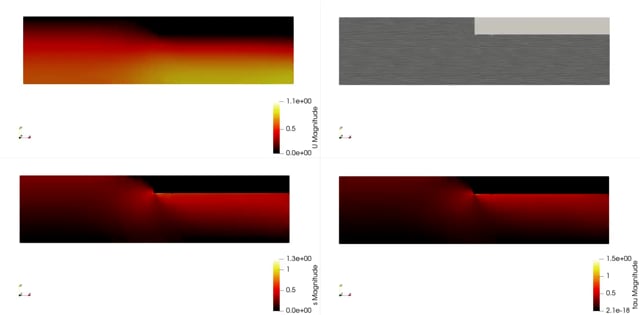
1. Introduction to Viscoelastic Contraction Flow
Viscoelastic contraction flow represents an important benchmark in computational fluid dynamics (CFD) and nonlinear rheology, particularly for understanding the behavior of polymeric materials passing through sudden geometric restrictions.
Unlike Newtonian fluids, viscoelastic materials exhibit both viscous dissipation and elastic energy storage. Their mechanical response depends on the history of deformation and the evolution of internal stresses.
When a viscoelastic fluid flows through a contraction, the reduction in cross-sectional area generates strong variations in velocity, deformation rates, and polymeric stresses.
These effects can produce complex flow structures, including localized stress concentrations, recirculation regions, and elasticity-driven instabilities under suitable operating conditions.
This numerical project investigates the transient response of a viscoelastic fluid passing through a contraction channel, with particular attention to the evolution of velocity fields, pressure gradients, and nonlinear material stresses.
The study contributes to research in computational rheology, viscoelastic CFD, numerical simulation, and polymer processing.
2. Physical Principles of Viscoelastic Contraction Flow
A. Flow Through a Geometric Contraction
A contraction flow occurs when a fluid moves from a wider region into a narrower channel.
For an incompressible fluid, the reduction in flow area is associated with an increase in average velocity when the volumetric flow rate is maintained.
The resulting acceleration generates significant changes in local deformation rates, particularly near the contraction entrance.
These changes become more complex when the fluid exhibits nonlinear viscoelastic behavior.
Important physical quantities include:
- Velocity field: Describing flow acceleration and redistribution.
- Pressure field: Characterizing pressure variations through the contraction.
- Shear stresses: Evaluating deformation near channel walls.
- Normal stresses: Investigating elastic contributions generated during flow.
- Relaxation time: Characterizing the time-dependent material response.
B. Elastic Memory and Stress Development
Viscoelastic fluids retain a memory of previous deformation through the evolution of internal stresses.
As the material approaches the contraction, polymeric structures undergo changes in orientation and deformation.
These changes can generate elevated normal and shear stresses, particularly where strong velocity gradients are present.
The resulting stress distribution depends on the constitutive model, relaxation parameters, geometry, and flow conditions.
Understanding this response is essential for accurately modeling nonlinear polymeric flows.
C. Shear-Thinning Behavior
Many polymer solutions and melts exhibit shear-thinning behavior, in which apparent viscosity decreases as the shear rate increases.
In contraction geometries, regions of elevated shear may therefore display rheological responses that differ significantly from those of Newtonian fluids.
However, the presence and intensity of shear-thinning depend on the material and the selected constitutive formulation.
Nonlinear viscoelastic models, including suitable Giesekus formulations, can be used to investigate these effects.
3. Elastic Instabilities and Vortex Dynamics
A. Formation of Recirculation Regions
Viscoelastic contraction flows may develop recirculation regions near geometric corners or upstream of the contraction entrance.
These regions arise from interactions between fluid inertia, viscosity, elastic stresses, and geometric confinement.
Their size and structure depend on the Reynolds number, fluid elasticity, contraction ratio, and material properties.
Computational simulations provide a framework for analyzing the evolution of these regions.
B. Elasticity-Driven Flow Instabilities
Under certain conditions, viscoelastic fluids can exhibit flow instabilities associated with the nonlinear evolution of elastic stresses.
These instabilities may occur even when inertial effects are relatively weak.
Depending on the operating conditions and constitutive behavior, potential phenomena include:
- Changes in upstream vortex size.
- Development of localized stress concentrations.
- Time-dependent flow asymmetry.
- Evolution of recirculation structures.
- Transitions between different flow states.
The presence of these phenomena must be established from the computed velocity, stress, and flow-structure fields.
C. Weissenberg Number and Elastic Effects
The Weissenberg number (Wi) is a dimensionless parameter commonly used to characterize the relative importance of viscoelastic relaxation and flow deformation timescales.
A representative definition is:
Wi = lambda * U / L
Where lambda is a characteristic relaxation time, U is a reference velocity, and L is a characteristic length scale.
As elastic effects become more significant, numerical simulations may require additional care to maintain stability and accurately resolve localized stresses.
The specific interpretation of Wi depends on the characteristic scales selected for the problem.
4. Main Computational Challenges
A. High Weissenberg Number Problem
One of the central challenges in viscoelastic contraction flow computation is the numerical difficulty associated with strong elastic effects.
This difficulty is commonly referred to as the High Weissenberg Number Problem (HWNP).
Elevated elastic stresses and nonlinear constitutive coupling can produce convergence difficulties, particularly near sharp geometric transitions.
Accurate numerical treatment requires suitable discretization methods, adequate spatial resolution, and robust solver strategies.
B. Capturing Localized Stress Gradients
Geometric contractions can generate steep variations in velocity and polymeric stress fields.
These gradients may be particularly pronounced near contraction corners and in regions of strong extensional deformation.
Insufficient spatial resolution can lead to inaccurate stress predictions or excessive numerical diffusion.
Local mesh refinement and appropriate numerical schemes can help improve the representation of these features.
C. Transient Stress Evolution
Transient simulation is important for examining how viscoelastic stresses develop and relax as the flow evolves.
The temporal response depends on the material relaxation times and imposed flow conditions.
Numerical calculations must resolve the relevant timescales without introducing excessive temporal errors.
Important considerations include time-step selection, nonlinear solver convergence, and the consistency of the evolving constitutive fields.
D. Numerical Stability and Conservation
Reliable CFD simulations require consistent treatment of the fluid conservation equations and constitutive relationships.
Important numerical considerations include:
- Mass conservation and momentum balance.
- Pressure-velocity coupling.
- Stability of constitutive stress calculations.
- Spatial resolution near contraction boundaries.
- Temporal discretization accuracy.
- Convergence monitoring and verification.
These considerations are essential for developing robust numerical methods for complex fluid flows.
5. CFD Visualization and Numerical Analysis
The accompanying video illustrates the dynamic contraction of a viscoelastic fluid and provides a visual perspective on the investigated flow configuration.
Computational visualization is particularly useful for interpreting nonlinear flow behavior and identifying regions that require further analysis.
A. Velocity Field Evolution
The velocity field describes how fluid motion changes as the material passes through the contraction.
Visualizing the flow can help identify acceleration regions, local velocity gradients, and potential recirculation structures.
B. Pressure Distribution
The pressure field provides information about the mechanical conditions required to drive fluid through the restricted geometry.
Pressure variations depend on the flow rate, contraction geometry, and rheological properties of the material.
Numerical analysis can help evaluate the relationship between pressure evolution and viscoelastic stress development.
C. Elastic Stress Concentrations
The extra-stress tensor describes important aspects of the internal mechanical response of a viscoelastic fluid.
Analyzing normal and shear stress components provides insight into the material’s deformation history and elastic response.
Localized stress concentrations may be associated with strong deformation regions and changes in the flow structure.
D. Flow Instability Assessment
The possible development of elastic instabilities can be investigated by examining transient velocity and stress fields.
Useful numerical indicators include:
- Evolution of recirculation-zone dimensions.
- Changes in flow symmetry.
- Temporal fluctuations of velocity and pressure.
- Development of localized stress maxima.
- Sensitivity to rheological and geometric parameters.
Quantitative conclusions require appropriate numerical convergence studies and comparison with suitable benchmark results.
6. Industrial Applications of Viscoelastic Contraction Flow
Understanding viscoelastic flow through restricted geometries is relevant to several industrial processing applications.
A. Polymer Extrusion
Polymer extrusion frequently involves complex fluids passing through channels, dies, and geometric transitions.
Numerical modeling helps investigate pressure requirements, stress evolution, and the influence of nonlinear material behavior.
Such studies can support research into extrusion conditions and die design.
B. Injection Molding
Injection molding involves the movement of polymeric materials through runners, gates, and mold cavities.
Viscoelastic modeling provides insight into the response of certain polymeric materials under complex deformation conditions.
The results can contribute to research on flow behavior and processing sensitivity.
C. Blow Molding and Polymer Processing
Viscoelastic constitutive models are also relevant to selected blow molding and polymer-processing applications.
Understanding material relaxation and nonlinear deformation is important when investigating the influence of processing conditions on material behavior.
D. Coating and Advanced Manufacturing
Complex fluids used in coating and other manufacturing operations may encounter geometric restrictions and significant deformation rates.
Numerical rheology can support investigations of stress development, flow uniformity, and material processing conditions.
E. Scientific Software Development
Contraction-flow benchmarks provide challenging validation cases for numerical solvers dealing with nonlinear constitutive equations.
These simulations are relevant to research into advanced CFD algorithms, computational rheology, and scientific software reliability.
7. Conclusion and Research Perspectives
The study of viscoelastic contraction flow provides valuable insight into the complex behavior of polymeric fluids subjected to sudden geometric restrictions.
The interaction between velocity gradients, elastic stresses, material relaxation, and flow geometry can produce challenging nonlinear phenomena.
Transient numerical simulations offer a framework for investigating these interactions and assessing the computational methods required to represent them accurately.
Particular attention must be given to solver stability, localized stress gradients, and the possible development of elasticity-driven flow instabilities.
Future investigations may include systematic variations of the contraction ratio, flow rate, relaxation time, and constitutive parameters, together with detailed mesh-convergence and validation studies.
TCHIKOU-R CONSULTING applies expertise in computational fluid dynamics, computational rheology, nonlinear constitutive modeling, and scientific software development to investigate complex scientific and industrial challenges.
Discover additional numerical simulations, polymer-flow studies, and advanced computational engineering applications in our Research & Projects collection.
