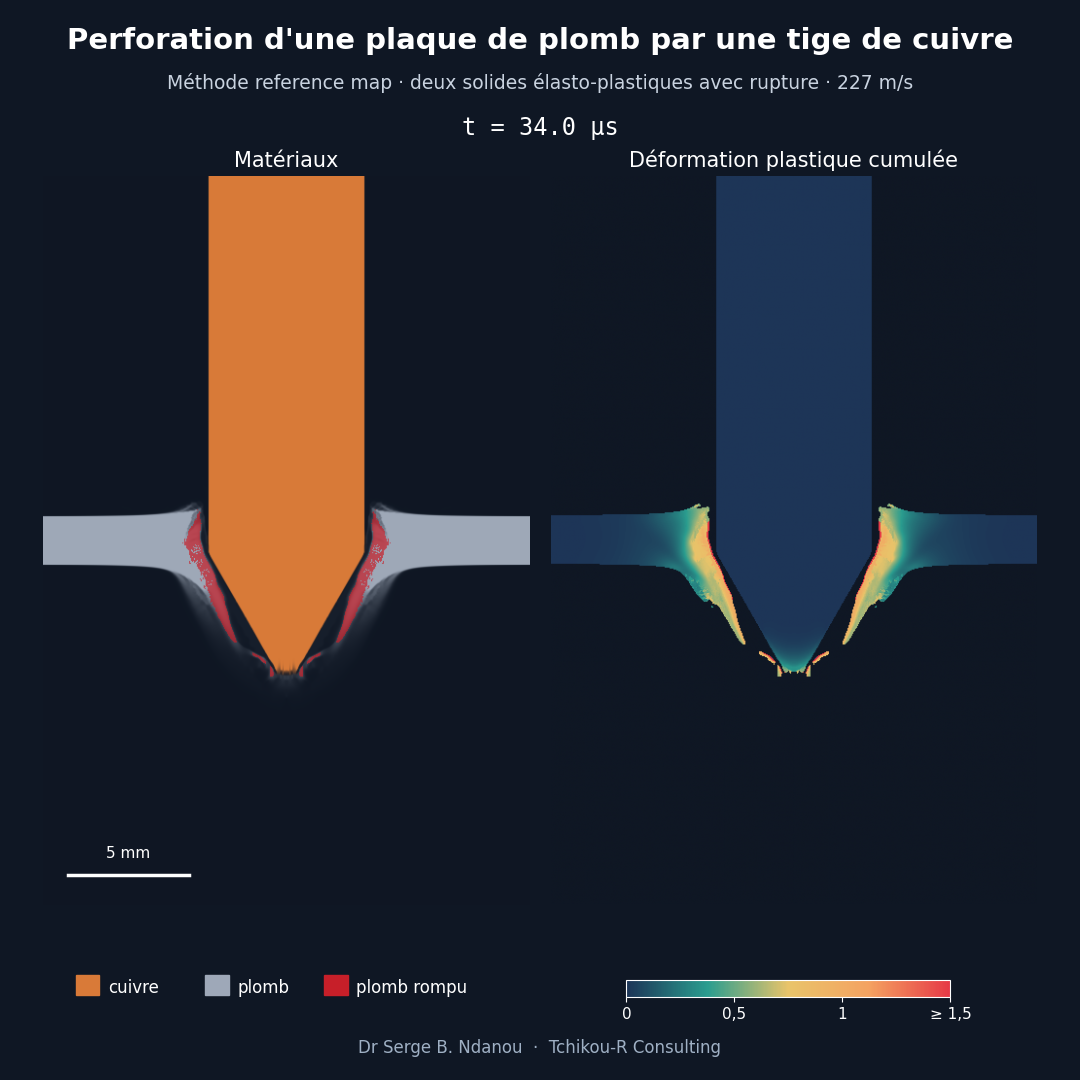
Copper rod (227 m/s) perforating a 2 mm lead plate, t = 34 µs. Left: materials, failed lead in red. Right: cumulative plastic strain.


Eulerian simulation with the reference map method: two elastoplastic solids (copper and lead) with plasticity and failure, each carried by its own adaptive reference grid. 0.04 mm mesh. Tchikou-R Consulting.
Copper rod (227 m/s) perforating a 2 mm lead plate, t = 34 µs. Left: materials, failed lead in red. Right: cumulative plastic strain.
Perforation tests are a classic of impact engineering and are usually run with explicit Lagrangian codes such as LS-DYNA. This study is a feasibility test of that kind, carried out with our own Eulerian code: a copper rod with a conical tip, launched at 227 m/s, perforates a 2 mm lead plate. Both metals are elastoplastic and both can fail.
The difficulty is well known. The tip pushes through the plate, the lead is sheared, torn and folded back into petals along the rod. With a mesh that follows the material, elements distort until they have to be deleted (erosion). Here the mesh stays fixed and the materials flow through it, so no element is ever deleted.
Density field during the perforation (axisymmetric half-section, rod axis horizontal).
The rod is the copper of our Taylor impact test: radius 3.2 mm, length 32.4 mm, conical tip 5.5 mm long (60° apex angle), velocity 227 m/s. The plate is lead, 2 mm thick, with an initial gap of 0.5 mm. The computation is axisymmetric, in a 16 mm × 50 mm domain with free outflow below the plate, over 60 microseconds.
Copper: stiffened-gas equation of state (γ = 4.96, p∞ = 27.95 GPa, ρ0 = 8930 kg/m³), hyperelastic shear response (μ = 44.7 GPa), perfectly plastic with Y = 314 MPa, Johnson-Cook ductile damage (OFHC constants) plus a spall criterion.
Lead: stiffened-gas equation of state (γ = 4.716, p∞ = 9.676 GPa, ρ0 = 11,340 kg/m³), hyperelastic shear response (μ = 8.6 GPa), Steinberg-Guinan hardening (Y0 = 11.5 MPa, increasing with plastic strain and pressure, decreasing with temperature), failure at a plastic strain of 1 plus a spall criterion.
Air: ideal gas.
The computation rests on the reference map method developed at Los Alamos (Ndanou, 2016).
The current grid is fixed in space. The materials flow through it, and the conservation laws (mass, momentum, energy) are solved there for copper, lead and air with a diffuse-interface multi-material model.
The reference map gives every point the coordinates it had at t = 0, transported with the flow. Its gradient gives the deformation of the material exactly, at any time, without transporting strain tensors that drift over thousands of time steps.
Two reference grids, one for the rod and one for the plate, are adaptive quadtrees laid out in the initial configuration of each solid, with a 20 % margin around it. They store the material memory: plastic deformation, hardening and damage. At every time step, the cells of pure solid send their state to them through a Delaunay triangulation. Each grid relaxes plasticity and checks failure with its own law, then sends the result back to the current grid. Refinement is unlimited: a leaf splits as soon as it receives two images, so each reference grid follows its material wherever it is stretched or torn.
The thin band visible along the rod is the lead-copper interface, where the two metals slide past each other and the lead tears. The diffuse-interface model tracks this zone with no contact algorithm.
0.04 mm mesh, 500,000 cells on the current grid, about 300,000 nodes on the reference grids at the start, 60 microseconds of physical time, run on a laptop.
Quantitative comparison with published perforation experiments, then application cases for launcher components, aerospace, rail and automotive structures.
For inquiries regarding perforation and impact simulations, reference map methods, or custom multiphysics solver development:
Dr Serge B. Ndanou, TCHIKOU-R CONSULTING – [email protected]
Explore additional simulations, scientific investigations, and computational engineering projects in our Portfolio.
