

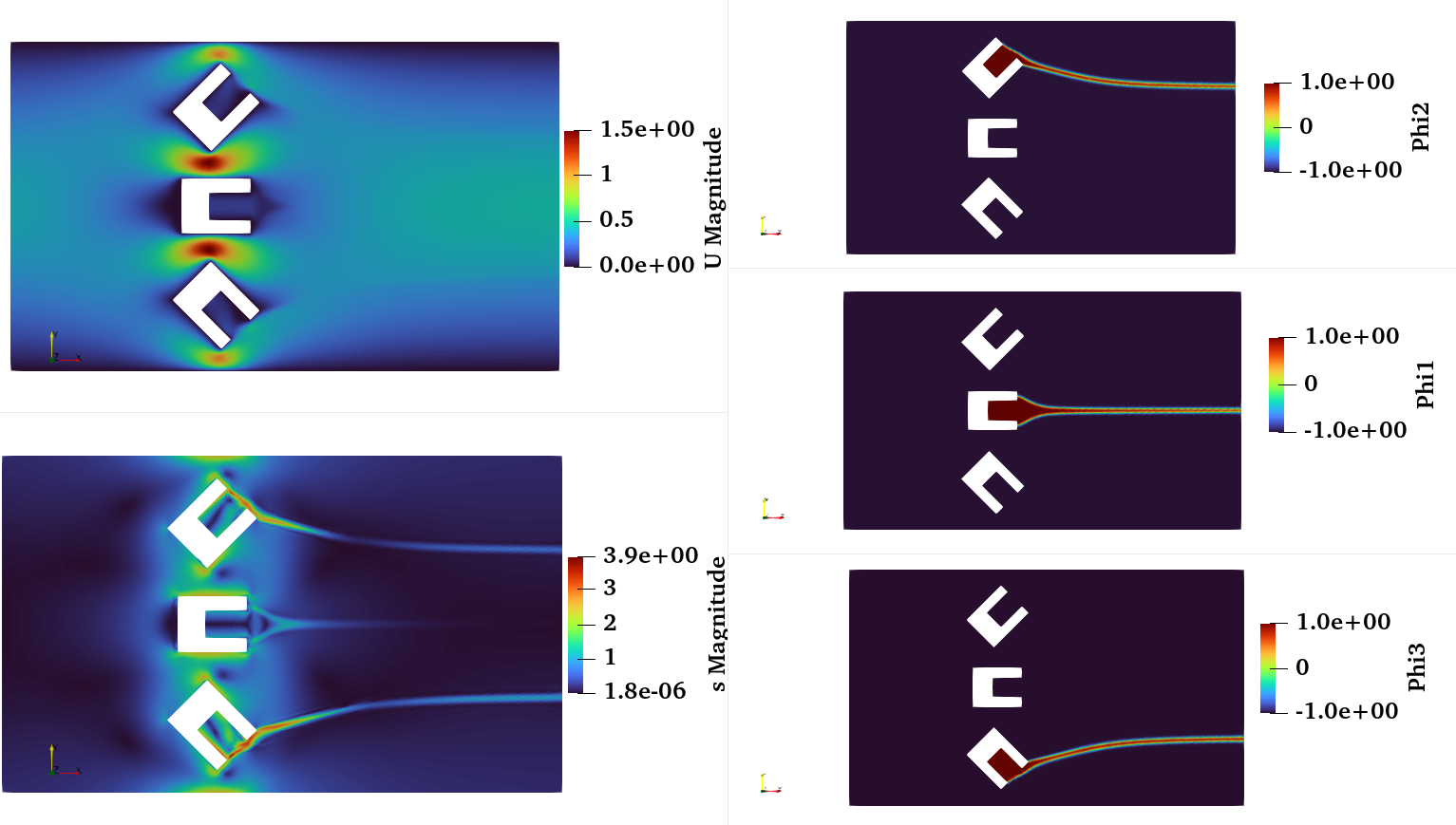
Simulation results: distribution of velocity (U), scalar magnitude (s), and phase fields (Phi1 to Phi3).
Multiphase Flow Around Three V-Shaped Obstacles: U, s, and Phi1–Phi3 Fields
//Multiphase Flow Around Three V-Shaped Obstacles: U, s, and Phi1–Phi3 Fields
Multiphase Flow Around Three V-Shaped Obstacles: U, s, and Phi1–Phi3 Fields
Category : Viscoelasticity
//Multiphase Flow Around Three V-Shaped Obstacles
Project Details
Eulerian multiphase simulation of flow past three V-shaped obstacles showing velocity (U), scalar magnitude (s), and phase fields (Phi1–Phi3) – TCHIKOU-R CONSULTING, November 202601. -
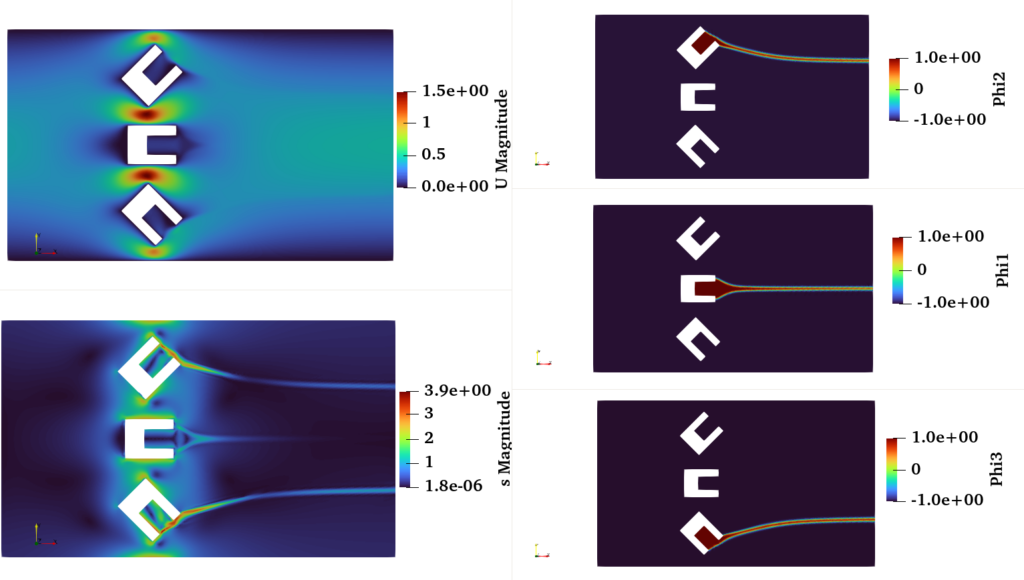
Multiphase Flow Around Three V-Shaped Obstacles: U, s, and Phi1–Phi3 Fields
1. Overview
Simulating multi-component flows interacting with complex geometries requires capturing sharp phase interfaces, wake formation, and localized shear zones without numerical diffusion. This study presents an Eulerian numerical simulation of flow passing through an array of three chevron- and channel-shaped obstacles, tracking the coupled evolution of velocity, scalar gradients, and three distinct phase fields.
2. Simulation results & field analysis
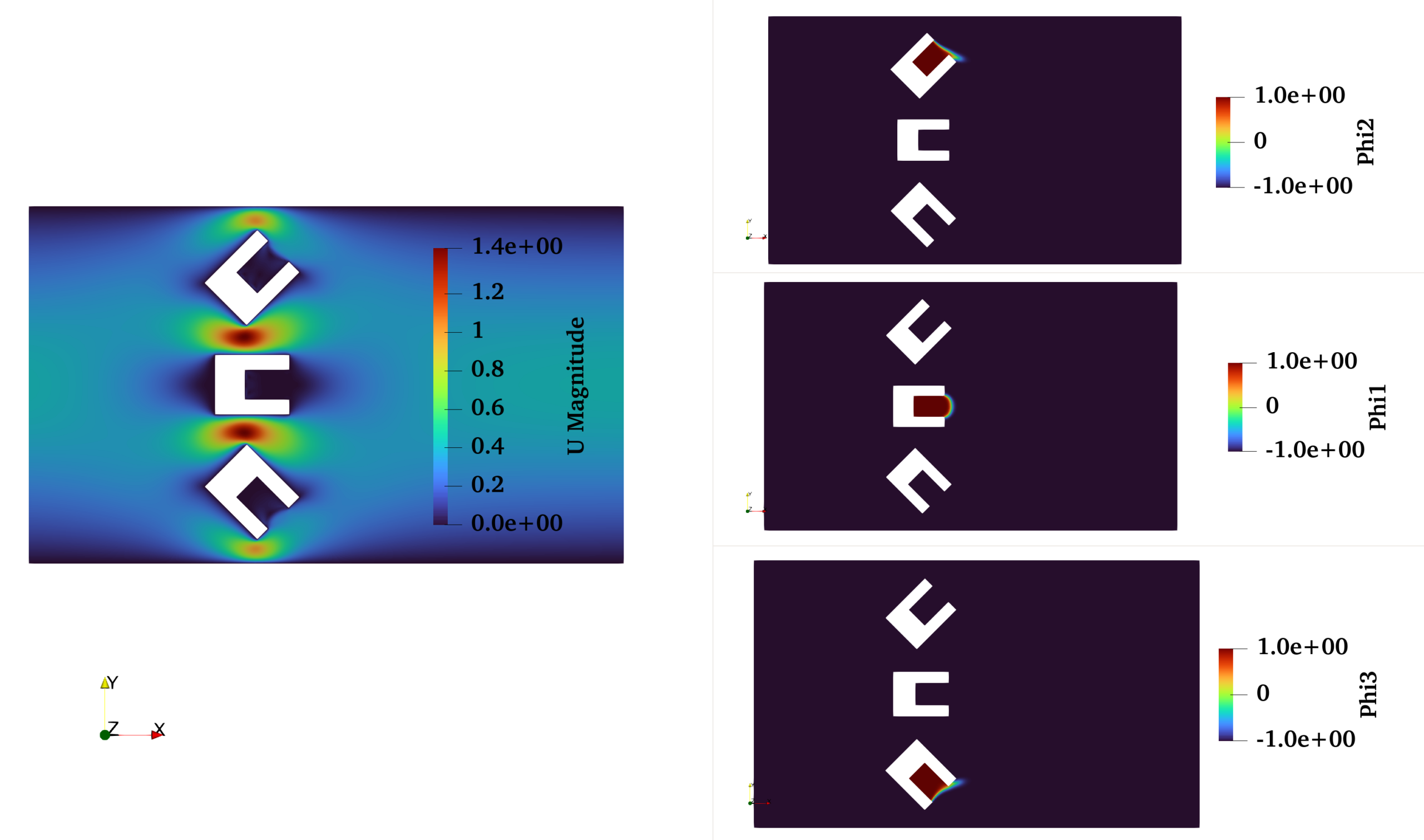
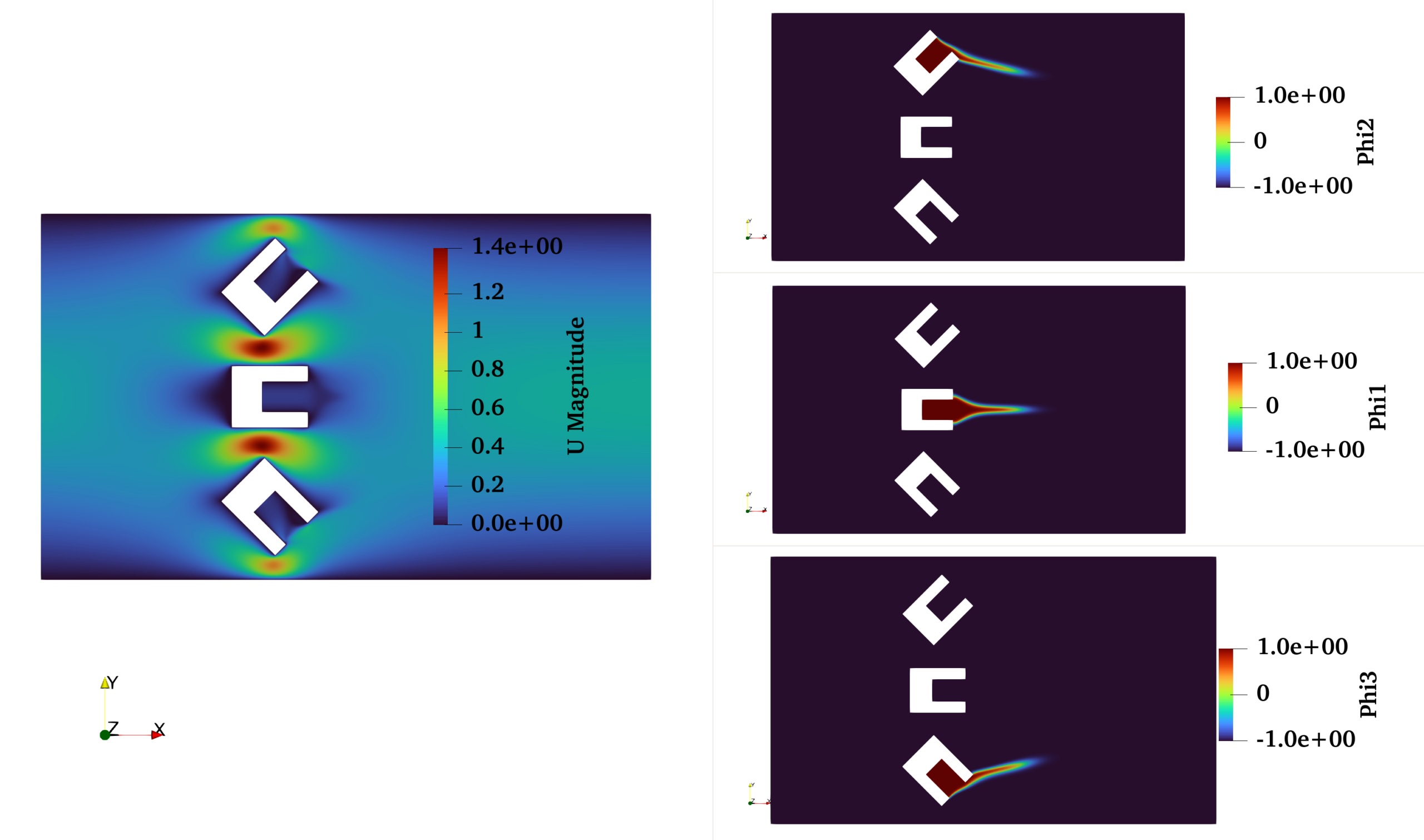
(a) Initial stage (left): Phase initialization inside the three obstacle cavities. (b) Developed wake stage (right): Downstream advection and sharp interface tracking of Phi1, Phi2, and Phi3.
Spatial distribution of velocity magnitude (U), scalar magnitude (s), and phase indicators (Phi1, Phi2, Phi3).
- Velocity field (U Magnitude): Flow accelerates strongly through the narrow gaps between the three obstacles, reaching peak velocities up to 1.50, while low-velocity recirculation zones form inside the concave cavities and downstream wakes.
- Scalar / gradient magnitude (s Magnitude): High values (up to 3.90) concentrate along the sharp edges of the obstacles and trace the thin shear layers extending downstream from the upper and lower bodies.
- Phase fields (Phi1, Phi2, Phi3): Each phase indicator (ranging from -1.0 to +1.0) remains sharply localized within its respective wake stream—Phi2 originating from the upper V-shaped obstacle, Phi1 from the central U-shaped channel, and Phi3 from the lower V-shaped obstacle—demonstrating clean interface tracking without spurious mixing.
3. Numerical methodology
The computation is performed on a fixed Eulerian grid using a diffuse-interface multi-phase formulation. Conservation laws for mass and momentum are coupled with advection equations for the phase indicators (Phi1, Phi2, Phi3), preserving sharp interface resolution across high-shear wake regions around complex solid boundaries.
4. Applications
These high-fidelity multi-phase and obstacle-interaction models apply directly to microfluidic mixing, chemical reactor design, aerodynamic wake control, and industrial fluid-structure systems.
5. Contact
For inquiries regarding computational fluid dynamics (CFD), multiphase flow modeling, or custom solver development:
Dr Serge B. Ndanou, TCHIKOU-R CONSULTING – [email protected]
Explore additional simulations, scientific investigations, and computational engineering projects in our Portfolio.
