

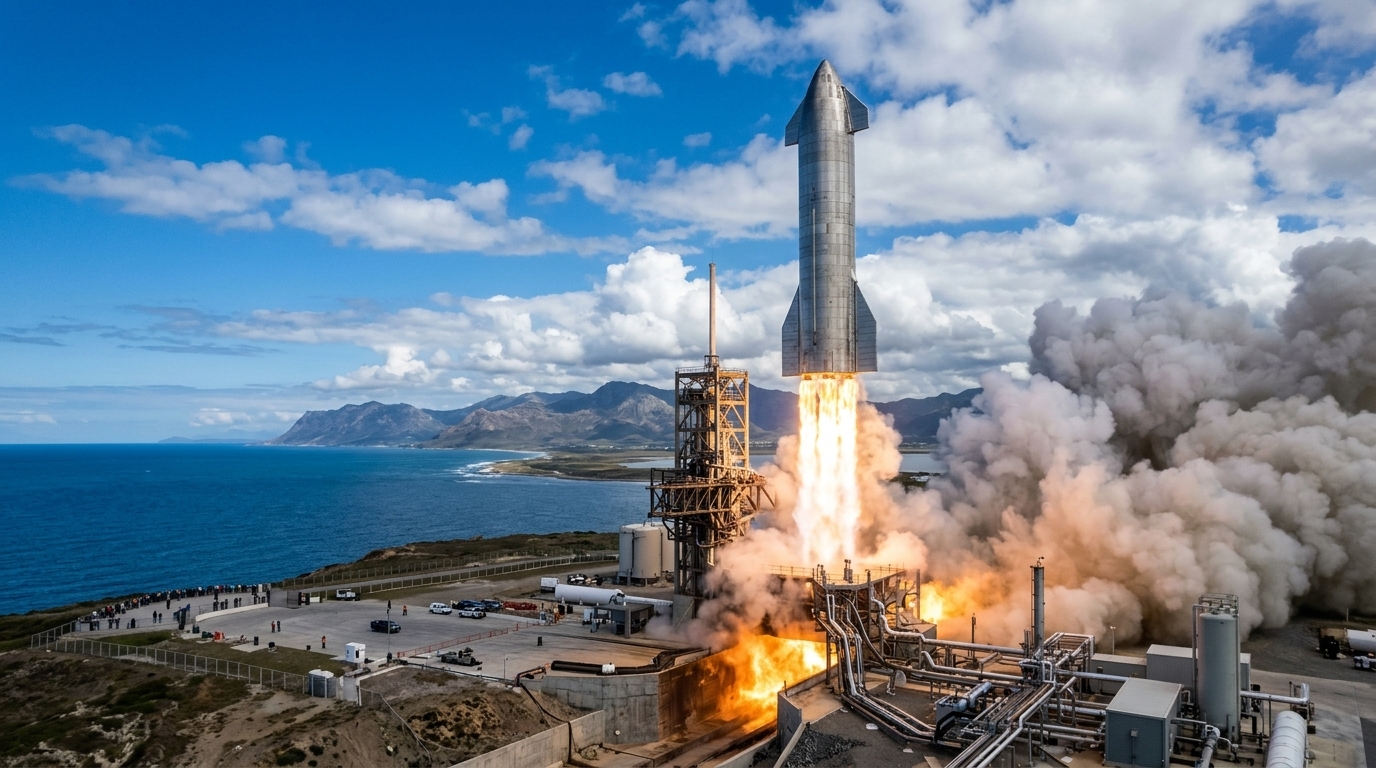
Shock physics, hypervelocity impact, and elastomer simulation for rockets and launch vehicles.
Space Launcher Component Test Simulations
//Space Launcher Component Test Simulations
Space Launcher Component Test Simulations
//Space Launcher Component Test Simulations
Project Details
Hypervelocity impact, shock physics, dynamic fragmentation, and elastomer modeling for rockets and space launchers – TCHIKOU-R CONSULTING, November 202601. -
Space Launcher Component Test Simulations
Category:
Hypervelocity Impact & Shock Physics
1. Overview and Scientific Context
Rockets, space launch vehicles, and orbital structures operate under extreme mechanical regimes—including hypervelocity micrometeoroid and orbital debris (MMOD) impacts, pyrotechnic stage separation shock waves, and intense ignition overpressure loads during liftoff.
Accurately predicting shock propagation, spallation, and dynamic fragmentation requires dedicated compressible hydrodynamics and nonlinear solid mechanics solvers. At TCHIKOU-R CONSULTING, we leverage Eulerian adaptive mesh refinement (AMR), Reference Map interface tracking, and experimentally validated constitutive laws to simulate extreme space-flight physics.
2. Core Modeling & Simulation Capabilities
Our computational physics expertise directly addresses high-energy-density and nonlinear material phenomena in rocket and space engineering:
- Hypervelocity Debris Impact & Shielding (MMOD): Simulation of strong shock waves, extreme elasto-plastic deformations (Steinberg-Guinan, Johnson-Cook), spallation, and dynamic fragmentation using Eulerian Reference Map, Finite Volume, and SPH methods.
- Pyrotechnic Separation & Shock Propagation: Multiphysics modeling of detonation waves, high-explosive loading, and transient stress-wave transmission across metallic and composite launcher interfaces.
- Propulsion Elastomers & High-Pressure Seals: Hyperelastic and multi-mode viscoelastic constitutive modeling (Giesekus, DEVSS stabilization) for booster segment O-rings, valve seals, and vibration isolation mounts.
- Transient Fluid-Structure Interaction (FSI) & HPC: Coupled compressible flow and structural response under ignition blast waves, executed on parallel MPI/PETSc architectures.
3. Representative Space Launcher Simulation Applications
Our numerical methods apply directly to specialized R&D investigations for rockets, launch vehicles, and orbital hardware:
| Space Subsystem / Material | Simulated Physical Phenomena | Key Numerical Outputs |
|---|---|---|
| Whipple Shields & Orbital Structures | Hypervelocity debris impact, shock-induced spallation, dynamic fragmentation | Ballistic limit thresholds, debris cloud dispersion, rear-wall damage |
| Stage Separation & Pyrotechnic Joints | Detonation wave propagation, high-rate fracture, transient shock loading | Peak shock stress, fracture localization, interface separation dynamics |
| Booster O-Rings & Structural Dampers | Large hyperelastic strains, viscoelastic relaxation, dynamic compression | Sealing contact pressure, time-dependent stiffness, deformation fields |
| Launch Pad & Fairing Acoustic Interfaces | Ignition blast-wave propagation and fluid-structure interaction (FSI) | Transient overpressure loads, structural dynamic response |
4. Scientific & Engineering Value
Grounded in extensive research on shock physics, hypervelocity impacts, and large-scale parallel solvers, we support space R&D teams on critical physical challenges:
- Sharp Interface Tracking Under Extreme Strains: Eliminate artificial numerical diffusion during hypervelocity impact and fragmentation via Reference Map and AMR methods.
- Experimentally Validated Shock & Damage Models: Rely on constitutive formulations benchmarked against reference shock, detonation, and impact experiments.
- Massively Parallel Simulation Workflows: Run high-resolution multi-material simulations efficiently using custom C++/Fortran solvers, MPI parallelization, and Python/Gmsh automation.
5. Contact
For inquiries regarding hypervelocity impact simulations, shock physics, elastomer modeling, or custom multiphysics solver development:
Dr Serge B. Ndanou, TCHIKOU-R CONSULTING – [email protected]
Explore additional simulations, scientific investigations, and computational engineering projects in our Portfolio.
