

1. Introduction to Turbulence in Viscoelastic Flow
Turbulence in viscoelastic flow represents a challenging research topic in computational fluid dynamics (CFD), combining complex fluid rheology, transient flow structures, and nonlinear stress evolution.
Unlike Newtonian fluids, viscoelastic materials exhibit both viscous dissipation and elastic energy storage. Their response depends on deformation history, relaxation times, and the evolution of internal stresses.
When complex fluids flow around solid obstacles, the interaction between geometry, inertia, viscosity, and elasticity can produce intricate flow patterns.
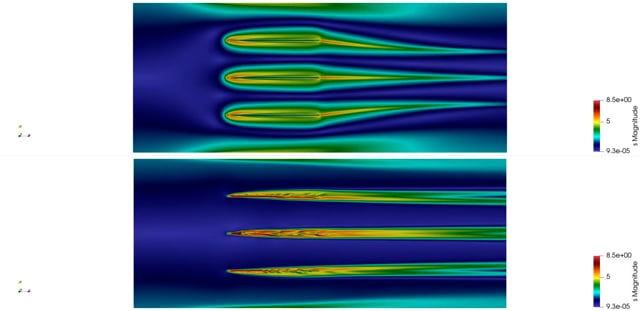
This numerical project presents a comparative visualization of viscoelastic flow around fins under two different flow conditions.
The accompanying video displays the two cases simultaneously:
- Upper visualization: Viscoelastic flow described as operating without turbulence.
- Lower visualization: Viscoelastic flow described as turbulent, with a reported Reynolds number of Re = 1000.
The comparison focuses particularly on the temporal evolution of the logarithmic stress-related fields near the fins.
The numerical investigation employs the Giesekus constitutive model to represent nonlinear viscoelastic fluid behavior.
This work provides a visual perspective on the interaction between fluid elasticity, flow structures, and complex geometry.
2. Physical Configuration and Comparative Flow Analysis
A. Viscoelastic Flow Around Fins
The numerical configuration considers viscoelastic fluid motion around a series of fin-like obstacles.
These solid structures modify the surrounding velocity field and introduce localized variations in fluid deformation.
Depending on the flow conditions, the resulting motion may involve shear layers, wake structures, recirculation regions, and time-dependent variations.
The interaction between the fluid and the fins provides a useful setting for investigating nonlinear rheological effects.
B. Flow Without Turbulence
The upper part of the video presents the reference case described as a viscoelastic flow without turbulence.
This visualization provides a basis for examining stress evolution around the fins in the absence of the turbulent behavior illustrated in the lower case.
The detailed Reynolds number, boundary conditions, and numerical stability characteristics of this reference case are not specified in the original project description.
Consequently, the video provides a qualitative comparison rather than a fully documented controlled numerical study.
C. Flow With Turbulence at Re = 1000
The lower part of the video presents the case identified as turbulent, with a reported Reynolds number of 1000.
The Reynolds number characterizes the relationship between inertial and viscous effects based on selected reference scales.
The presence of geometric obstacles may generate complex transient flow structures and influence the development of flow instabilities.
However, identifying fully developed turbulence requires analysis of the computed flow dynamics and cannot be established from Reynolds number alone.
The original comparison provides an opportunity to investigate the temporal evolution of the viscoelastic stress field under the reported operating conditions.
3. Giesekus Constitutive Modeling
A. Nonlinear Viscoelastic Behavior
The Giesekus model is a nonlinear constitutive framework commonly used to investigate the behavior of selected polymeric fluids.
Depending on its material parameters, the model can represent important rheological characteristics, including:
- Shear-dependent viscosity.
- Normal stress differences.
- Elastic memory effects.
- Stress relaxation.
- Nonlinear coupling between deformation and polymeric stresses.
These properties make the model relevant to complex flows involving strong velocity gradients and time-dependent deformation.
B. Coupling Between Fluid Motion and Elastic Stresses
In computational rheology, the fluid conservation equations are coupled with constitutive equations describing the evolution of viscoelastic stresses.
As the fluid moves around the fins, changes in deformation may influence the internal stress distribution.
In turn, the viscoelastic stresses contribute to the fluid momentum balance and can modify the surrounding flow.
Accurately representing these interactions is essential when investigating nonlinear viscoelastic dynamics.
C. Giesekus Modeling and Turbulence
The Giesekus model describes rheological behavior; it is not, by itself, a turbulence model.
Investigating turbulent viscoelastic flows requires an appropriate numerical treatment of the underlying unsteady flow dynamics.
Depending on the research objectives, this may involve different spatial and temporal resolution strategies.
The original project does not specify whether the simulations use direct numerical simulation, large-eddy simulation, or another turbulence-related numerical approach.
These details would be valuable additions to a future technical description of the benchmark.
4. Logarithmic Stress Visualization
A. Why Visualize Viscoelastic Stresses?
Viscoelastic stress fields provide important information about how a complex fluid responds to deformation.
In flows around solid obstacles, strong variations in stress may develop near surfaces, within shear layers, and downstream of the geometry.
Visualizing these fields helps identify localized changes in material response and their evolution over time.
B. Logarithmic Stress Representation
The study presents the temporal evolution of a field identified as the logarithmic stress representation, s.
This visualization provides a way to examine spatial and temporal changes in the numerical stress-related quantities.
Its exact mathematical definition depends on the transformation implemented in the computational model.
The original description does not establish whether this representation is based on a log-conformation formulation or another logarithmic transformation.
Accordingly, the visualization is described here using the terminology provided with the project.
C. Stress Evolution Near the Fins
The fins introduce geometric constraints that influence local velocity gradients and material deformation.
These effects are relevant to the distribution of viscoelastic stresses around the obstacles.
Comparing the two visualizations provides a way to examine differences in the appearance and time evolution of the stress-related fields.
A quantitative comparison would require consistent plotting scales, comparable physical parameters, and suitable numerical measurements.
5. Flow Structures and Numerical Challenges
A. Transient Flow Dynamics
Unsteady flow conditions can produce time-dependent variations in velocity, pressure, and constitutive stresses.
The interaction between these quantities is particularly important for viscoelastic materials because their response depends on deformation history.
Numerical simulations must represent the relevant physical timescales while maintaining sufficient spatial resolution.
B. Wake and Shear-Layer Dynamics
Flow around fins may generate wake regions and shear layers associated with the presence of the obstacles.
The evolution of these structures depends on the geometry, Reynolds number, material properties, and imposed flow conditions.
Viscoelastic stresses may alter the resulting dynamics, although the direction and magnitude of the effects depend on the particular configuration.
Further analysis of velocity and vorticity fields would help connect the stress visualizations with the underlying flow structures.
C. Numerical Stability
The simulation of complex viscoelastic flow can be computationally demanding.
Strong elastic effects, transient behavior, and localized stress gradients can introduce numerical challenges.
Important computational considerations include:
- Spatial resolution around the fin surfaces.
- Time-step selection for transient calculations.
- Consistent pressure-velocity coupling.
- Stable integration of the Giesekus constitutive equation.
- Resolution of localized stress gradients.
- Monitoring of numerical convergence and conservation.
These considerations are essential for producing reliable numerical predictions.
D. Comparing Flow Regimes
A rigorous comparison between flow conditions requires clearly defined reference parameters.
Useful information includes the Reynolds number of each case, material relaxation time, geometric dimensions, flow boundary conditions, and numerical discretization.
If the objective is to isolate the influence of turbulence, differences in these parameters must be carefully considered.
Quantitative measures such as velocity fluctuations, stress statistics, or turbulence-related flow diagnostics can complement the visual comparison.
6. Scientific and Industrial Applications
A. Polymer Processing
Polymeric materials frequently flow through geometries containing obstacles, restrictions, and complex channels.
Understanding the relationship between fluid elasticity and unsteady flow behavior can support research into processing conditions and material transport.
B. Industrial Mixing Systems
Mixers and other processing equipment may generate complex shear and extensional deformation.
Numerical rheology provides tools for investigating how viscoelastic materials respond to these conditions.
C. Flow Around Internal Components
Industrial fluid systems may contain fins, inserts, or other internal structures that alter the flow.
Computational analysis can contribute to understanding local velocity gradients, pressure variations, and material stresses around these components.
D. Advanced CFD Research
Simulations of unsteady viscoelastic flows are useful for studying the interaction between complex material properties and nonlinear fluid dynamics.
They also provide challenging test cases for numerical methods and scientific software development.
E. Scientific Computing and Solver Development
Accurate representation of viscoelastic stresses in transient flow requires expertise in numerical analysis, constitutive modeling, and computational fluid mechanics.
These capabilities are relevant to developing advanced simulation tools for scientific and engineering research.
7. Conclusion and Research Perspectives
This project presents a visual comparison of turbulence in viscoelastic flow using CFD simulations based on the Giesekus constitutive model.
The accompanying video compares two flow conditions around fins, with the upper visualization described as non-turbulent and the lower visualization identified as turbulent at Re = 1000.
Particular attention is given to the temporal evolution of the logarithmic stress-related field, illustrating the importance of stress visualization in computational rheology.
The comparison provides a foundation for further research into nonlinear viscoelastic dynamics, transient flow structures, and the interaction between material elasticity and fluid inertia.
Further investigations may include quantitative comparisons of stress distributions, velocity fluctuations, flow structures, and sensitivity to rheological parameters.
TCHIKOU-R CONSULTING applies expertise in computational fluid dynamics, viscoelastic constitutive modeling, numerical analysis, and scientific software development to investigate complex engineering problems.
Discover more scientific simulations, computational research, and engineering applications in our Research & Projects collection.
