


1. Introduction to Three-Fluid Viscoelastic Co-Extrusion
Three-fluid viscoelastic co-extrusion represents an advanced computational fluid dynamics (CFD) problem involving multiple polymeric materials, geometric contraction, evolving interfaces, and extrudate swelling.
Co-extrusion is a manufacturing process in which two or more polymeric materials are transported through a common extrusion system to produce a combined extrudate.
Each material may possess different rheological properties, including viscosity, elasticity, and characteristic relaxation times.
The interaction between these materials introduces complex physical phenomena that are difficult to describe using conventional single-fluid models.
This research project presents a completed two-dimensional numerical simulation involving three viscoelastic fluids and a surrounding air phase.
The computational configuration combines three important phenomena:
- Injection and transport of three distinct viscoelastic materials.
- Flow contraction and interactions between polymer interfaces.
- Extrudate swell after the materials leave the confined geometry.
The simulation provides detailed insight into the behavior of the individual fluids and the evolution of their interfaces throughout the extrusion process.
This work is relevant to multiphase CFD, polymer processing, computational rheology, and scientific software development.
2. Computational Geometry and Initial Conditions
A. Two-Dimensional Co-Extrusion Configuration
The numerical model represents a two-dimensional co-extrusion process involving three viscoelastic fluids transported through a common flow domain.
The computational geometry includes multiple injection regions, a contraction section, and an outlet opening into the surrounding air.
This configuration makes it possible to investigate how the different fluids interact while passing through geometric restrictions.
It also provides a framework for observing changes in material shape during and after the extrusion process.
B. Four-Phase Representation
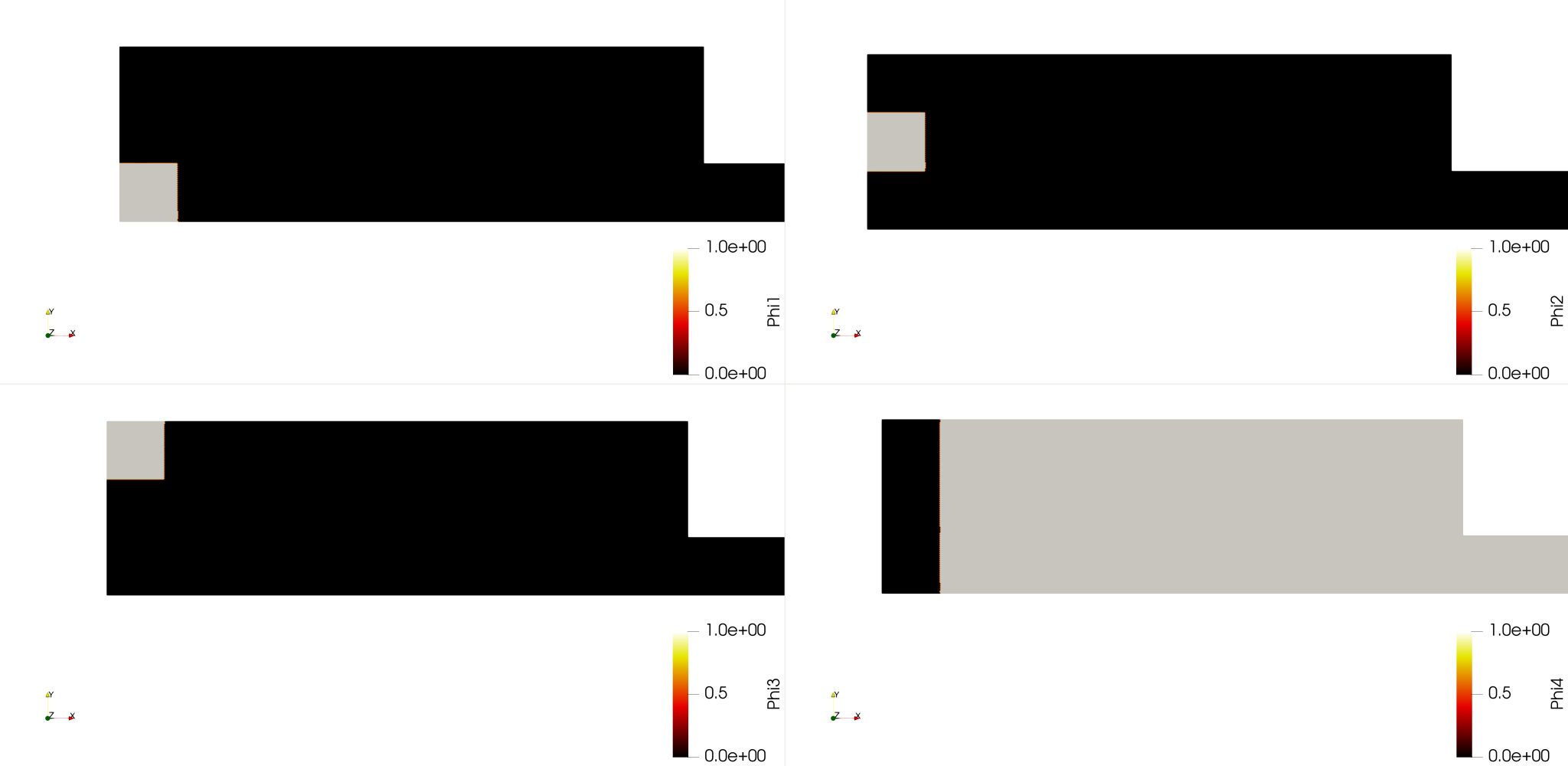
The different materials are identified using four phase-indicator fields.
- Phi1: First viscoelastic fluid.
- Phi2: Second viscoelastic fluid.
- Phi3: Third viscoelastic fluid.
- Phi4: Surrounding air.
These fields distinguish the different material regions and provide a visual representation of their evolution during the simulation.
The four-phase description is particularly useful for analyzing the movement of interfaces between the three polymeric fluids and the external environment.
C. Initial Fluid Distribution
The original numerical presentation begins with the computational geometry and the initial positions of the different materials.
At the start of the simulation, the injection regions are approximately half-filled with their corresponding viscoelastic fluids.
The remaining portions are initially occupied by air.
Consequently, the polymeric fluids are initially in contact with the air phase.
As the numerical flow develops, the injected materials progressively occupy the extrusion channel.
This initial configuration makes it possible to follow the transient establishment of the co-extrusion process before the steady-state solution is reached.
3. Numerical Convergence and Steady-State Flow
A. Development of the Flow Solution
The numerical simulation follows the evolution of the different fluid regions from their initial configuration toward a stationary flow state.
During this process, the computational solver resolves the coupled fluid motion and the evolution of the viscoelastic stress fields.
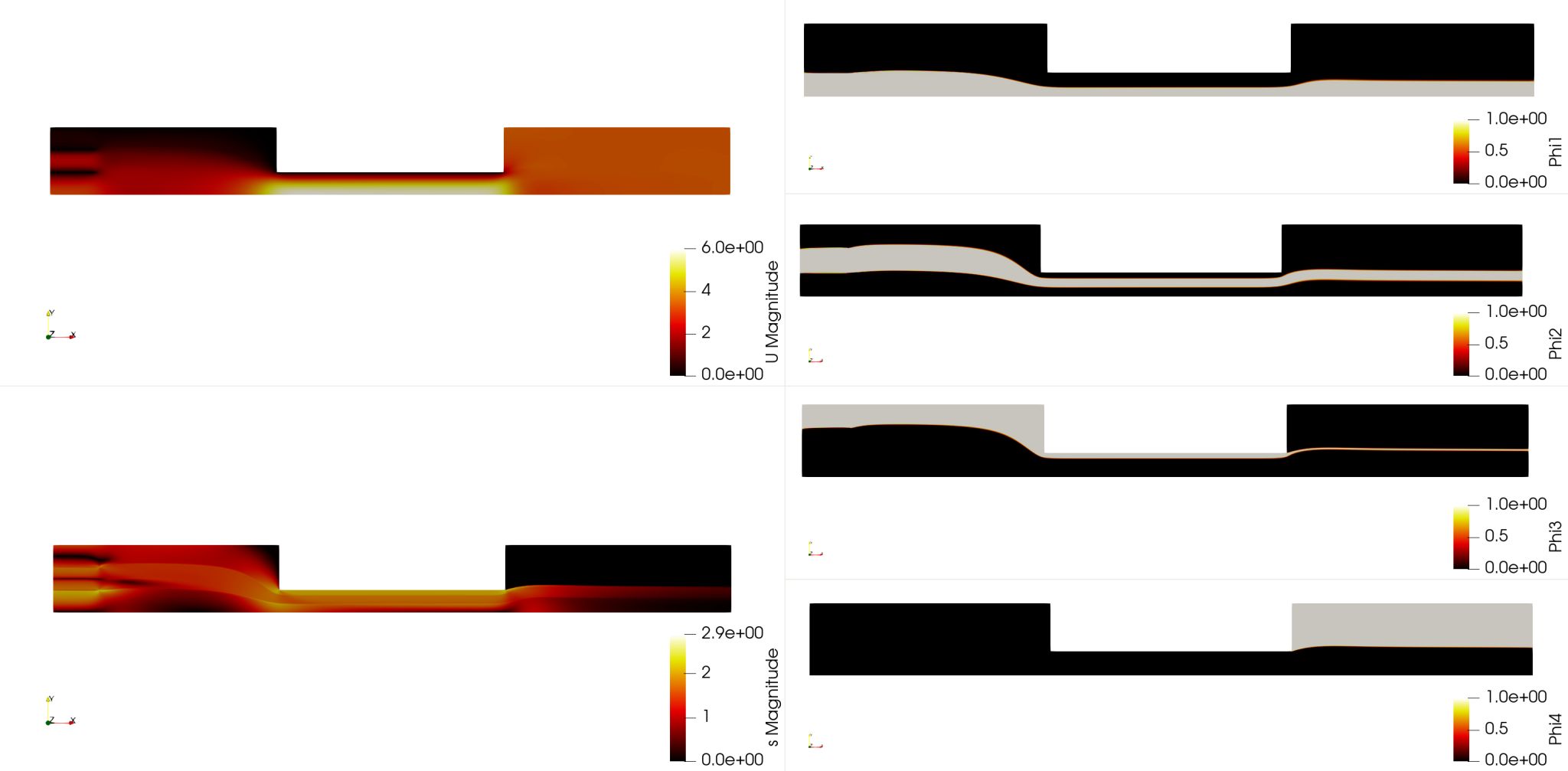
The original study reports that a steady-state solution was obtained after convergence of the numerical variables.
This represents an important stage in the investigation because it provides a consistent configuration for examining the interactions between the three fluids.
B. Velocity and Logarithmic Stress Fields
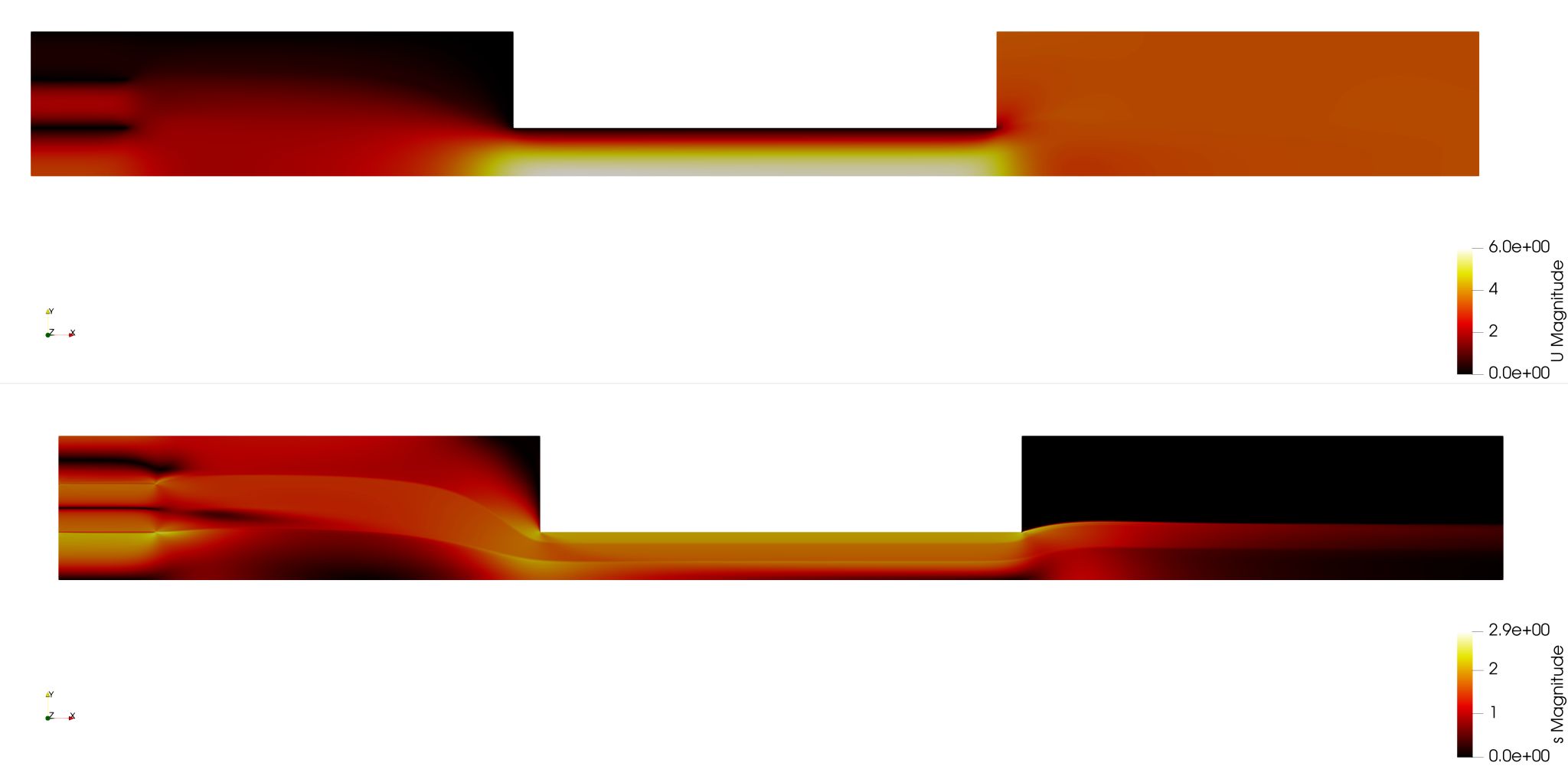
The computed velocity field provides information about the transport and deformation of the polymeric materials through the co-extrusion geometry.
The study also examines a logarithmic representation of the viscoelastic stress-related fields.
According to the reported results, the velocity and logarithmic stress fields display smooth numerical distributions in the converged solution.
These visualizations help interpret the interaction between material transport, internal stresses, and geometric confinement.
Quantitative accuracy should be assessed separately through suitable mesh-convergence and numerical verification procedures.
C. Displacement of the Initial Air Phase
An important observation concerns the evolution of the initially air-filled portions of the extrusion channel.
As the three viscoelastic fluids advance through the geometry, they progressively displace the air.
The reported steady-state solution shows that the polymeric fluids have completely expelled the initial air from the tube.
The air phase remains relevant outside the extrusion outlet, where the extruded materials encounter the surrounding environment.
This observation illustrates the ability of the computational representation to distinguish the different material regions throughout the simulated process.
4. Contraction Flow and Interface Interactions
A. Flow Through the Contraction
The contraction section introduces changes in velocity and material deformation as the three fluids move through the restricted geometry.
For viscoelastic materials, these changes can generate nonlinear stresses and affect the subsequent deformation of each fluid region.
The interaction becomes more complex when several viscoelastic materials are present simultaneously.
Each fluid may respond differently according to its rheological properties and its position within the combined flow.
B. First Swelling of Fluid Phi1
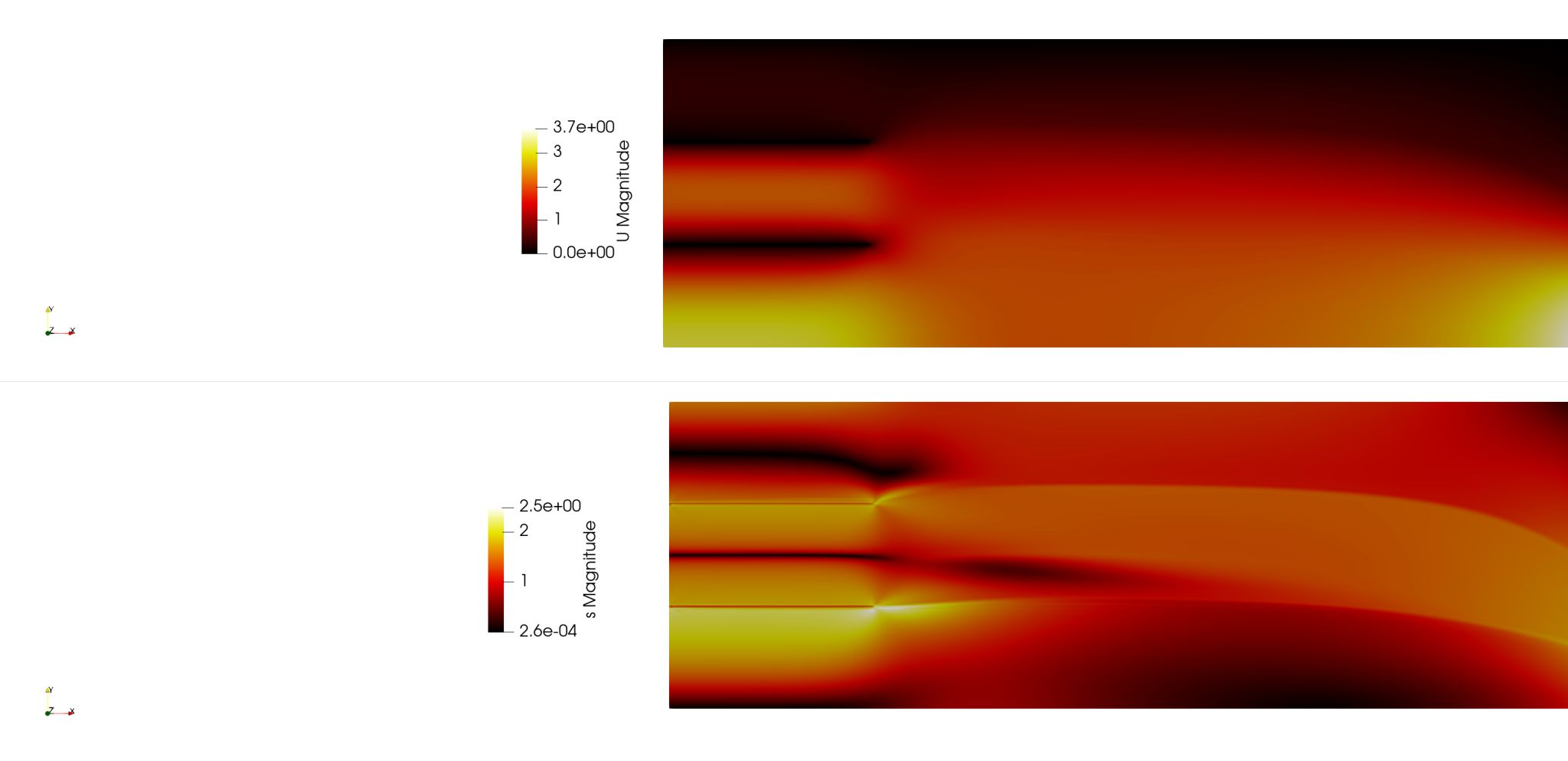
One of the most interesting observations concerns the behavior of the first viscoelastic fluid, Phi1.
According to the simulation results, Phi1 initially expands after leaving its individual injector.
This local swelling occurs near the interface separating Phi1 from the neighboring viscoelastic fluid Phi2.
The observation highlights the influence of geometric transitions and neighboring material regions on the shape of the individual flow components.
C. Compression Between Viscoelastic Fluids
After its initial expansion, Phi1 is compressed by the surrounding viscoelastic materials as the combined flow develops.
This behavior demonstrates that the deformation of an individual fluid cannot necessarily be understood independently of the other materials.
Interactions between the fluid regions can alter the local interface positions and modify the distribution of the different polymeric materials.
The numerical results therefore provide insight into the coupled nature of multi-material extrusion.
D. Interface Evolution
In three-fluid viscoelastic co-extrusion, the positions of the interfaces are important indicators of material distribution.
Interface deformation may reflect differences in rheological properties, flow conditions, and geometric constraints.
Accurately representing these interactions is essential when studying multilayer extrusion and related multi-material processing systems.
The simulation describes the evolution of distinct polymer regions; it does not, by itself, establish molecular mixing, interdiffusion, or chemical compatibility between the materials.
5. Die Swell and Vortex Formation
A. Extrudate Swell at the Outlet
After the combined material leaves the confined extrusion geometry, the flow enters an open region surrounded by air.
For viscoelastic materials, the release of geometric confinement may be accompanied by elastic stress relaxation and changes in extrudate dimensions.
This phenomenon is commonly known as extrudate swell or die swell.
In the reported simulation, fluid Phi1 displays a small additional swelling after leaving the common extrusion outlet.
This follows its earlier expansion near the injector and its subsequent compression by the neighboring fluids.
The sequence highlights the complex deformation history experienced by an individual material during co-extrusion.
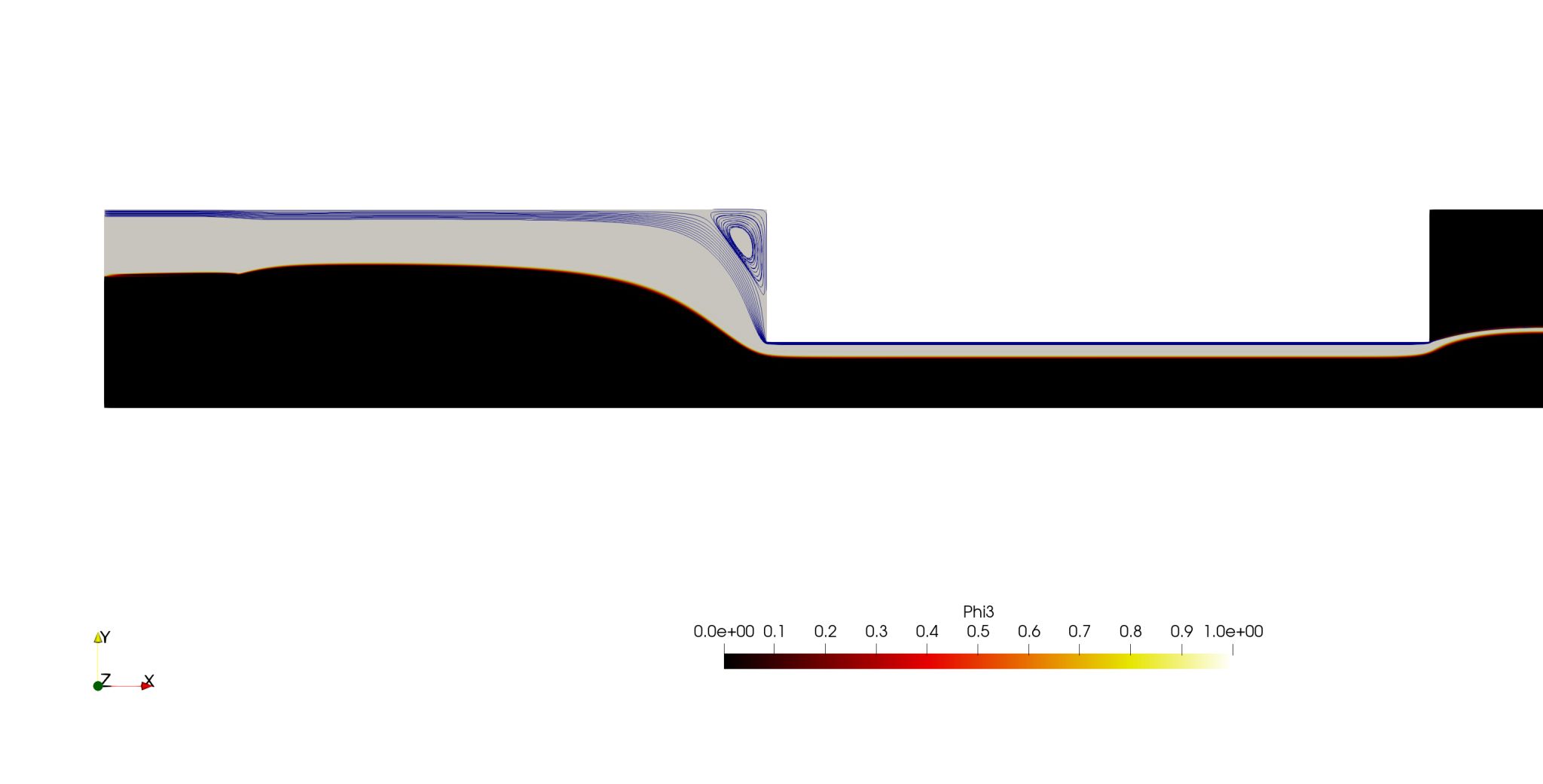
B. Recirculation Vortex in Fluid Phi3
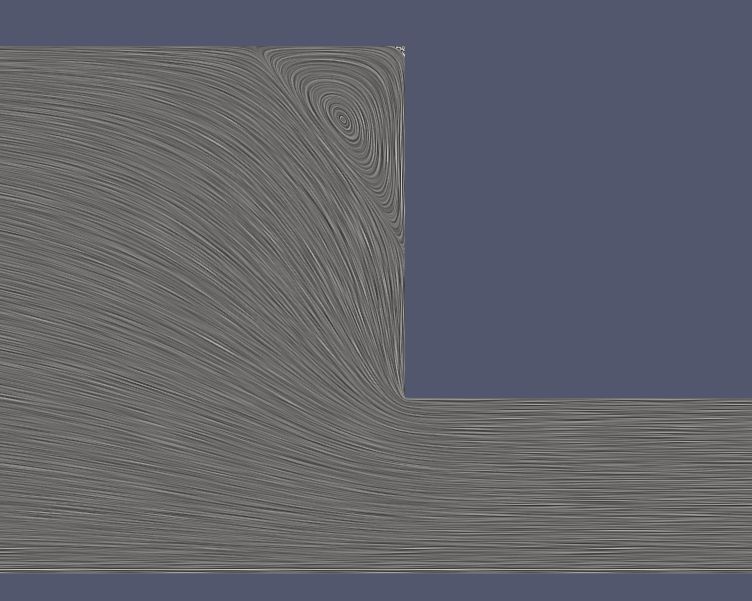
Another distinctive result is the appearance of a recirculation vortex associated with the contraction region.
The original numerical observations indicate that this vortex develops exclusively within fluid Phi3 for the investigated configuration.
The vortex is also reported to be smaller than initially expected.
This result is significant because it shows how the local flow structure may be confined to one of the materials rather than extending across several fluid regions.
The size and position of recirculation zones depend on the geometry, flow conditions, and rheological characteristics of the materials.
C. Investigating Interactions Between Fluids
The reported vortex behavior raises an important research question:
Under which conditions can a recirculation structure interact with two or more viscoelastic fluids simultaneously?
The original project identifies increasing the flow rate as a potential next step for investigating this question.
Such a parameter study could provide additional insight into the interaction between contraction-induced flow structures and multiple polymer interfaces.
The proposed extension should be distinguished from the results already obtained in the two-dimensional simulation.
6. Computational Challenges and Engineering Applications
A. Coupled Multiphase Viscoelastic Modeling
Simulating three viscoelastic fluids together with air introduces significant computational complexity.
The numerical framework must resolve the evolution of multiple material regions while accounting for the fluid motion and relevant constitutive stresses.
Important numerical challenges include:
- Accurate representation of three polymeric materials and the surrounding air.
- Transport and deformation of multiple fluid interfaces.
- Nonlinear viscoelastic stress calculations.
- Strong velocity and stress gradients near contraction regions.
- Consistent treatment of the free surface at the outlet.
- Convergence of the coupled numerical solution.
B. Numerical Verification
Reliable simulations require appropriate numerical verification.
Relevant assessment criteria include mesh sensitivity, convergence of the velocity and stress fields, conservation properties, and the accuracy of interface representation.
For multi-material extrusion, it is also important to investigate whether the computed interface positions remain stable under changes in numerical resolution.
These checks help distinguish physical behavior from numerical artifacts.
C. Polymer Co-Extrusion and Multilayer Products
Co-extrusion is relevant to manufacturing processes that combine several polymeric materials into a single product.
Examples include multilayer films, packaging materials, protective coatings, and specialized polymer profiles.
Numerical simulation can help investigate the influence of rheological properties and processing conditions on material distribution and interface geometry.
Industrial application requires appropriate material characterization and validation against relevant operating conditions.
D. Extrusion Die Design
Computational studies of contraction flow and die swell provide useful information for understanding how die geometry influences polymer deformation.
When several viscoelastic fluids are processed simultaneously, the interaction between materials adds another level of complexity.
Numerical analysis can support research into flow distribution, interface evolution, and the dimensional behavior of the extrudate.
E. Scientific Software Development
Multi-material viscoelastic simulations represent challenging applications of scientific computing.
They require advanced numerical treatment of constitutive equations, fluid interfaces, nonlinear coupling, and free-surface motion.
The successful completion of the reported two-dimensional simulation provides a basis for further numerical investigations involving more complex geometries and flow conditions.
7. Conclusion and Research Perspectives
This project presents a completed two-dimensional simulation of three-fluid viscoelastic co-extrusion, including contraction flow, interactions between polymer regions, and die swell in air.
The computational model distinguishes three viscoelastic materials, Phi1, Phi2, and Phi3, together with a surrounding air phase, Phi4.
The numerical study reports a converged steady-state solution with smooth velocity and logarithmic stress-related fields.
The results reveal several distinctive physical features:
- Complete displacement of the initial air from the extrusion tube.
- Initial swelling of Phi1 after its injector.
- Subsequent compression of Phi1 by neighboring viscoelastic fluids.
- A small additional swelling of Phi1 after the final outlet.
- A contraction-related recirculation vortex observed only within Phi3.
These observations illustrate the complex interactions that can arise when several viscoelastic fluids undergo simultaneous deformation.
The original research description identifies two important perspectives: increasing the flow rate to investigate vortex interactions across multiple fluids, and extending the numerical study toward a three-dimensional configuration.
These developments represent potential continuations of the reported two-dimensional results.
TCHIKOU-R CONSULTING applies expertise in computational fluid dynamics, nonlinear rheology, multiphase flow modeling, and scientific software development to investigate complex polymer-processing problems.
Explore more computational simulations, numerical research, and engineering applications in our Research & Projects collection.
Further Scientific Reading
The Impact of Upstream Contraction Flow on Three-Dimensional Polymer Extrudate Swell from Slit Dies. Journal of Non-Newtonian Fluid Mechanics, 2020.
This publication provides additional background on the relationship between contraction geometry, viscoelastic stresses, and extrudate swell.
