

1. Introduction to Aluminum Plate Spallation
Aluminum plate spallation is an important phenomenon in dynamic solid mechanics and the study of metallic materials subjected to intense transient loading.
High-speed impacts produce rapidly evolving mechanical fields involving pressure, material velocity, density, deformation, and internal stresses.
Under sufficiently severe loading conditions, these processes may lead to material damage, crack formation, and fragmentation.
This research project presents a numerical investigation of a titanium projectile impacting an aluminum target plate surrounded by air.
The original simulation considers an impact velocity of 1 km/s and examines the resulting evolution of the mechanical fields within the interacting materials.
Particular attention is given to the separation of an aluminum fragment and the development of cracks within the titanium projectile.
The study illustrates the scientific challenges associated with high-speed impact simulation, nonlinear solid mechanics, dynamic fracture, and computational materials research.
2. Numerical Configuration and Impact Conditions
A. Titanium Projectile and Aluminum Target
The computational configuration consists of a titanium projectile interacting with an aluminum target plate.
Both metallic solids are represented within a computational domain containing the surrounding air.
The simulation follows the transient mechanical response of the materials during and after contact.
The geometry and material properties influence the distribution of the resulting stresses, deformation, and damage.
B. Dynamic Loading Conditions
The original numerical study reports an impact velocity of 1 km/s.
This rapid loading generates strong local mechanical disturbances and significant changes in the computed physical fields.
The simulation provides a framework for observing how the projectile and target respond during the short-duration impact event.
The resulting behavior is examined through the evolution of density, velocity, pressure, and normal stress.
C. Surrounding Air
The aluminum target and titanium projectile are represented within a domain that includes air.
This enables the numerical visualization of the different material regions as the geometry evolves.
The precise influence of the surrounding air depends on the physical models and coupling conditions implemented in the simulation.
Its inclusion should therefore be distinguished from any claim that detailed aerodynamic effects have been validated.
3. Visualization of the Numerical Results
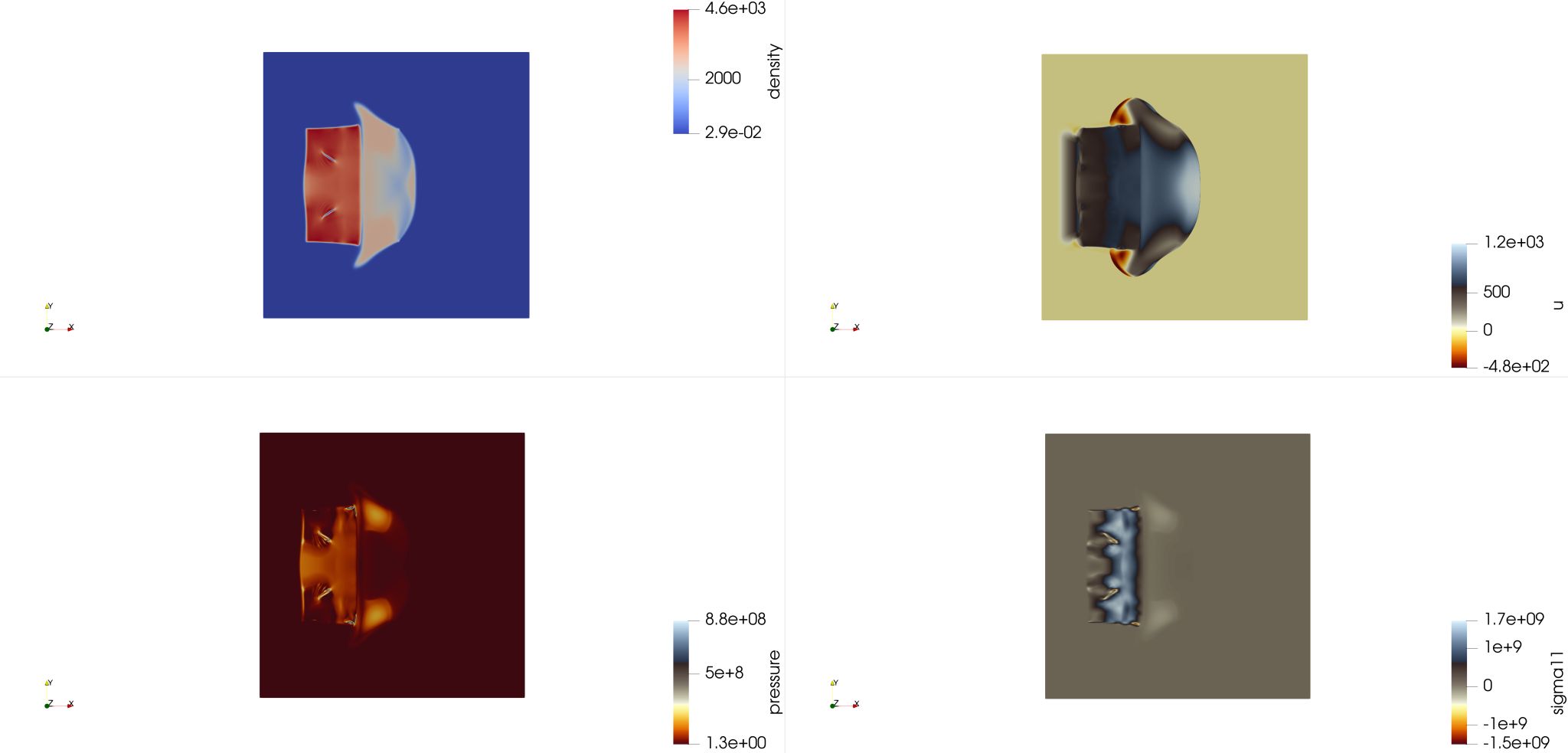
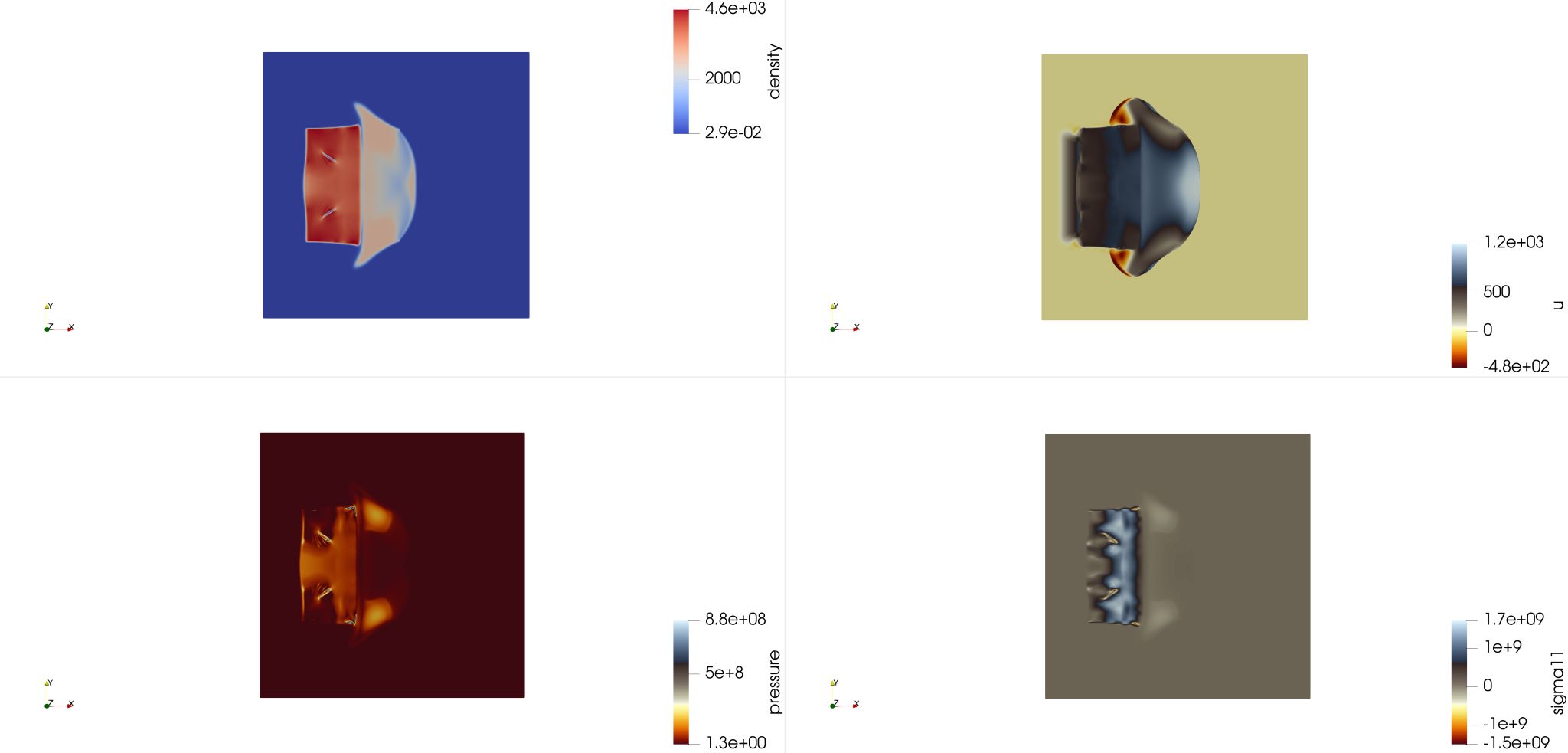
The original simulation presents four complementary physical quantities arranged in a comparative visualization.
Each field provides a different perspective on the dynamic interaction between the two metallic solids.
A. Density Field: Upper-Left Panel
The upper-left visualization presents the density field.
Density variations can provide information about the compressive response of the materials during the impact event.
The field also assists in visualizing the evolution of the material regions within the computational domain.
Interpretation of density changes depends on the selected compressibility and material models.
B. Velocity Component u: Upper-Right Panel
The upper-right visualization displays the velocity component identified as u.
This field describes one component of the local material motion during the transient impact.
Its evolution helps illustrate the displacement and relative movement of the interacting solids.
The direction associated with u depends on the coordinate system used in the numerical model.
C. Pressure Field: Lower-Left Panel
The lower-left visualization presents the pressure distribution.
The original study reports a localized high-pressure region reaching approximately 1.7 GPa at the impact interface.
This value highlights the intensity of the compressive conditions represented in the numerical calculation.
The pressure field provides insight into the local mechanical response, but should be interpreted together with the other stress components and the material model.
D. Normal Stress Component Sigma11: Lower-Right Panel
The lower-right visualization displays the normal stress component sigma11.
This component represents the normal stress associated with the first coordinate direction.
Its evolution provides additional information about the internal mechanical state of the metallic materials.
Analysis of this field is relevant to understanding the development of localized stress regions during dynamic loading.
Identifying tensile or compressive regions requires consideration of the stress-sign convention used in the simulation.
4. Spallation and Dynamic Material Fracture
A. Understanding Spallation
Spallation is a dynamic material failure phenomenon associated with the separation of material under rapidly evolving mechanical loading.
In metallic solids, it is commonly associated with tensile damage generated during stress-wave interactions.
Numerical investigation of spallation requires consideration of the material response and the development of internal damage or fracture.
The precise failure mechanism depends on the selected physical and constitutive models.
B. Aluminum Fragment Separation
One of the principal observations reported in this study is the visible separation of a fragment from the aluminum plate.
The numerical visualization shows the detached material moving away from the main aluminum region.
This observation is central to the project because it illustrates the dynamic evolution of material separation during the simulated event.
Further quantitative analysis would be required to characterize the fragment dimensions, motion, and underlying damage mechanisms.
C. Crack Development in the Titanium Projectile
The original study also reports the appearance and growth of two fractures within the titanium projectile.
The fractures evolve during the simulation, illustrating the complex mechanical response of the impacted materials.
At the stage described in the original publication, an important unanswered question concerned whether these fractures would eventually extend to the projectile surface.
The source material does not establish their final propagation or failure outcome.
The project should therefore be presented as an ongoing investigation rather than a completed fracture-validation study.
D. Comparison Between Numerical Configurations
The original research also reports a qualitative difference between the displayed simulation and another configuration involving a reduced titanium thickness.
In the displayed case, separation between the metallic solids is observed during the impact sequence.
According to the project description, the same separation behavior was not observed in the comparison case with the titanium thickness reduced by half.
This observation highlights the sensitivity of transient material response to the numerical configuration.
It does not, on its own, establish a general relationship between thickness and material failure.
Additional numerical verification and material characterization would be necessary before drawing broader conclusions.
5. Computational Challenges and Numerical Reliability
A. Rapid Transient Dynamics
High-speed impact simulations involve mechanical processes evolving over short physical timescales.
The computational method must provide adequate temporal resolution to represent the evolving material response.
Time-step selection and numerical stability are therefore important aspects of the calculation.
B. Nonlinear Material Behavior
The mechanical response of metallic materials under intense dynamic loading can involve nonlinear deformation and failure.
The numerical interpretation depends on the constitutive relationships used to describe the titanium and aluminum.
The original project description does not specify the complete material equations or fracture criteria.
Accordingly, the observations are presented without attributing them to a particular constitutive or damage model.
C. Material Separation and Evolving Geometry
Representing material separation introduces challenges associated with changing boundaries and discontinuous material regions.
The computational framework must describe the geometry consistently as deformation and fragmentation evolve.
Such calculations require careful treatment of the physical interfaces and the governing mechanical equations.
D. Numerical Verification
Reliable interpretation of dynamic impact simulations requires appropriate numerical checks.
Relevant considerations include:
- Spatial mesh sensitivity.
- Temporal convergence.
- Consistency of material density and velocity fields.
- Monitoring of momentum and energy balances.
- Evaluation of stress-field resolution.
- Assessment of material-interface representation.
- Comparison with appropriate experimental or reference data.
These procedures help distinguish physically meaningful results from possible numerical artifacts.
6. Scientific and Engineering Relevance
A. Dynamic Solid Mechanics
Numerical impact problems provide challenging examples for studying the response of solid materials under transient loading.
They are relevant to research involving nonlinear deformation, mechanical-wave propagation, and material damage.
B. Computational Materials Research
Investigating metallic materials under rapid deformation can contribute to a better understanding of their mechanical response.
Numerical simulation provides access to internal mechanical fields that may be difficult to observe experimentally.
Appropriate experimental comparison remains essential when predictive accuracy is required.
C. Structural Integrity Research
The study of dynamic fracture and material separation is relevant to fundamental research on structural integrity.
Computational methods can support scientific investigation of material response during short-duration mechanical events.
Engineering conclusions about structural performance require validated material models and supporting evidence.
D. Scientific Software Development
Impact and fracture simulations are demanding computational problems involving transient dynamics, nonlinear material descriptions, and evolving geometries.
They provide opportunities to investigate numerical methods, computational robustness, and scientific visualization techniques.
These research activities are relevant to advanced computational mechanics software development.
7. Conclusion and Research Perspectives
This numerical investigation of aluminum plate spallation illustrates the complex mechanical response of metallic materials subjected to high-speed impact.
The original simulation considers a titanium projectile interacting with an aluminum target plate at an impact velocity of 1 km/s.
The visualization presents four physical fields: density, velocity component u, pressure, and normal stress component sigma11.
The reported pressure reaches approximately 1.7 GPa in a localized region near the impact interface.
The study also shows a fragment separating from the aluminum plate and two fractures evolving within the titanium projectile.
At the time of the original description, the simulations were ongoing, with the final evolution of the projectile fractures remaining an open research question.
These observations illustrate the importance of numerical simulation for investigating transient material deformation, stress evolution, and dynamic fracture.
TCHIKOU-R CONSULTING applies expertise in computational solid mechanics, numerical methods, nonlinear material modeling, and scientific software development to complex engineering and research problems.
Discover more computational research, numerical simulations, and advanced mechanics projects in our Research & Projects collection.
Access to the Full Simulation Video
The original project description indicates that the complete simulation video is available through paid access.
For information about viewing conditions and access arrangements, please contact TCHIKOU-R CONSULTING.
