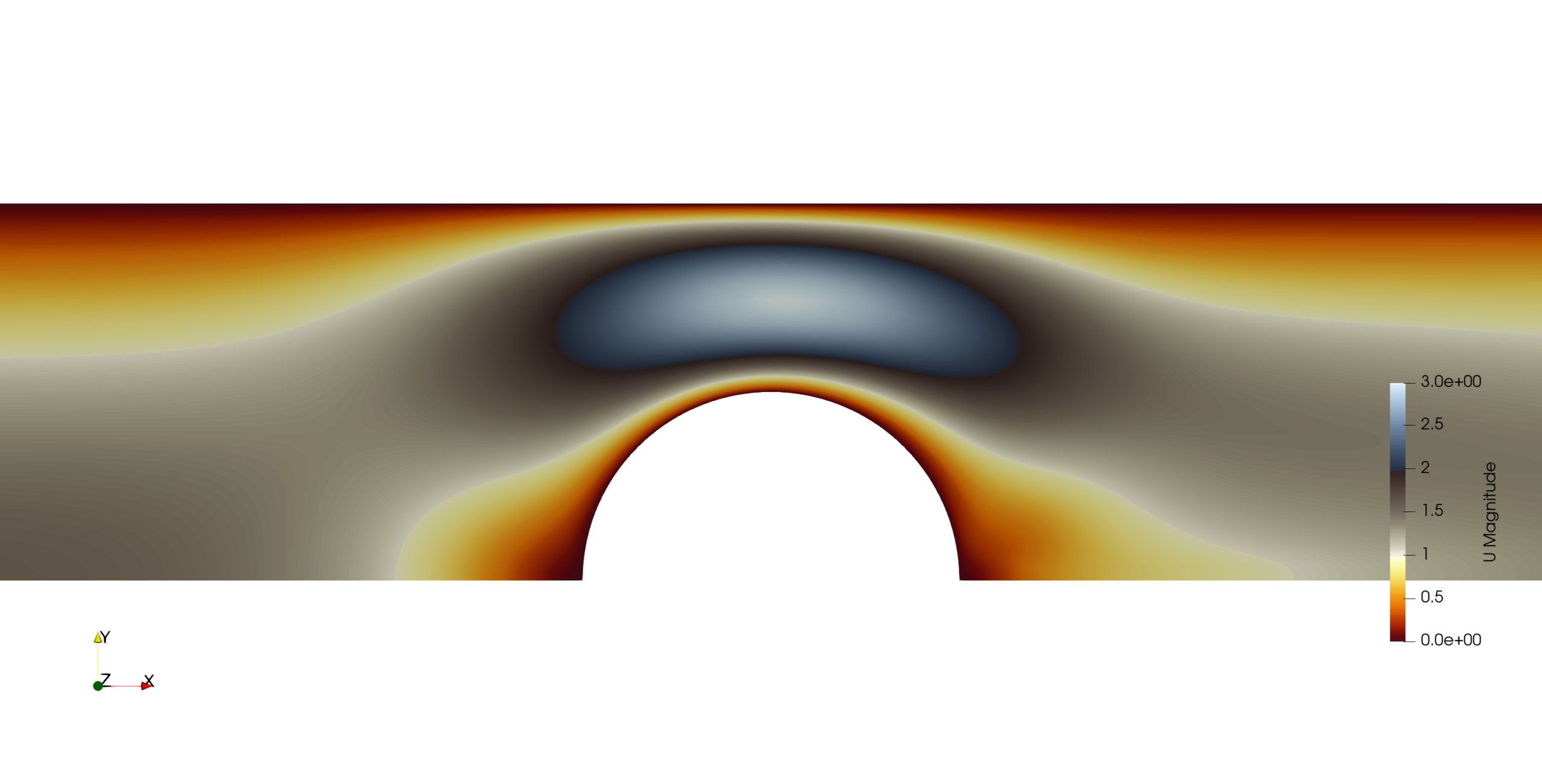
Benchmark Overview: Flow Around a Cylinder
Fundamental CFD Benchmark
The flow around a circular cylinder is a classical benchmark in computational fluid dynamics.
It provides a controlled configuration for analyzing the relationship between fluid inertia, viscosity, elasticity, and the geometry of an immersed obstacle.
For Newtonian fluids, the Reynolds number strongly influences flow separation, recirculation, and vortex shedding.
Introducing viscoelasticity adds new physical mechanisms associated with polymeric stresses and material relaxation.
The resulting flow may display significant differences from its Newtonian counterpart, depending on the constitutive model and operating conditions.
Numerical Quantities of Interest
- Velocity profiles upstream and downstream of the cylinder.
- Pressure distribution around the solid obstacle.
- Shear and normal stress fields.
- Wake length and recirculation structure.
- Drag and lift forces acting on the cylinder.
- Time-dependent vortex behavior, where applicable.
These measurements can be used to compare computational predictions with suitable benchmark data.
Physical Effects and Dimensionless Parameters
Viscoelasticity and Wake Dynamics
The presence of elastic stresses can substantially alter the flow structures developing around a circular cylinder.
Important physical phenomena to investigate include:
- Wake stabilization or destabilization: Elasticity may modify the onset and evolution of flow instabilities.
- Vortex dynamics: Polymeric stresses can influence vortex formation, shedding frequency, and wake structure.
- Stress concentration: Strong gradients may develop near the cylinder surface and in the downstream region.
- Drag and lift variation: Viscoelasticity can modify hydrodynamic forces, with effects depending on the flow regime.
- Flow asymmetry: Interactions between inertia and elasticity may produce complex asymmetric flow patterns.
These effects are not universal. Their occurrence depends on Reynolds number, elasticity, material parameters, geometry, and boundary conditions.
Key Dimensionless Parameters
Three dimensionless numbers are particularly relevant to the analysis.
Reynolds Number (Re)
Re = rho * U * D / eta
The Reynolds number characterizes the relative importance of inertial and viscous effects.
Weissenberg Number (Wi)
Wi = lambda * U / D
The Weissenberg number compares a characteristic material relaxation time with the deformation timescale of the flow.
Deborah Number (De)
De = lambda / T
The Deborah number relates the material relaxation time to a characteristic observation or process timescale.
Here, rho is fluid density, U is a characteristic velocity, D is the cylinder diameter, eta is a reference viscosity, lambda is a relaxation time, and T is a characteristic flow timescale.
The distinction between Wi and De depends on the physical timescales selected for the problem.
Numerical Challenges and Anisotropic Mesh Adaptation
High Weissenberg Number Problem
One of the major challenges in computational viscoelasticity is the numerical instability that may arise when elastic effects become strong.
This difficulty is commonly associated with the High Weissenberg Number Problem (HWNP).
Strong stress gradients and nonlinear constitutive coupling may affect the stability and convergence of numerical solvers.
Addressing these challenges requires careful numerical formulation, suitable discretization methods, and appropriate convergence controls.
Dynamic Anisotropic Mesh Adaptation
An important aspect of this research is the development of an in-house CFD approach incorporating anisotropic mesh adaptation.
Unlike uniform mesh refinement, anisotropic adaptation allows the computational grid to be refined differently along selected spatial directions.
This approach is particularly relevant when numerical solutions contain localized gradients or thin regions requiring additional spatial resolution.
For viscoelastic cylinder flow, potential refinement targets include:
- Velocity gradients close to the cylinder surface.
- Regions of elevated polymeric stress.
- Shear layers and downstream wake structures.
- Localized pressure or deformation gradients.
By concentrating computational resolution where it is most useful, adaptive methods may improve the balance between solution accuracy and computational cost.
The actual performance gains must be established through systematic benchmark comparisons.
Solver Verification and Benchmarking
Reliable computational predictions require careful evaluation of numerical accuracy and convergence.
Important assessment criteria include:
- Mesh refinement and grid convergence studies.
- Time-step sensitivity for transient calculations.
- Consistency of computed velocity and pressure fields.
- Resolution of localized elastic stress gradients.
- Solver convergence behavior.
- Comparison with published reference solutions or commercial CFD software.
These comparisons help assess the reliability of the numerical framework and identify opportunities for further improvement.
Engineering Applications and Industrial Relevance
Polymer Processing and Extrusion
Viscoelastic flow simulations provide valuable insight into polymer processing equipment where complex materials interact with solid boundaries and geometric restrictions.
Potential applications include extrusion dies, polymer mixing equipment, and manufacturing systems involving nonlinear rheological behavior.
Industrial Mixing and Rotating Equipment
Understanding fluid motion around immersed objects is relevant to systems containing mixing elements, internal obstacles, or rotating mechanical components.
Numerical simulation can help investigate local stresses, flow redistribution, and complex material responses.
Microfluidics and Biological Flows
Low-Reynolds-number viscoelastic flows are also relevant to microfluidic systems and selected biological fluids.
Computational studies can support the investigation of elastic effects around small obstacles and within confined geometries.
Scientific Software and Computational Engineering
The cylinder-flow benchmark is particularly useful for evaluating numerical methods before applying them to more complex engineering configurations.
It provides a foundation for developing and assessing computational tools involving:
- Nonlinear constitutive equations.
- Complex fluid-solid interactions.
- Adaptive computational meshes.
- High-gradient stress calculations.
- Scientific software validation.
These capabilities are relevant to research laboratories and industrial engineering teams working with complex materials.
4. Conclusion and Research Perspectives
The study of viscoelastic flow around a cylinder represents an important benchmark for understanding nonlinear fluid behavior and evaluating advanced CFD methods.
The interaction between fluid elasticity, inertia, and solid boundaries generates numerical challenges involving stress gradients, wake dynamics, and solver stability.
The development of adaptive numerical approaches, particularly anisotropic mesh refinement, offers opportunities to improve the representation of localized flow structures while managing computational resources.
TCHIKOU-R CONSULTING brings expertise in computational fluid dynamics, nonlinear rheology, numerical simulation, and scientific software development to the investigation of complex physical problems.
Explore more scientific investigations, numerical simulations, and computational engineering applications in our Research & Projects collection.