

1. Introduction: Bearing Lubrication Benchmark
The bearing lubrication benchmark provides an opportunity to investigate the complex interaction between rotating mechanical components and viscoelastic fluid flow.
Understanding lubrication behavior is essential in mechanical engineering, particularly when fluid elasticity, nonlinear stresses, and moving boundaries influence the performance of rotating systems.
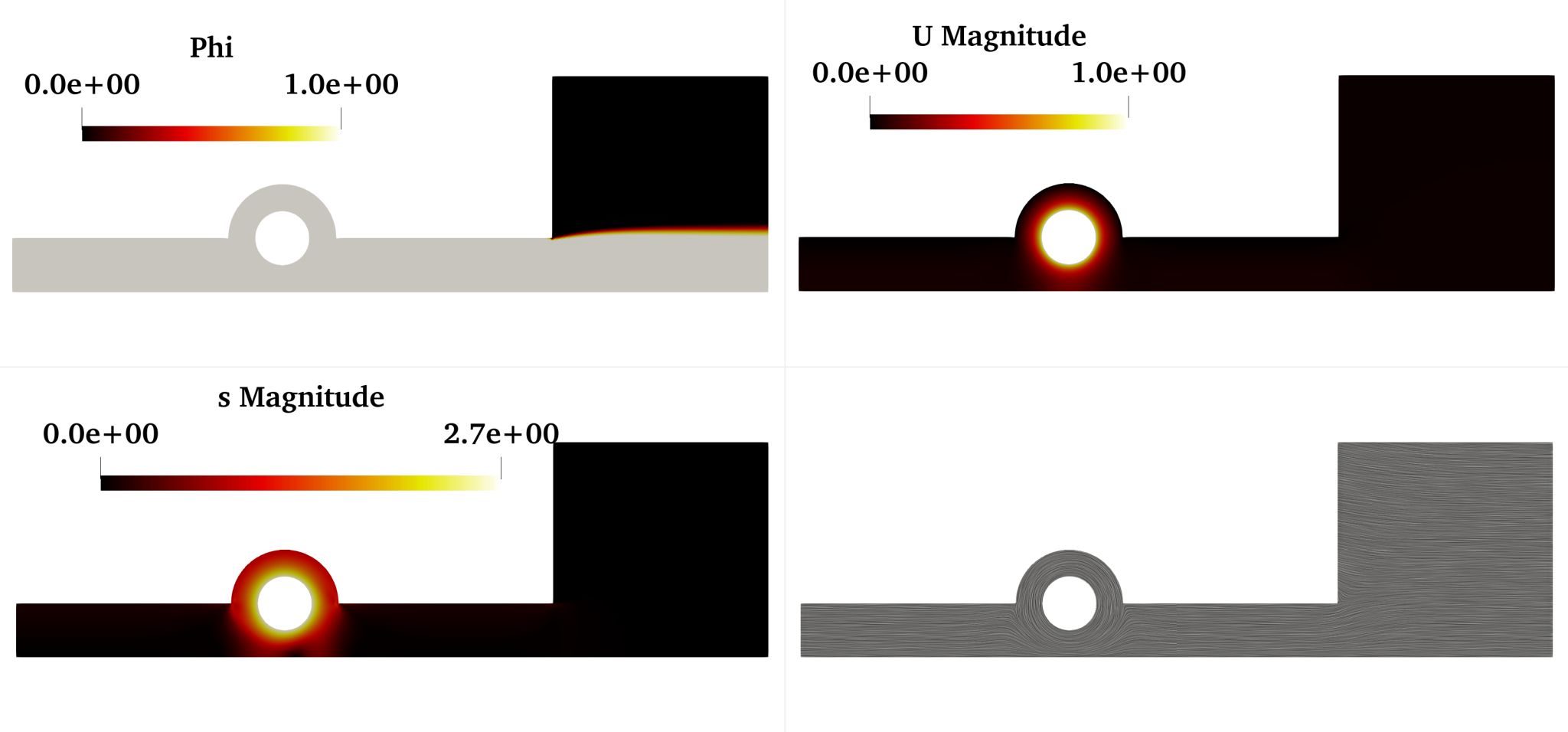
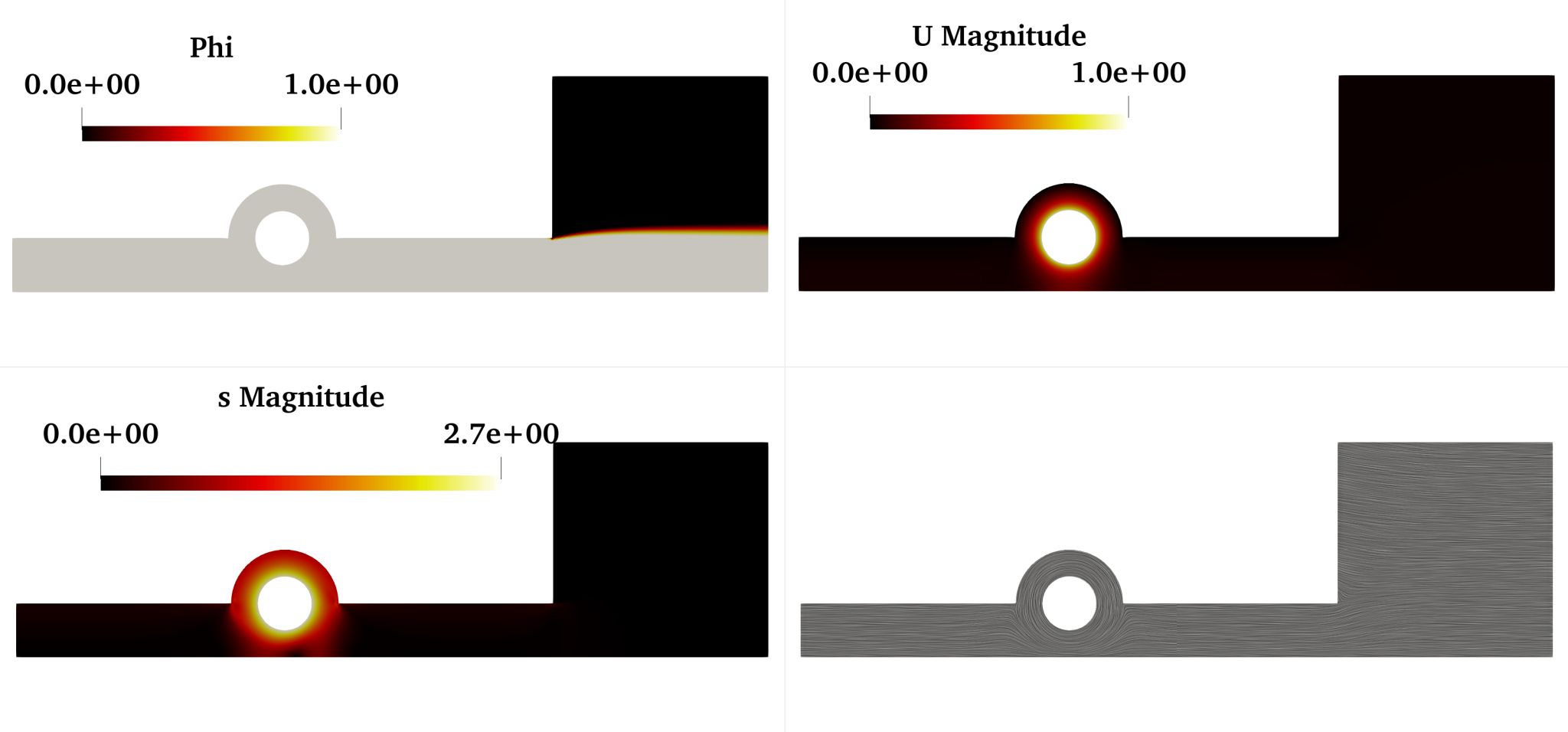
This project builds upon a previous computational fluid dynamics (CFD) simulation involving a rotating wheel immersed in a viscoelastic fluid modeled using the Giesekus constitutive equation.
In the earlier numerical configuration, the fluid moved from left to right, interacting with a rotating wheel before approaching an outlet die.
Revisiting this numerical framework offers an opportunity to investigate additional lubrication-related phenomena and evaluate how rotational motion may influence the surrounding flow.
The proposed benchmark illustrates the value of reusing numerical models and computational developments to address new scientific questions.
2. Physical and Numerical Modeling
A. Rotating Wheel in Viscoelastic Flow
The numerical configuration considers a rotating wheel interacting with a viscoelastic fluid moving through a computational domain.
The imposed rotational motion modifies the local velocity field and can generate strong shear gradients near the moving solid boundary.
These gradients influence the distribution of mechanical stresses within the surrounding fluid.
Unlike Newtonian lubricants, viscoelastic fluids exhibit both viscous and elastic responses, which may significantly affect the flow under certain operating conditions.
B. The Giesekus Constitutive Model
The Giesekus model is a nonlinear viscoelastic constitutive equation used to describe the rheological behavior of complex polymeric fluids.
It accounts for elastic memory effects and can reproduce nonlinear rheological characteristics such as shear-thinning behavior and normal stress differences, depending on the model parameters.
In a rotating-wheel configuration, these properties may influence:
- Local shear stress distributions near the wheel surface.
- Normal stresses generated by the rotating motion.
- Velocity profiles and flow redistribution.
- Pressure development within the fluid domain.
- Elastic relaxation downstream of the rotating component.
The numerical investigation therefore provides a framework for studying the relationship between rotation, fluid rheology, and lubrication behavior.
3. Main Computational Challenges
A. Moving Boundary Representation
Accurately representing the motion of a rotating wheel is a central challenge in computational lubrication studies.
The numerical formulation must account for the prescribed motion of the solid boundary while maintaining consistent fluid boundary conditions.
When a moving-geometry representation is required, the computational framework must also accurately update the position of the rotating geometry.
B. Viscoelastic Stress Evolution
Viscoelastic constitutive equations introduce additional stress variables that evolve with the flow.
The interaction between rotational motion and elastic stress relaxation can produce complex, time-dependent flow responses.
Resolving these effects requires suitable numerical methods and careful treatment of the nonlinear constitutive equations.
C. Numerical Stability and Solver Convergence
Highly elastic fluid simulations may encounter convergence difficulties, particularly when strong velocity gradients and elevated elastic stresses develop.
The Weissenberg number (We) provides a useful measure of the relative importance of elastic relaxation and characteristic flow timescales.
The numerical strategy must therefore account for the selected rheological parameters, spatial discretization, time-step selection, and convergence criteria.
Reliable convergence is important for evaluating the effects of wheel rotation under different operating conditions.
4. Benchmark Investigation: Influence of Wheel Rotation
A central research question in this bearing lubrication benchmark concerns the influence of rotational speed on the surrounding viscoelastic flow.
A. Rotational Speed and Flow Behavior
Changing the angular velocity of the wheel modifies the local shear conditions and may influence the distribution of elastic stresses.
A systematic parametric investigation could consider:
- Wheel angular velocity: Evaluating how rotational speed modifies the surrounding flow.
- Rotation direction: Comparing the interaction between rotation and the imposed fluid flow.
- Pressure distribution: Investigating possible changes in local pressure fields.
- Shear and normal stresses: Studying the influence of viscoelastic material behavior.
- Fluid relaxation times: Evaluating sensitivity to rheological parameters.
B. Interaction with the Outlet Die
The original numerical configuration also includes an outlet region that raises an additional scientific question.
Can the rotational speed of the wheel influence the deformation or swelling of the viscoelastic fluid as it exits the die?
If an appropriate free-surface model is included, the investigation could examine the relationship between upstream rotational motion, stress development, elastic relaxation, and potential extrudate swell.
Extrudate swell is associated with the recovery of elastic deformation as viscoelastic material leaves a confined flow region.
The influence of wheel rotation on this phenomenon remains a question to be examined numerically rather than an established result of this benchmark.
C. Suggested Benchmark Comparisons
A systematic comparison of numerical configurations could include:
- A reference case with a stationary wheel.
- Several prescribed wheel rotation speeds.
- Different viscoelastic relaxation parameters.
- Comparisons of velocity, pressure, and stress fields.
- Free-surface deformation and swelling ratios, where applicable.
These comparisons could help identify the most influential parameters and provide a basis for evaluating the numerical framework.
5. Engineering and Industrial Applications
Advanced modeling of bearing lubrication and viscoelastic flow is relevant to several engineering applications.
A. Rotating Machinery and Lubrication Systems
Computational lubrication studies help investigate fluid behavior around rotating mechanical components.
Understanding local stress distributions and flow patterns can support the analysis of lubrication systems operating under complex rheological conditions.
B. Polymer Processing Equipment
Viscoelastic flow simulations are relevant to industrial systems involving rotating screws, mixing equipment, and polymer-processing components.
Such studies can provide insight into the effects of mechanical motion on fluid deformation and stress development.
C. Extrusion and Die Design
The interaction between upstream flow conditions and outlet deformation is an important consideration in polymer extrusion.
Numerical investigations may contribute to a better understanding of dimensional changes, stress relaxation, and processing sensitivity.
D. Scientific Software Development
This benchmark also illustrates the importance of modular and reusable numerical simulation frameworks.
Previously developed geometry-tracking and viscoelastic solver capabilities can provide a foundation for investigating additional mechanical configurations.
Reusing validated computational components can reduce duplicated development effort, while each new application still requires appropriate verification and validation.
6. Conclusion and Research Perspectives
The bearing lubrication benchmark represents a promising extension of earlier numerical work involving rotating geometries and viscoelastic fluid dynamics.
By building upon a rotating-wheel simulation using the Giesekus model, this project provides a foundation for investigating how imposed mechanical motion influences velocity fields, nonlinear stresses, and potentially downstream flow behavior.
One particularly interesting question concerns the possible relationship between wheel rotation speed and extrudate swelling at the outlet die.
Addressing this question requires further numerical investigation, suitable free-surface modeling, and systematic comparisons between operating conditions.
The project highlights the value of computational research developed over time. Numerical methods created for one problem can become valuable tools for addressing new challenges in fluid mechanics and engineering.
TCHIKOU-R CONSULTING applies expertise in computational fluid dynamics, viscoelastic constitutive modeling, moving-boundary simulations, and scientific software development to investigate complex industrial and scientific problems.
Explore more computational simulations, fluid mechanics research, and engineering applications in our Research & Projects collection.
Acknowledgments
Special thanks to Hussein Muhammed for bringing this benchmark problem to our attention and inspiring this renewed investigation.
We also acknowledge the scientific discussion with Walisson de Jesus Souza, particularly the question of how wheel rotation might affect extrudate swelling.
Scientific progress often begins with sharing ideas, revisiting previous work, and exploring new questions together.
