

1. Introduction to Viscoelastic Flow Computation
Advanced viscoelastic flow computation plays an essential role in understanding the nonlinear behavior of complex fluids, particularly polymer solutions and melts subjected to strong deformation.
Unlike Newtonian fluids, viscoelastic materials exhibit both viscous dissipation and elastic energy storage. Their response depends on the history of deformation, the evolution of internal stresses, and characteristic material relaxation times.
This numerical research investigates an eight-mode Phan-Thien–Tanner (PTT) constitutive model applied to an 8:1 contraction configuration followed by extrudate swelling at the outlet.
The computational approach also employs the log-conformation formulation introduced by Fattal and Kupferman, providing a numerical framework for studying the evolution of viscoelastic stresses under challenging flow conditions.
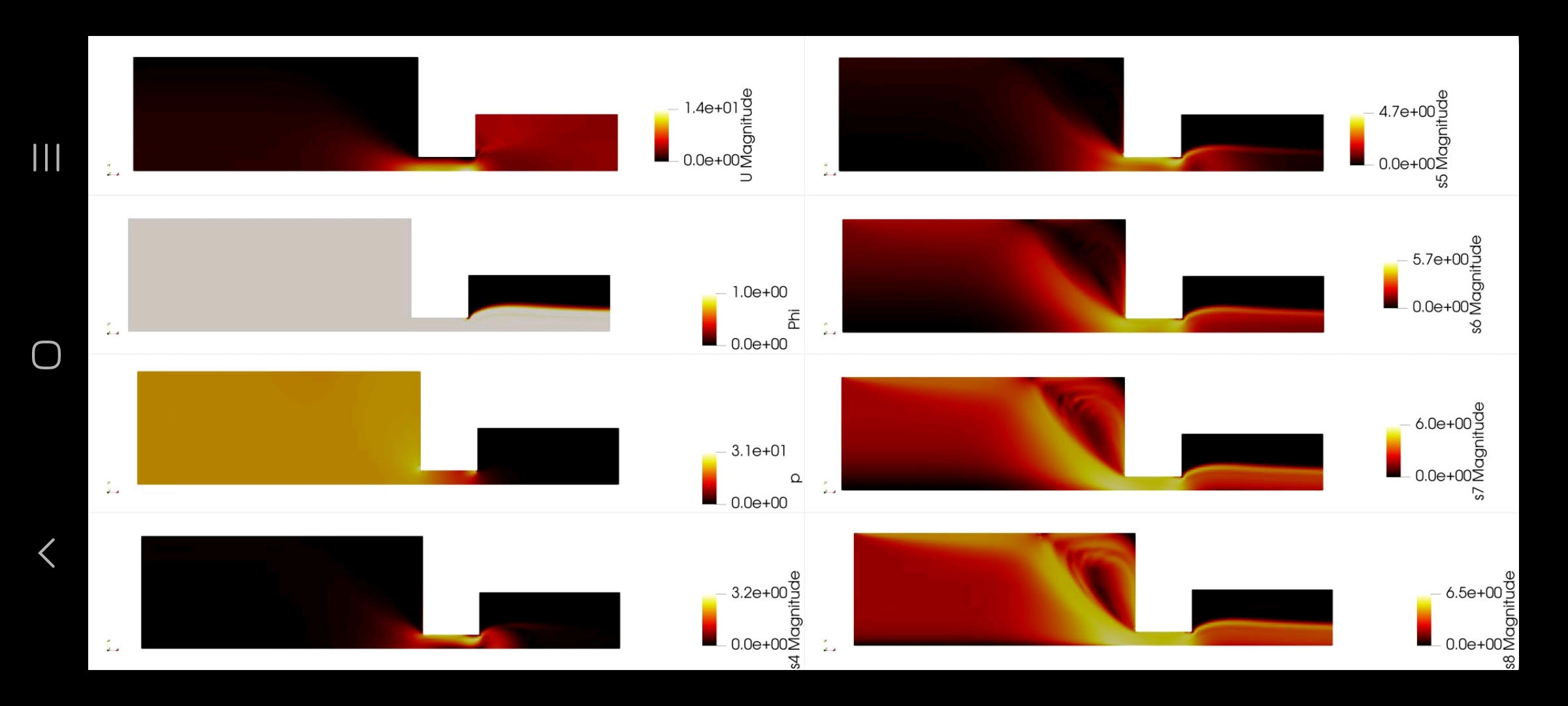
The simulation provides valuable visualizations of velocity, material interfaces, and individual relaxation-mode contributions.
These results offer insight into the interactions between geometric contraction, nonlinear fluid rheology, elastic stress accumulation, and free-surface deformation.
2. Eight-Mode PTT Constitutive Modeling
A. The Phan-Thien–Tanner Model
The Phan-Thien–Tanner (PTT) model is a constitutive framework developed to represent nonlinear viscoelastic fluid behavior.
It can describe important rheological phenomena associated with polymeric materials, including:
- Elastic stress development during deformation.
- Time-dependent stress relaxation.
- Normal stress differences.
- Shear-dependent viscosity.
- Nonlinear extensional responses, depending on the constitutive parameters.
These properties are particularly relevant to industrial flows involving strong velocity gradients, geometric restrictions, and complex deformation histories.
B. Why Use Eight Relaxation Modes?
Real polymeric materials frequently exhibit a spectrum of relaxation times rather than a single characteristic relaxation mechanism.
A multi-mode formulation represents this behavior through several constitutive contributions, each associated with its own relaxation parameters.
In this study, the fluid is modeled using eight PTT-type modes.
Each mode contributes to the total polymeric stress response, allowing the numerical framework to investigate the influence of different relaxation mechanisms on the overall flow.
This representation provides a detailed view of the internal rheological response and enables comparisons between individual modal stress fields.
Appropriate calibration of the modal parameters remains essential for predictive simulations of actual polymeric materials.
3. The 8:1 Contraction and Extrudate Swell Configuration
A. Flow Through an 8:1 Contraction
The numerical configuration considers a viscoelastic fluid flowing through a geometric contraction with an 8:1 contraction ratio.
As the fluid enters the narrower region, the imposed geometric restriction modifies the velocity field and generates significant local deformation rates.
For viscoelastic fluids, these changes can result in strong polymeric stresses near the contraction entrance and within the downstream flow.
The configuration therefore represents a challenging benchmark for computational rheology and nonlinear CFD solvers.
B. Pressure and Stress Evolution
The contraction region is associated with complex distributions of velocity, pressure, and viscoelastic stresses.
Important quantities for numerical analysis include:
- Velocity field (U): Characterizing flow acceleration and redistribution.
- Pressure field (p): Investigating pressure variations through the contraction.
- Polymeric stresses: Examining nonlinear stress accumulation and relaxation.
- Recirculation zones: Identifying vortical structures where they develop.
- Relaxation-mode contributions: Understanding how different modes influence the computed solution.
Analyzing these quantities helps explain the complex behavior of viscoelastic materials flowing through restricted geometries.
C. Extrudate Swell at the Outlet
After passing through the confined region, the viscoelastic fluid exits the die and develops a free surface.
Under suitable conditions, the material may expand beyond the original die dimensions.
This phenomenon, known as extrudate swell or die swell, is associated with elastic stress relaxation and changes in the mechanical constraints acting on the fluid.
The resulting swelling depends on material rheology, flow conditions, geometry, and the evolution of internal stresses.
Understanding this behavior is important for dimensional control in industrial polymer extrusion processes.
4. Log-Conformation Formulation of Fattal and Kupferman
A. The Numerical Challenge
One of the principal difficulties in viscoelastic flow computation is maintaining numerical stability when significant elastic effects develop.
Strong polymeric stress gradients and nonlinear constitutive coupling can lead to convergence difficulties, particularly at elevated Weissenberg numbers.
These difficulties are commonly associated with the High Weissenberg Number Problem (HWNP).
B. Logarithmic Representation
The log-conformation formulation introduced by Fattal and Kupferman reformulates suitable viscoelastic constitutive equations using the matrix logarithm of the conformation tensor.
This transformation provides an alternative representation of the evolution of the polymeric configuration.
For a symmetric positive-definite conformation tensor, the logarithmic representation can help maintain important mathematical properties during numerical integration.
It also provides a framework for improving the numerical treatment of strong elastic deformation.
However, numerical accuracy and convergence still depend on spatial resolution, temporal integration, constitutive parameters, and solver implementation.
C. Application to Multi-Mode Viscoelasticity
In the present study, the logarithmic formulation is used to investigate the evolution of the different PTT-type relaxation modes.
The approach makes it possible to examine modal contributions within a challenging contraction and free-surface flow configuration.
Studying the response of individual modes provides additional information about the distribution and development of nonlinear viscoelastic stresses.
5. Visualization and Interpretation of Numerical Results
A. Velocity Field and Fluid Interface
The computational visualizations include the velocity field U and an indicator function phi used to distinguish between the viscoelastic fluid and the surrounding air.
In the adopted representation:
- phi = 1: Viscoelastic fluid.
- phi = 0: Surrounding air.
This representation provides a practical way to visualize the fluid region and investigate the development of extrudate swelling at the outlet.
The velocity field complements this information by showing how the flow evolves through the contraction and into the downstream region.
B. Modal Stress Visualization
One of the distinctive aspects of this study is the examination of the individual stress contributions associated with the eight PTT-type modes.
The original visualizations highlight the five most significant modal responses, with particular attention to modes 7 and 8.
These two modes exhibit pronounced stress structures associated with the region where a vortex is identified in the numerical flow.
This observation is especially interesting because it illustrates how individual relaxation mechanisms may reveal localized flow structures that are less apparent in aggregate quantities.
However, identifying a vortex requires examination of the velocity field, streamlines, vorticity, or an appropriate vortex-detection criterion. Modal stresses provide complementary evidence of the underlying flow dynamics.
C. Scientific Interpretation
The visualization of individual modes offers an opportunity to investigate how different material relaxation mechanisms interact with the imposed flow geometry.
In particular, the analysis can help address questions such as:
- Which modes contribute most strongly to localized stress concentrations?
- How do relaxation times influence the development of vortical flow structures?
- How does the contraction geometry affect modal stress distributions?
- What relationship exists between upstream stress development and downstream extrudate swelling?
These questions provide a basis for further numerical analysis and rheological interpretation.
6. Computational Challenges and Engineering Applications
A. Numerical Stability and Accuracy
Combining multiple viscoelastic relaxation modes with a contraction geometry and moving fluid interface creates a demanding computational problem.
Important numerical considerations include:
- Stable integration of nonlinear constitutive equations.
- Accurate representation of individual relaxation modes.
- Spatial resolution of localized stress gradients.
- Consistent tracking of the fluid-air interface.
- Convergence assessment and numerical verification.
- Efficient management of computational resources.
These aspects are important when developing reliable CFD methods for complex polymeric fluids.
B. Polymer Extrusion and Processing
The 8:1 contraction and die swell configuration is directly relevant to polymer processing research.
Understanding viscoelastic stresses and outlet swelling can contribute to improved die design and better control of extruded product dimensions.
C. Advanced Material Characterization
Multi-mode constitutive modeling provides a framework for connecting numerical flow predictions with the relaxation behavior of polymeric materials.
With suitable experimental calibration, these approaches can support the investigation of complex rheological properties.
D. Scientific Software Development
Implementation of multi-mode constitutive equations and log-conformation methods requires expertise in applied mathematics, numerical analysis, and scientific computing.
The resulting numerical techniques are relevant to the development of advanced CFD tools capable of investigating nonlinear viscoelastic flow phenomena.
7. Conclusion and Research Perspectives
This study presents a novel perspective on viscoelastic flow computation through the analysis of eight PTT-type relaxation modes in an 8:1 contraction followed by extrudate swelling.
The combination of multi-mode constitutive modeling and the log-conformation formulation provides a framework for investigating nonlinear polymeric stresses and complex flow behavior.
Visualizing the velocity field, fluid interface, and individual modal contributions offers complementary perspectives on stress development, vortex-associated structures, and free-surface deformation.
The pronounced responses observed in modes 7 and 8 highlight the scientific value of examining individual relaxation mechanisms rather than relying solely on aggregate flow quantities.
These investigations contribute to research in computational fluid dynamics, nonlinear rheology, polymer processing, and numerical simulation.
TCHIKOU-R CONSULTING applies expertise in computational physics, advanced constitutive modeling, numerical methods, and scientific software development to the investigation of complex engineering problems.
Discover additional numerical simulations, computational research, and engineering applications in our Research & Projects collection.
Scientific Reference
Fattal, R. and Kupferman, R. (2004). Constitutive laws for the matrix-logarithm of the conformation tensor. Journal of Non-Newtonian Fluid Mechanics, 123(2–3), 281–285.
