

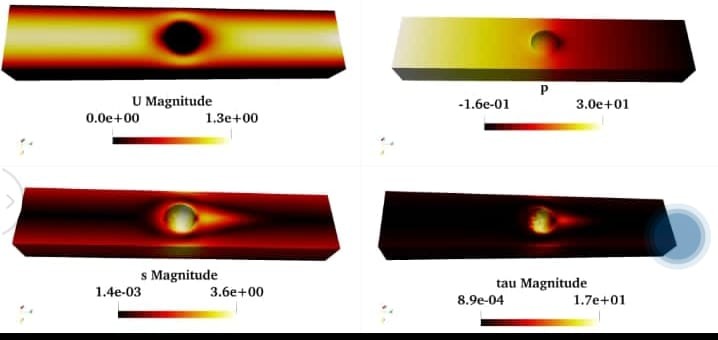
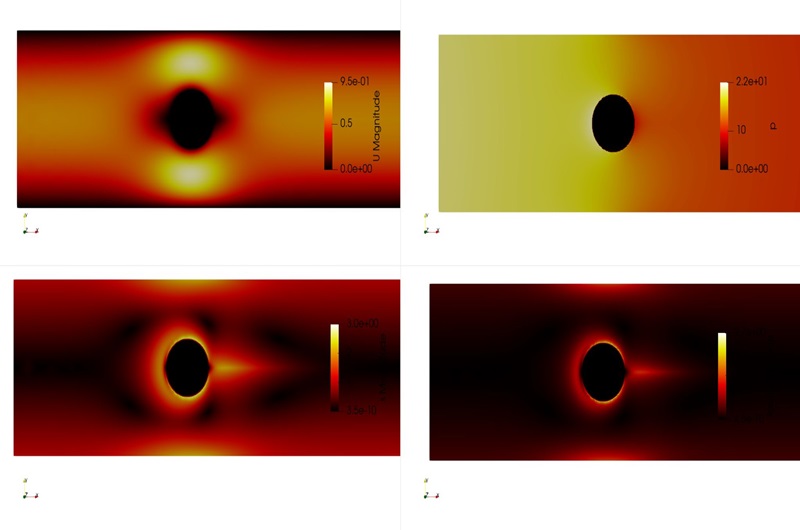
1. Introduction to Polymer Flow Calculations
Polymer flow calculations play an essential role in computational materials science and engineering, particularly in understanding the complex behavior of polymeric materials during processing and deformation.
Unlike conventional Newtonian fluids, many polymer melts and solutions exhibit viscoelastic properties, combining viscous dissipation with elastic energy storage.
Their mechanical response depends on deformation history, material relaxation times, and nonlinear constitutive behavior.
Accurately representing these phenomena requires advanced mathematical models and robust numerical methods capable of solving coupled fluid mechanics and constitutive equations.
These computational challenges are particularly important in polymer processing, extrusion, injection molding, and other industrial applications involving complex fluid motion.
From 2019 to 2023, Dr. Serge Bertrand Ndanou conducted research on polymer flow calculations at the GIREF Laboratory, Université Laval, Quebec, Canada.
During this period, he worked under the mentorship of Professor André Fortin, whose research has contributed significantly to numerical methods for viscoelastic fluid mechanics.
This research experience strengthened his expertise in numerical modeling, finite element methods, computational rheology, and scientific software development.
2. Research Experience at GIREF Laboratory
A. The GIREF Research Environment
The Groupe Interdisciplinaire de Recherche en Éléments Finis (GIREF) at Université Laval conducts research in applied mathematics, numerical modeling, finite element methods, and computational simulation.
Its research activities include numerical methods for complex physical problems, nonlinear materials, multiphysics modeling, and scientific computing.
This environment provides opportunities to investigate challenging problems requiring both mathematical understanding and practical computational implementation.
During his research experience at GIREF, Serge developed and applied expertise relevant to numerical simulations of complex polymeric fluids.
B. Research Mentorship and Numerical Methods
Professor André Fortin has contributed to the development and analysis of numerical techniques for nonlinear fluid mechanics and viscoelastic flows.
His research, including contributions to discrete elastic-viscous stress splitting methods, has influenced the numerical treatment of polymer flow problems.
Working under his mentorship provided Serge with valuable experience in advanced numerical modeling and the analysis of computational methods for complex fluids.
The research period also contributed to the development of skills in scientific programming, mathematical modeling, and the interpretation of numerical results.
C. Bridging Theory and Computational Practice
Accurate polymer flow simulation requires more than selecting a constitutive equation.
It involves understanding the mathematical structure of the governing equations, selecting suitable numerical discretization strategies, and evaluating the reliability of computed solutions.
This combination of mathematical theory and practical numerical implementation is central to computational rheology.
It also provides a foundation for investigating more complex material behavior and industrial flow configurations.
3. The DEVSS Finite Element Method
A. Discrete Elastic-Viscous Stress Splitting
The DEVSS method (Discrete Elastic-Viscous Stress Splitting) is a numerical formulation developed for the finite element solution of viscoelastic flow problems.
The method is associated with research by Robert Guénette and André Fortin and subsequent developments in computational rheology.
DEVSS introduces a discrete treatment of viscous and elastic stress contributions within the governing fluid mechanics equations.
This approach provides additional flexibility in the construction of stable finite element formulations for selected viscoelastic flow models.
It has become an important reference in the numerical study of complex polymeric fluids.
B. Numerical Challenges in Viscoelastic Flow
Viscoelastic flow simulations involve coupling the conservation equations of fluid mechanics with constitutive equations describing the evolution of polymeric stresses.
The resulting nonlinear system can become difficult to solve, particularly when elastic effects become significant.
Important numerical considerations include:
- Consistent pressure-velocity coupling.
- Accurate representation of viscoelastic stresses.
- Selection of suitable finite element approximation spaces.
- Stability of nonlinear numerical iterations.
- Spatial resolution of localized deformation and stress gradients.
- Verification of numerical convergence.
Approaches such as DEVSS contribute to the development of numerical formulations designed to address selected aspects of these challenges.
Nevertheless, no numerical formulation guarantees convergence or accuracy for every viscoelastic flow configuration.
C. Application to Polymer Flow Calculations
During his GIREF research experience, Serge worked on polymer flow calculations involving advanced numerical techniques, including the DEVSS framework.
This work provided practical experience in the mathematical and computational treatment of nonlinear viscoelastic fluid behavior.
Understanding the properties and limitations of such methods is important when developing numerical solutions for complex polymer-processing problems.
4. Numerical Modeling and Scientific Computing
A. Constitutive Modeling of Polymeric Materials
Predictive polymer flow calculations require constitutive models capable of representing relevant aspects of material behavior.
Depending on the material and application, these models may account for shear-dependent viscosity, elastic stress development, normal stress differences, and relaxation effects.
Common viscoelastic constitutive frameworks include Oldroyd-B, Giesekus, and Phan-Thien–Tanner models.
The selection of a model depends on the material properties and the physical phenomena under investigation.
Appropriate parameter calibration and numerical verification remain essential for reliable predictions.
B. Finite Element Modeling
The finite element method (FEM) provides a mathematical framework for approximating the solution of governing equations over a discretized computational domain.
It is widely used in computational mechanics and can be applied to complex fluid geometries and nonlinear material behavior.
Accurate simulation requires careful consideration of the numerical approximation, mesh quality, boundary conditions, and convergence properties.
Research into finite element formulations contributes to the development of reliable computational tools for complex engineering applications.
C. Scientific Software Development
Advanced computational research frequently requires the development, adaptation, and evaluation of specialized numerical software.
Such work combines applied mathematics, algorithm design, programming, and scientific visualization.
During his GIREF experience, Serge contributed to computational modeling activities and the development or improvement of tools used to analyze polymer flow behavior.
This experience supports his broader expertise in scientific computing and the development of numerical methods for complex physical problems.
D. Numerical Verification and Model Assessment
Reliable polymer flow calculations require systematic assessment of the computational solution.
Relevant activities may include mesh-convergence studies, sensitivity analysis, solver convergence checks, and comparison with experimental or reference data.
Serge’s description of his GIREF experience includes work related to numerical modeling, validation, optimization, and collaborative scientific research.
Specific quantitative improvements or validation results should be documented separately when supporting data are available.
5. Importance of Polymer Flow Calculations in Engineering
A. Polymer Processing and Manufacturing
Polymeric materials are used in a wide variety of industrial manufacturing processes.
Their flow behavior influences pressure requirements, material distribution, deformation, and product geometry.
Numerical simulation can help engineers investigate the effects of operating conditions and material properties before conducting extensive physical testing.
B. Product Performance
The deformation history experienced during processing can influence the properties of a polymeric product.
Computational rheology provides tools for investigating the relationship between processing conditions and material behavior.
Such analyses may support a better understanding of manufacturing sensitivity and material response.
C. Material Development
New polymer formulations, blends, and composites may exhibit complex rheological behavior.
Advanced numerical models can support investigations of these materials under different deformation conditions.
Predictive application requires material characterization and appropriate experimental validation.
D. Industrial Research and Development
Computational methods for polymer flow are relevant to engineering teams working on extrusion, injection molding, coatings, and other material-processing technologies.
They can support feasibility studies, numerical investigations, and the development of specialized computational tools.
The practical value of numerical modeling depends on the reliability of the underlying physical assumptions and computed solutions.
6. Conclusion: From GIREF Research to Computational Engineering
The research experience of Dr. Serge Bertrand Ndanou at GIREF Laboratory between 2019 and 2023 represents an important stage in his scientific development.
Working under the mentorship of Professor André Fortin strengthened his understanding of polymer flow calculations, finite element methods, nonlinear viscoelastic modeling, and numerical simulation.
Experience with the DEVSS method provided valuable insight into the numerical challenges associated with solving the governing equations of complex polymeric fluids.
The research also contributed to the development of expertise in scientific software, computational analysis, and the interpretation of numerical results.
These skills are relevant to research laboratories and industrial engineering organizations working with complex materials and advanced computational problems.
Today, TCHIKOU-R CONSULTING brings together expertise in computational physics, numerical methods, nonlinear material modeling, and scientific software development to support research and engineering activities.
Discover further examples of numerical simulations, computational research, and complex fluid modeling in our Research & Projects collection.
Scientific References and Further Reading
GIREF Laboratory, Université Laval: Research activities and numerical modeling.
Fortin, A., Guénette, R. and Pierre, R. (2000). On the discrete EVSS method. Computer Methods in Applied Mechanics and Engineering, 189(1), 121–139.
