

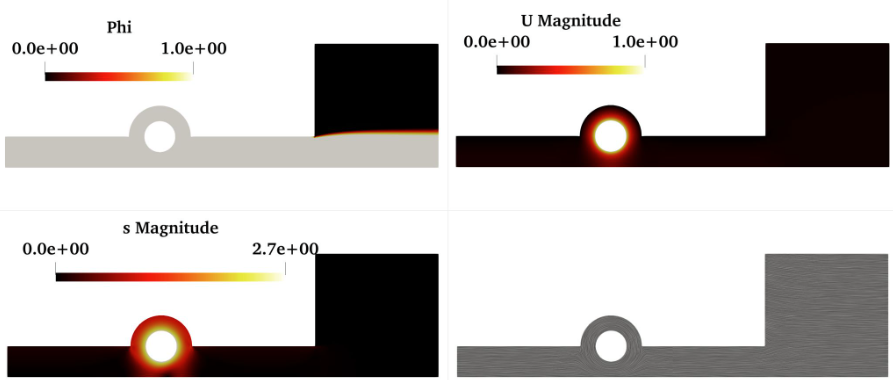
1. Introduction to Bearing Lubrication
The bearing lubrication benchmark represents an important numerical test for investigating hydrodynamic lubrication, nonlinear fluid behavior, and the interaction between rotating mechanical components.
Journal bearings are widely used in rotating machinery to support shafts and reduce direct mechanical contact between moving surfaces.
In hydrodynamic lubrication, the relative motion of the bearing surfaces generates a pressure distribution within a thin lubricant film. Under suitable operating conditions, this pressure supports the applied mechanical load.
Predicting the behavior of the lubricating film is essential for understanding pressure development, shear stresses, frictional effects, and the mechanical performance of rotating systems.
This numerical project investigates a bearing lubrication configuration using the Giesekus viscoelastic constitutive model.
The benchmark focuses on the challenges associated with thin fluid films, moving boundaries, nonlinear stress distributions, and numerical solver convergence.
These investigations are relevant to computational fluid dynamics (CFD), tribology, computational rheology, and mechanical engineering.
2. Hydrodynamic Journal Bearing Configuration
A. Physical Principles of Journal Bearings
A journal bearing typically consists of a rotating shaft surrounded by a stationary bearing housing.
A thin lubricant film separates the two solid surfaces.
When the shaft rotates, viscous effects transport lubricant through the clearance region, creating a hydrodynamic pressure distribution under suitable geometric and operating conditions.
The resulting pressure field influences the bearing load-carrying capacity and the forces acting on the rotating shaft.
B. Influence of Bearing Eccentricity
In practical journal bearings, the shaft center may be displaced relative to the center of the bearing housing.
This displacement creates a nonuniform lubricant-film thickness around the shaft.
The eccentricity ratio is an important geometric parameter describing the relative displacement between the shaft and the bearing housing.
As the eccentricity changes, the minimum film thickness, pressure distribution, and local velocity gradients may also change.
These effects are particularly important when investigating lubrication performance under reduced-clearance conditions.
C. Lubricant Film Behavior
The thin lubricant film experiences significant velocity gradients because of the relative motion of the bearing surfaces.
For viscoelastic lubricants, the resulting flow may involve additional elastic stresses and nonlinear rheological behavior.
The numerical challenge is to resolve these coupled physical effects while maintaining sufficient spatial resolution within the narrow clearance region.
3. Giesekus Viscoelastic Constitutive Model
A. Why Consider Viscoelastic Lubrication?
Many conventional lubrication models describe the lubricant as a Newtonian fluid with viscosity independent of the local shear rate.
However, selected polymer-containing lubricants and complex fluids may exhibit non-Newtonian behavior, including shear-dependent viscosity and elastic effects.
These properties can influence the stress distribution and hydrodynamic response of the lubricating film.
Accurate prediction of such behavior requires appropriate constitutive modeling.
B. The Giesekus Model
The Giesekus model is a nonlinear viscoelastic constitutive equation used to represent complex rheological responses in polymeric fluids.
Depending on the selected parameters, it can capture several important phenomena:
- Shear-thinning: Reduction of apparent viscosity with increasing shear rate.
- Elastic memory: Dependence of material response on its deformation history.
- Normal stress differences: Additional stresses arising in viscoelastic flow.
- Stress relaxation: Time-dependent evolution of stored elastic stresses.
- Nonlinear constitutive behavior: Coupling between deformation and polymeric stress evolution.
These characteristics make the model relevant to numerical studies of selected non-Newtonian lubrication systems.
C. Coupling with Fluid Dynamics
Computational modeling of viscoelastic lubrication involves coupling fluid conservation equations with the constitutive relationship describing the lubricant.
The velocity field, pressure distribution, and viscoelastic stresses influence one another through this coupled formulation.
Resolving the nonlinear interaction between these quantities is essential for evaluating the numerical behavior of the lubricant film.
4. Main Computational Challenges
A. High-Shear Flow and Stress Concentrations
Journal bearing lubrication involves strong velocity gradients within narrow fluid-film regions.
These gradients may generate substantial shear stresses, particularly close to moving solid boundaries.
When a viscoelastic constitutive law is used, elastic stresses introduce additional nonlinearities into the numerical problem.
Maintaining solver stability under these conditions requires careful numerical treatment.
B. Eccentricity and Thin-Film Resolution
Nonuniform film thickness introduces significant spatial variations in the hydrodynamic pressure and local deformation rates.
Numerical meshes must provide adequate resolution in the smallest clearance regions.
Insufficient spatial resolution can lead to inaccurate pressure gradients and stress predictions.
The appropriate balance between mesh density, numerical accuracy, and computational cost is therefore an important consideration.
C. Numerical Solver Convergence
Reliable solution of nonlinear viscoelastic flow equations can be computationally demanding.
Solver convergence depends on factors such as:
- Constitutive parameters and material relaxation times.
- Rotational velocity and imposed boundary conditions.
- Spatial discretization and mesh quality.
- Numerical treatment of nonlinear stresses.
- Time-step selection for transient calculations.
- Solver tolerances and convergence strategy.
The objective of the benchmark is to evaluate numerical robustness and identify suitable computational strategies for challenging lubrication configurations.
D. Elasticity and the Weissenberg Number
The Weissenberg number (Wi) is a dimensionless parameter used to characterize the relative importance of fluid relaxation time and a characteristic deformation timescale.
When elastic effects become significant, numerical simulations may become more challenging because of strong constitutive coupling and localized stress gradients.
Evaluating solver behavior across different elasticity parameters provides valuable information about numerical stability and computational limitations.
5. Benchmark Evaluation and Numerical Validation
A reliable bearing lubrication benchmark should be evaluated using measurable physical quantities and systematic numerical verification.
A. Pressure Distribution
The hydrodynamic pressure field is one of the principal quantities used to characterize bearing lubrication.
Its spatial distribution reflects the combined influence of bearing geometry, operating conditions, and lubricant properties.
Numerical predictions can be compared across different eccentricity ratios, rotational speeds, and constitutive parameters.
B. Load-Carrying Capacity
The pressure generated in the lubricant film contributes to the force supporting the rotating shaft.
Integrating the appropriate pressure and stress contributions over the bearing surface provides information about the resulting hydrodynamic forces.
Such calculations are relevant when investigating the influence of fluid elasticity on bearing load capacity.
C. Shear Stress and Frictional Effects
Shear stresses generated within the lubricant film contribute to the mechanical forces acting on the moving surfaces.
Analyzing these stresses can help investigate friction-related effects and the influence of nonlinear fluid rheology.
Predicting actual wear or component lifetime would require additional tribological models and appropriate experimental validation.
D. Numerical Verification
Important verification procedures include:
- Mesh convergence: Evaluating the influence of spatial resolution.
- Solver convergence: Monitoring residuals and consistency of computed fields.
- Parameter sensitivity: Investigating variations in eccentricity, rotational speed, and rheological properties.
- Reference comparison: Comparing predictions with suitable published benchmark solutions.
- Physical consistency: Checking pressure, velocity, and stress distributions against expected lubrication behavior.
These procedures are essential for establishing confidence in numerical simulations before using them for engineering design.
6. Industrial Engineering Applications
Computational investigations of bearing lubrication can support research and engineering across several industrial sectors.
A. Turbines and Power Generation
Hydrodynamic bearings are important components in various rotating machines used for energy production.
Numerical lubrication studies can help engineers investigate bearing operating conditions, mechanical loads, and lubricant-film behavior.
B. Industrial Pumps and Compressors
Pumps and compressors frequently incorporate rotating shafts supported by bearings.
Understanding hydrodynamic lubrication can contribute to studies of mechanical reliability, operating efficiency, and lubricant performance.
C. Automotive and Mechanical Systems
Journal bearings are also used in engines and other mechanical systems requiring controlled relative motion between components.
Numerical simulation can support investigations of film thickness, pressure distribution, and lubrication behavior under varying operating conditions.
D. Advanced Lubricant Development
The Giesekus constitutive framework offers a useful approach for researching lubricants with nonlinear viscoelastic properties.
With appropriate material characterization and validation, numerical models can contribute to understanding the effects of lubricant rheology on bearing performance.
E. Scientific Software Development
Complex lubrication problems provide valuable benchmark cases for evaluating CFD solvers and numerical methods.
They can support the development and assessment of computational tools involving nonlinear constitutive models, moving boundaries, and strong stress gradients.
7. Conclusion and Research Perspectives
The bearing lubrication benchmark provides a valuable numerical framework for studying hydrodynamic lubrication under challenging geometric and rheological conditions.
By combining journal bearing modeling with the Giesekus constitutive equation, the study investigates computational challenges associated with narrow fluid films, rotating boundaries, nonlinear stresses, and solver convergence.
Pressure distribution, shear stresses, eccentricity effects, and load-carrying capacity represent important quantities for evaluating such numerical models.
The benchmark also illustrates the importance of systematic verification when developing CFD methods for nonlinear viscoelastic fluids.
Further investigations may include different rotational speeds, eccentricity ratios, material relaxation times, and comparative studies with suitable benchmark solutions.
TCHIKOU-R CONSULTING applies expertise in computational fluid dynamics, computational mechanics, rheology, and scientific software development to the investigation of complex engineering problems.
Discover more numerical simulations, scientific investigations, and engineering applications in our Research & Projects collection.
Scientific Reference
Abbaspur et al. (2023). An analytical study on nonlinear viscoelastic lubrication in journal bearings. Scientific Reports, 13, Article 16836.
This publication provides additional scientific background on nonlinear viscoelastic journal-bearing lubrication using the Giesekus constitutive model.
