

1. Introduction and Project Overview
The Reference Map Technique (RMT) provides an advanced numerical framework for modeling large solid deformations and fluid-structure interactions within complex hydrodynamic environments.
This research project investigates the integration of the Reference Map Technique with a generalized Mooney-Rivlin hyperelastic constitutive model to study the mechanical response of deformable solids interacting with surrounding fluid phases.
Modeling these interactions represents a significant challenge in computational fluid dynamics (CFD) and computational solid mechanics, particularly when strong nonlinearities, moving material interfaces, and large deformations occur simultaneously.
The numerical framework focuses on three fundamental objectives:
- Representing large solid deformations within an Eulerian computational framework.
- Preserving the accuracy of material interfaces during numerical transport.
- Improving the robustness of nonlinear fluid-solid coupling calculations.
These capabilities are relevant to advanced simulation problems involving soft materials, hyperelastic structures, and multiphase hydrodynamic flows.
2. Reference Map Technique and Hyperelastic Modeling
A. The Reference Map Technique
The Reference Map Technique (RMT) introduces a numerical representation that tracks the reference configuration of material points within an Eulerian description.
Unlike conventional approaches based exclusively on tracking a deforming computational mesh, RMT allows solid deformation to be reconstructed using a reference mapping field.
The deformation gradient can then be obtained from the spatial derivatives of this reference map, enabling the calculation of constitutive stresses associated with large material deformations.
This formulation offers a useful framework for coupling deformable solids with surrounding fluids on a fixed computational grid.
B. Generalized Mooney-Rivlin Hyperelastic Model
The project combines the reference mapping approach with a generalized Mooney-Rivlin hyperelastic constitutive model.
Mooney-Rivlin formulations are widely used to represent the nonlinear elastic behavior of rubber-like materials and other deformable solids.
By relating the material strain-energy function to deformation measures, these models support the calculation of stresses under finite deformation.
Combining RMT with hyperelastic constitutive laws provides a numerical approach for investigating strongly deformable solids interacting with fluid phases.
3. Main Computational Challenges
Several numerical challenges arise when integrating hyperelastic solid models into multiphase hydrodynamic solvers.
A. Sharp Interface Preservation
Accurate representation of material interfaces is essential when different phases exhibit strongly contrasting mechanical properties.
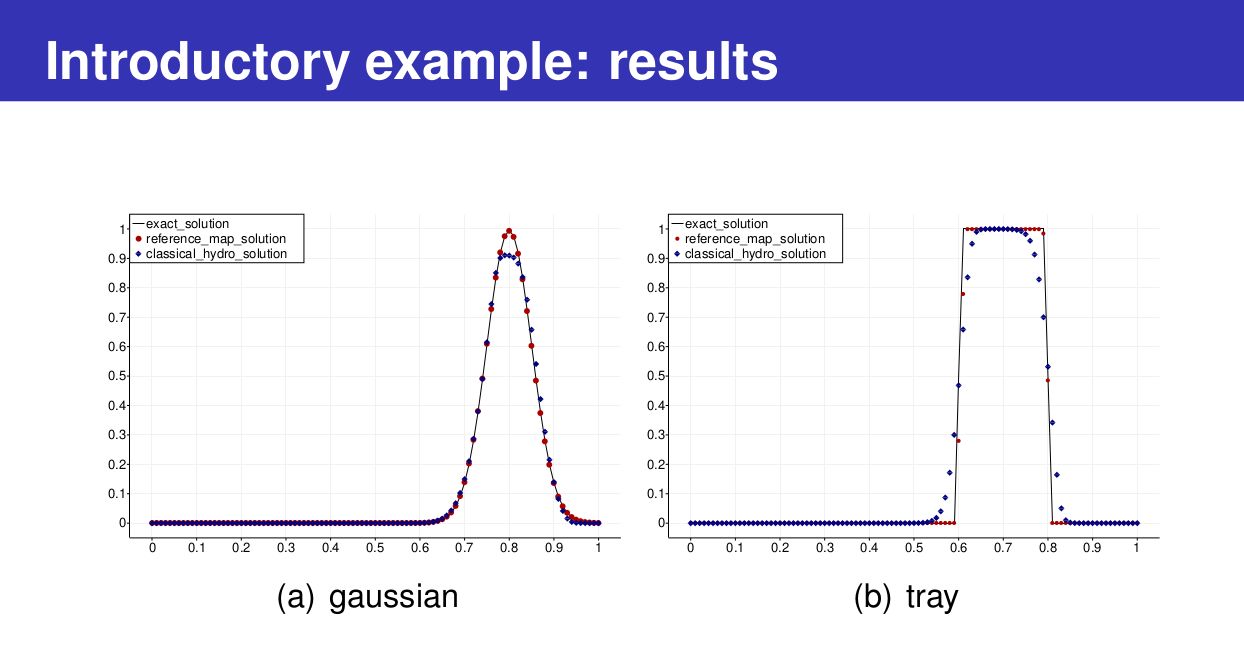
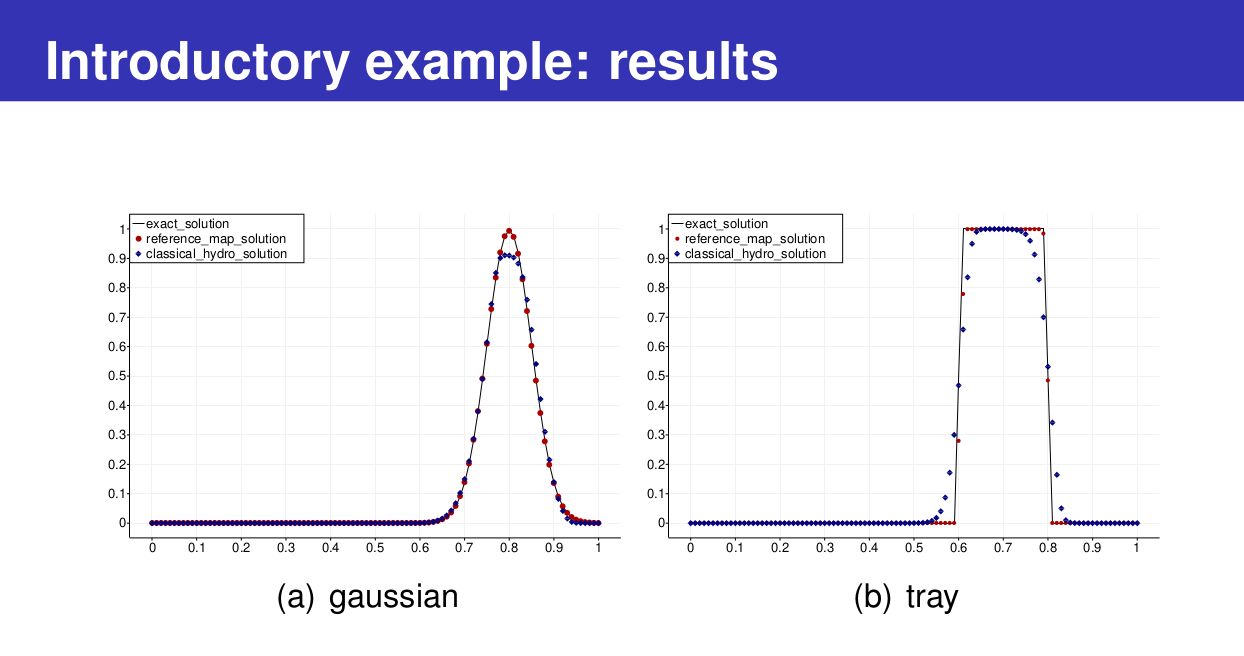
Numerical advection can introduce artificial diffusion, potentially smoothing sharp transitions between fluids and solids.
The challenge is to limit interface smearing and suppress non-physical numerical oscillations while maintaining stability.
The quality of these results depends on the interface representation, transport schemes, spatial resolution, and coupling strategy.
B. Nonlinear Hyperelastic Coupling
Coupling hydrodynamic equations with nonlinear hyperelastic constitutive laws introduces additional complexity into the numerical solver.
Large material deformations can generate strongly varying stress fields, requiring careful treatment of the interactions between fluid motion and solid response.
Achieving robust convergence and maintaining numerical stability are therefore essential objectives of the computational development.
C. Wave Propagation and Transient Dynamics
Transient multiphase simulations may involve propagating stress waves and rapidly evolving material interfaces.
Accurately resolving these phenomena requires numerical schemes that control excessive dissipation and artificial oscillations.
Temporal integration, spatial discretization, and conservation properties play important roles in determining the accuracy of the computed solution.
4. Engineering and Biomedical Applications
The numerical methods investigated in this project have potential applications across several scientific and industrial domains.
A. Biomedical Engineering
Fluid-structure interaction models can contribute to the study of deformable biological tissues interacting with surrounding fluids.
Potential research applications include:
- Modeling cardiovascular tissue deformation.
- Investigating heart wall mechanics and fluid-solid coupling.
- Studying the mechanical response of soft biological materials.
- Developing computational approaches for biomedical fluid-structure interaction problems.
B. Industrial Engineering
Hyperelastic materials are commonly encountered in mechanical systems requiring flexibility, resilience, and large deformation capacity.
Potential applications include:
- Rubber seals and industrial sealing systems.
- Shock absorbers and flexible mechanical components.
- Deformable structures exposed to transient mechanical loading.
- Soft material behavior in complex fluid environments.
C. Aerospace and Defense Engineering
Advanced numerical modeling of deformable materials is also relevant to aerospace and defense research.
Potential applications include analyzing flexible components, studying transient structural responses, and investigating fluid-structure interactions under demanding operating conditions.
Such simulations can support research into structural performance, material behavior, and numerical model development.
5. Numerical Validation and Modeling Considerations
Reliable computational predictions require systematic numerical verification and validation.
For a framework combining the Reference Map Technique, hyperelastic constitutive laws, and multiphase flow equations, important evaluation criteria include:
- Interface accuracy: Assessing the representation of moving material boundaries.
- Mesh convergence: Evaluating the influence of spatial resolution on computed results.
- Temporal accuracy: Examining the sensitivity of the solution to time-step selection.
- Conservation properties: Monitoring the consistency of mass and momentum calculations.
- Nonlinear stability: Assessing solver robustness under large deformations and strong material-property contrasts.
- Benchmark comparison: Comparing numerical predictions with suitable analytical, experimental, or published reference solutions.
These criteria provide a foundation for assessing the reliability and applicability of advanced fluid-structure interaction solvers.
For additional scientific background, see the foundational publication by Kamrin, Rycroft, and Nave (2012): Reference map technique for finite-strain elasticity and fluid-solid interaction.
6. Conclusion
The Reference Map Technique for multiphase hydrodynamic flows offers a valuable computational approach for investigating complex interactions between fluids and highly deformable solids.
By integrating a reference mapping formulation with a generalized Mooney-Rivlin hyperelastic model, this project addresses important numerical challenges associated with large deformation, material-interface representation, and nonlinear fluid-structure coupling.
The methods explored are relevant to scientific research and engineering applications involving soft materials, industrial elastomers, biomedical mechanics, and advanced structural simulations.
TCHIKOU-R CONSULTING brings expertise in computational mechanics, fluid dynamics, numerical methods, and scientific software development to the investigation of challenging multiphysics problems.
Discover additional computational research, advanced numerical simulations, and engineering projects in our Research & Projects collection.
