

1. Introduction
Modeling a rotating wheel in viscoelastic flow represents a significant challenge in computational fluid dynamics (CFD), particularly when the geometry moves within a complex, non-Newtonian fluid.
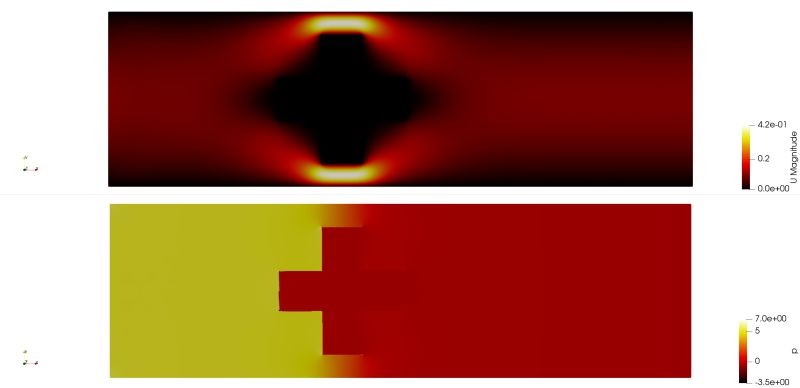
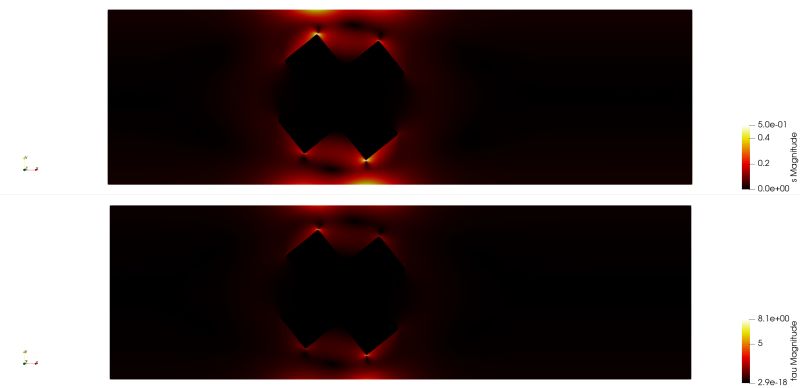
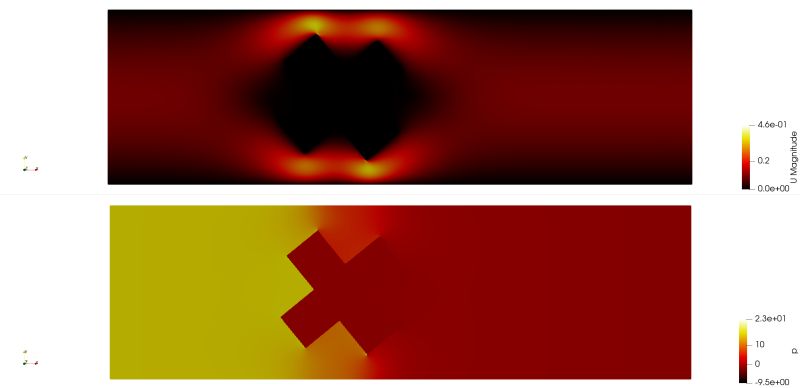
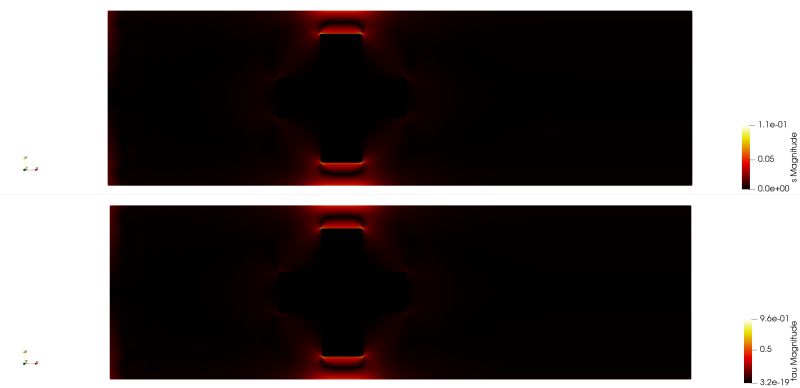
This numerical simulation investigates the motion of a rotating wheel equipped with a rectangular blade, using the Giesekus constitutive model to describe the viscoelastic behavior of the surrounding fluid.
The objective is to accurately represent prescribed geometric motion while maintaining the stability and convergence of the numerical solver.
This work demonstrates advanced capabilities in moving-boundary modeling, numerical methods, and computational rheology.
2. Numerical Modeling of Viscoelastic Flow
Viscoelastic fluids exhibit both viscous and elastic responses. Unlike Newtonian fluids, their behavior depends on the history of deformation and the evolution of internal stresses.
The Giesekus model provides a constitutive framework for describing nonlinear viscoelastic effects, including stress relaxation and shear-dependent rheological behavior.
In this simulation, the wheel follows a prescribed rotational motion while interacting with the surrounding viscoelastic fluid.
The numerical implementation must account for the evolving geometry, changing flow conditions, and nonlinear coupling between fluid motion and elastic stresses.
3. Main Computational Challenges
Two major computational challenges are central to this project.
A. Dynamic Geometry Tracking
Accurately tracking the rotating geometry throughout the simulation requires continuously updating the positions of vertices and edges.
Maintaining a consistent representation of the moving boundaries is one of the most demanding aspects of the numerical development.
This challenge becomes particularly important when dealing with complex geometries and time-dependent motion.
B. Numerical Solver Convergence
The second challenge involves achieving reliable convergence at each simulation time step.
Viscoelastic flow simulations can become computationally demanding, especially when elastic effects are significant.
The Weissenberg number (We) characterizes the relative importance of elastic relaxation and flow deformation timescales.
In this study, the effective Weissenberg number evolves dynamically rather than remaining constant throughout the simulated motion.
Maintaining numerical stability under these conditions requires careful implementation and efficient numerical solution strategies.
4. Extension Toward Three-Dimensional Simulation
An important next step is extending the numerical framework from two-dimensional to three-dimensional geometries.
This development introduces additional challenges, particularly in tracking the prescribed motion of vertices, edges, and surfaces in three-dimensional space.
The extension also increases the computational complexity associated with geometric representation and nonlinear viscoelastic calculations.
The ongoing development aims to support increasingly complex moving geometries in advanced CFD simulations.
5. Scientific and Industrial Applications
The numerical methods explored in this project are relevant to several research and engineering fields:
- Polymer processing: Investigating the behavior of complex fluids around moving mechanical components.
- Mixing and agitation systems: Studying flow patterns generated by rotating equipment.
- Computational rheology: Improving numerical approaches for nonlinear viscoelastic constitutive models.
- Industrial CFD: Supporting the simulation of moving geometries in non-Newtonian flows.
- Scientific software development: Developing robust numerical approaches for challenging multiphysics problems.
These applications illustrate the potential value of advanced numerical modeling in scientific research and industrial engineering.
6. Conclusion
The simulation of a rotating wheel in viscoelastic flow highlights the challenges associated with moving boundaries, nonlinear material behavior, and numerical solver convergence.
By combining dynamic geometry tracking with the Giesekus constitutive model, this research contributes to the development of computational methods for complex viscoelastic flow problems.
The ongoing extension toward three-dimensional simulations represents a further step in addressing increasingly realistic engineering configurations.
TCHIKOU-R CONSULTING applies expertise in computational fluid dynamics, computational mechanics, and numerical simulation to investigate complex scientific and engineering challenges.
Explore more numerical simulations, scientific investigations, and engineering applications in our Research & Projects collection.
