

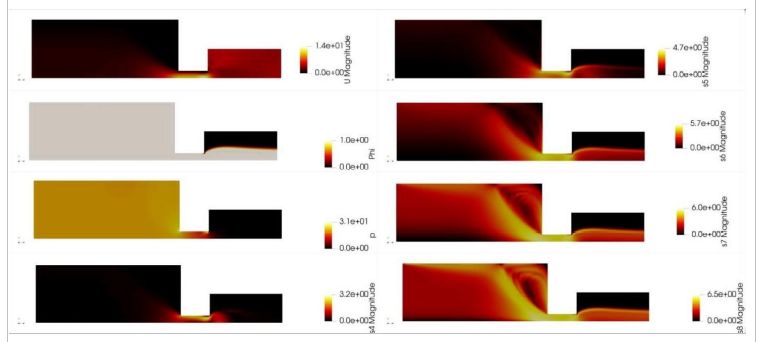
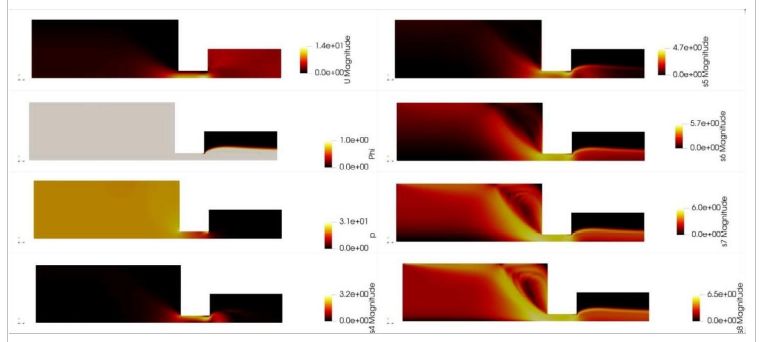
1. Introduction to the Multi-Mode PTT Model
The multi-mode PTT model provides an advanced constitutive framework for investigating the behavior of viscoelastic fluids under complex flow conditions.
Developed from the Phan-Thien–Tanner constitutive theory, this approach is particularly relevant to polymer melts and solutions exhibiting nonlinear rheological responses.
Unlike Newtonian fluids, viscoelastic materials display both viscous dissipation and elastic energy storage. Their response depends not only on the current deformation rate but also on the material’s deformation history.
The multi-mode formulation represents the fluid response through several relaxation mechanisms, making it suitable for investigating materials with a broad spectrum of relaxation times.
This scientific project examines two important flow configurations:
- Contraction flow: Investigating velocity gradients, elastic stresses, and flow structures in narrowing channels.
- Extrudate swell: Studying elastic recovery and dimensional changes as a viscoelastic material exits a confined extrusion die.
These configurations provide valuable benchmarks for computational fluid dynamics (CFD), numerical rheology, and polymer processing research.
2. Constitutive Modeling of Viscoelastic Fluids
A. The Phan-Thien–Tanner Constitutive Law
The Phan-Thien–Tanner (PTT) model describes the nonlinear stress response of viscoelastic fluids using a constitutive relationship based on polymer network behavior.
Depending on the selected formulation and material parameters, the model can represent important rheological effects, including:
- Shear-dependent viscosity and shear-thinning behavior.
- Normal stress differences generated during deformation.
- Stress relaxation and elastic memory effects.
- Nonlinear extensional viscosity responses.
These characteristics are essential for understanding polymer behavior in industrial flows involving complex deformation histories.
B. Why Use a Multi-Mode PTT Model?
A single-mode viscoelastic model describes material relaxation using one characteristic relaxation time.
However, real polymeric materials often exhibit several relaxation mechanisms associated with their molecular structure and distribution of relaxation times.
The multi-mode PTT model addresses this complexity by combining contributions from multiple relaxation modes.
Each mode contributes to the overall polymeric stress response, allowing the model to represent a wider range of time-dependent rheological behavior when its parameters are appropriately calibrated.
This approach is particularly useful for numerical investigations of polymer extrusion, complex channel flows, and nonlinear material deformation.
3. Contraction Flow: Stress and Velocity Evolution
A. Flow Through a Narrowing Channel
A contraction flow occurs when a fluid passes from a wider channel into a narrower region.
Under suitable flow conditions, the reduction in cross-sectional area produces an increase in average velocity and substantial changes in the local deformation rates.
For viscoelastic fluids, these geometric changes can generate complex distributions of polymeric stresses.
The contraction region therefore represents an important numerical benchmark for testing constitutive models and computational solvers.
B. Stress Concentration and Elastic Effects
Strong velocity gradients near the contraction entrance can produce elevated shear and extensional stresses.
These stresses depend on the rheological properties of the fluid, including its relaxation times and nonlinear constitutive behavior.
Elastic effects may influence the development of upstream recirculation regions, vortex structures, and flow asymmetries.
The occurrence and intensity of these phenomena depend on the geometry, flow conditions, and constitutive parameters.
C. Numerical Quantities of Interest
Computational simulations of contraction flows can be evaluated using several key quantities:
- Velocity distribution: Identifying flow acceleration and changes in the velocity field.
- Pressure drop: Evaluating the pressure difference across the contraction.
- Normal and shear stresses: Examining the viscoelastic stress response.
- Vortex characteristics: Investigating recirculation regions where present.
- Weissenberg number: Characterizing the relative importance of elastic relaxation and flow timescales.
These indicators support the analysis of nonlinear viscoelastic behavior and the evaluation of numerical model performance.
4. Extrudate Swell and Elastic Recovery
A. Understanding Die Swell
Extrudate swell, also known as die swell, is a characteristic phenomenon observed when certain viscoelastic materials exit an extrusion die.
After leaving the confined geometry, the material may expand beyond the dimensions of the die opening.
This behavior is associated with the relaxation of stresses accumulated during flow through the extrusion equipment.
The resulting free-surface deformation depends on material rheology, operating conditions, and die geometry.
B. Role of Elastic Memory
During confined flow, polymeric materials may accumulate elastic stresses resulting from shear and extensional deformation.
As the material exits the die, changes in the applied constraints allow part of this stored elastic deformation to recover.
The resulting swelling behavior is influenced by relaxation times, flow rate, temperature, and nonlinear rheological properties.
The multi-mode PTT model provides a framework for investigating these effects in computational simulations.
C. Swelling Ratio and Product Dimensions
The swelling ratio is commonly defined by comparing a characteristic dimension of the extrudate with the corresponding die dimension.
Predicting this ratio is important for controlling the final dimensions of extruded polymer products.
Accurate simulation can help engineers evaluate the sensitivity of product geometry to processing conditions and material properties.
5. Numerical Challenges and Validation
Simulating viscoelastic contraction flows and extrudate swelling introduces several computational challenges.
A. Numerical Stability
Highly elastic flows can generate strong stress gradients and numerical convergence difficulties.
The stability of the numerical solution depends on the constitutive formulation, discretization methods, boundary conditions, and solver strategy.
B. Free-Surface Tracking
Extrudate swell simulations require an accurate representation of the evolving free surface.
The numerical method must describe the deformation of the material boundary while maintaining appropriate stress and kinematic conditions.
C. Model Verification and Validation
Reliable numerical predictions should be assessed using appropriate verification and validation procedures.
Important considerations include:
- Spatial mesh refinement and convergence studies.
- Time-step sensitivity for transient simulations.
- Constitutive parameter calibration against rheological measurements.
- Comparison of pressure drops and velocity profiles with reference solutions.
- Comparison of swelling ratios with suitable experimental measurements.
These procedures are important for establishing confidence in computational predictions before their use in engineering applications.
6. Industrial Applications
Advanced simulation of viscoelastic fluids supports research and development across several industrial sectors.
A. Polymer Extrusion and Manufacturing
Understanding contraction flow and extrudate swell can contribute to improved die design, dimensional control, and polymer processing conditions.
B. Injection Molding and Material Processing
Viscoelastic constitutive models help researchers investigate stress development and complex flow behavior in polymer processing equipment.
C. Coating and Printing Technologies
Numerical rheology can support the evaluation of fluid deformation, coating uniformity, and material behavior in selected printing and coating processes.
D. Biomedical and Soft-Material Research
Viscoelastic modeling approaches are also relevant to the study of selected biological fluids, soft materials, and complex flow systems.
Specific applications require constitutive models calibrated for the materials and conditions under investigation.
7. Conclusion
The multi-mode PTT model provides a valuable framework for understanding nonlinear viscoelastic flow behavior in contraction and extrusion configurations.
By accounting for multiple relaxation mechanisms, the formulation supports a more detailed investigation of polymeric stress evolution and time-dependent material response.
Contraction flow simulations help investigate the influence of geometric restrictions on velocity and elastic stresses, while extrudate swell studies reveal the importance of elastic recovery and free-surface deformation.
These numerical investigations contribute to a better understanding of computational rheology and its potential applications in polymer processing, advanced material engineering, and industrial fluid dynamics.
TCHIKOU-R CONSULTING applies expertise in computational fluid dynamics, viscoelastic constitutive modeling, and numerical simulation to explore complex scientific and industrial challenges.
Discover additional numerical simulations, scientific investigations, and engineering applications in our Research & Projects collection.
Scientific References
For additional background on the constitutive model and its applications:
- Phan-Thien, N. and Tanner, R. I. (1977). A new constitutive equation derived from network theory. Journal of Non-Newtonian Fluid Mechanics.
- Mu et al. Finite-Element Simulation of Polymer Flow and Extrudate Swell Through Hollow Profile Extrusion Die with the Multimode Differential Viscoelastic Model. Advances in Polymer Technology.
