

1. Introduction to Journal Bearing Lubrication
Journal bearing lubrication is an important field of computational fluid dynamics (CFD) and mechanical engineering, particularly for understanding the interaction between rotating shafts and thin lubricant films.
Hydrodynamic journal bearings support rotating mechanical components through pressure generated within a lubricating fluid film.
The behavior of this film depends on rotational motion, bearing geometry, clearance conditions, and the rheological properties of the lubricant.
When the lubricant exhibits viscoelastic behavior, additional physical mechanisms arise from elastic stress development, material relaxation, and nonlinear flow responses.
This numerical project investigates the dynamic behavior of a rotating cylindrical geometry interacting with a viscoelastic fluid under demanding lubrication conditions.
The objective is to examine the evolution of velocity, pressure, and viscoelastic stresses while addressing the computational challenges associated with narrow clearances and moving solid boundaries.
This research is relevant to CFD simulation, computational rheology, tribology, and advanced mechanical engineering.
2. Hydrodynamic Lubrication and Rotating-Cylinder Dynamics
A. Physical Principles of Hydrodynamic Lubrication
In a journal bearing, a rotating shaft is separated from the surrounding bearing housing by a thin layer of lubricant.
The relative motion between these surfaces generates fluid movement and, under suitable geometric conditions, a hydrodynamic pressure distribution.
This pressure contributes to supporting the mechanical load applied to the rotating shaft.
The resulting lubrication performance depends on several important parameters:
- Rotational velocity of the shaft.
- Radial clearance between the shaft and housing.
- Bearing eccentricity and film-thickness distribution.
- Lubricant viscosity and rheological properties.
- Operating conditions and applied mechanical loads.
Computational modeling provides a framework for investigating how these parameters influence the behavior of the lubricant film.
B. Rotating Boundaries and Velocity Gradients
The rotation of the cylindrical shaft creates strong velocity gradients within the narrow lubricant region.
Because the distance between the moving and stationary surfaces can be very small, substantial local shear rates may develop.
These gradients influence the shear stresses and pressure distribution within the fluid.
For non-Newtonian lubricants, the local flow response may also depend on material relaxation and nonlinear constitutive behavior.
C. Bearing Eccentricity
Bearing eccentricity describes the displacement of the rotating shaft relative to the center of the surrounding housing.
This displacement produces a nonuniform lubricant-film thickness around the shaft.
Regions of reduced clearance may experience elevated velocity gradients and significant changes in pressure and stress.
Accurately resolving these variations represents an important numerical challenge in hydrodynamic lubrication simulations.
3. Viscoelastic Stress Analysis and Giesekus Modeling
A. Why Viscoelasticity Matters
Traditional lubrication models frequently assume Newtonian behavior, where viscosity is independent of shear rate under specified temperature and pressure conditions.
However, selected polymer-containing lubricants and other complex fluids may exhibit viscoelastic properties.
Such materials combine viscous dissipation with elastic energy storage, resulting in a mechanical response influenced by deformation history.
These effects can modify the stress distribution and flow behavior within a journal bearing.
B. The Giesekus Constitutive Model
The Giesekus model is a nonlinear constitutive equation used in computational rheology to describe certain viscoelastic fluids.
Depending on the selected material parameters, the model can represent important rheological phenomena:
- Shear-thinning: Variation of apparent viscosity with shear rate.
- Elastic memory: Dependence of material response on previous deformation.
- Normal stress differences: Elastic stress contributions generated during flow.
- Stress relaxation: Time-dependent evolution of polymeric stresses.
- Nonlinear coupling: Interaction between fluid motion and constitutive stress evolution.
These properties make the Giesekus model relevant to numerical investigations of complex lubrication flows involving viscoelastic materials.
C. Evolution of Viscoelastic Stresses
The viscoelastic stress response depends on the local deformation history and the relaxation characteristics of the fluid.
In rotating systems, the continuously evolving velocity field can produce time-dependent stress distributions.
Important quantities include the shear stress components, normal stress differences, and the spatial evolution of the extra-stress tensor.
Analyzing these fields helps investigate the interaction between shaft rotation, fluid elasticity, and nonlinear material behavior.
4. Main Computational Challenges
A. High-Shear Numerical Stability
Simulating journal bearing lubrication under strong shear conditions requires numerical methods capable of resolving steep velocity gradients and nonlinear stress variations.
The coupling between fluid motion and viscoelastic constitutive equations can introduce numerical convergence difficulties.
These challenges become more significant when strong elastic effects develop or when the computational geometry includes very narrow clearance regions.
Numerical robustness depends on the selected discretization methods, constitutive parameters, and solver strategy.
B. Narrow Clearance and Eccentricity
The nonuniform clearance between the rotating shaft and surrounding housing introduces additional complexity into the numerical model.
Accurate spatial resolution is required to capture variations in lubricant-film thickness and the resulting changes in hydrodynamic pressure.
Depending on the numerical formulation, local mesh refinement may be necessary to represent regions containing strong gradients.
Mesh quality and spatial convergence are therefore important considerations.
C. Viscoelastic Memory and Relaxation
Viscoelastic fluids retain a time-dependent response to previous deformation.
This behavior requires the numerical solver to represent the evolution of additional constitutive variables alongside the fluid conservation equations.
Important parameters include the characteristic relaxation time and the relative magnitude of elastic effects.
The Weissenberg number (Wi) provides a dimensionless measure relating the material relaxation time to a characteristic deformation timescale.
Its value helps characterize the importance of viscoelastic effects in the numerical problem.
D. Transient Simulation and Solver Convergence
Dynamic journal bearing simulations may require time-dependent numerical calculations to investigate changing flow and stress fields.
The solver must accurately represent the evolution of physical quantities while maintaining numerical stability.
Important considerations include:
- Temporal discretization and time-step selection.
- Spatial mesh resolution and quality.
- Boundary conditions at moving solid surfaces.
- Nonlinear constitutive stress calculations.
- Pressure-velocity coupling.
- Solver convergence criteria and numerical residuals.
Systematic verification is essential for assessing the reliability of the computed solution.
5. CFD Visualization and Numerical Quantities of Interest
Advanced CFD simulation of journal bearing lubrication provides access to physical quantities that are difficult to measure directly inside narrow lubricant films.
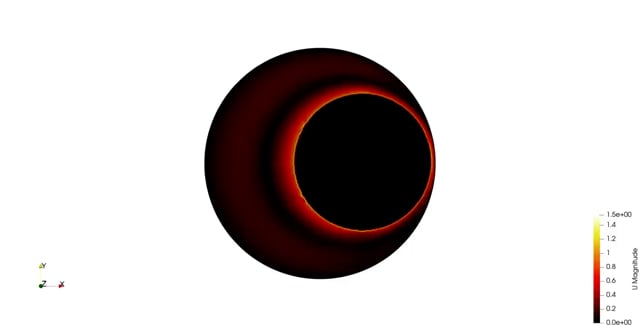
Numerical visualizations can support the interpretation of the interaction between fluid motion, bearing geometry, and nonlinear rheology.
A. Velocity Field
The velocity field describes fluid motion generated by the rotating shaft and the surrounding geometric constraints.
Its analysis provides information about local shear gradients, flow redistribution, and the influence of the moving boundary.
B. Hydrodynamic Pressure
The pressure field is a central quantity in hydrodynamic bearing analysis.
Its distribution is related to the geometry of the lubricant film, rotational conditions, and material properties.
Pressure and surface-stress integration can provide estimates of the hydrodynamic forces acting on the shaft when the numerical model includes the necessary physics and boundary conditions.
C. Viscoelastic Stress Distribution
The extra-stress tensor provides additional information about the internal mechanical response of the viscoelastic lubricant.
Spatial variations in these stresses can help identify regions of significant deformation and elastic stress accumulation.
Examining the relationship between velocity gradients and stress evolution is particularly useful for understanding nonlinear lubrication behavior.
D. Numerical Benchmark Evaluation
The reliability of the simulation can be assessed through several numerical quantities:
- Pressure distribution: Evaluating the hydrodynamic pressure field.
- Velocity profiles: Examining flow behavior in narrow clearance regions.
- Stress gradients: Investigating localized viscoelastic effects.
- Grid convergence: Assessing sensitivity to mesh refinement.
- Temporal convergence: Evaluating sensitivity to time-step selection.
- Conservation consistency: Monitoring the numerical balance of mass and momentum.
Quantitative validation requires comparison with appropriate reference solutions or experimental data.
The accompanying video provides a visual illustration of the numerical study, while verified performance conclusions require supporting calculations and benchmark results.
6. Industrial Engineering Applications
The numerical methods involved in viscoelastic journal bearing studies are relevant to several engineering and industrial sectors.
A. Automotive Powertrains
Journal bearings are used in mechanical systems requiring reliable support of rotating shafts.
Computational lubrication models can help engineers investigate film behavior, pressure distributions, and mechanical operating conditions.
B. Aerospace Mechanical Systems
Rotating equipment in aerospace applications may operate under demanding mechanical and thermal conditions.
Numerical lubrication studies provide a framework for analyzing selected aspects of bearing operation and fluid behavior.
C. Maritime Propulsion Systems
Marine propulsion machinery incorporates rotating shafts and bearing components that require appropriate lubrication.
Hydrodynamic simulations may contribute to the investigation of bearing loads, lubricant-film characteristics, and operating conditions.
D. Industrial Turbines and Compressors
High-speed rotating machinery relies on suitable bearing systems to support dynamic mechanical loads.
Computational models can support investigations of lubrication behavior and operating conditions in selected industrial equipment.
E. Scientific Software Development
Nonlinear viscoelastic lubrication provides a challenging test case for the development and validation of advanced numerical solvers.
These problems require expertise in fluid mechanics, nonlinear constitutive modeling, numerical discretization, and scientific computing.
Such capabilities are relevant to research and development activities involving advanced simulation software.
7. Conclusion and Research Perspectives
The study of journal bearing lubrication using viscoelastic constitutive modeling provides valuable insight into the complex behavior of lubricants interacting with rotating mechanical components.
Strong velocity gradients, narrow clearance regions, nonlinear material stresses, and transient effects introduce significant challenges for numerical simulation.
The Giesekus constitutive framework offers an approach for investigating selected viscoelastic effects, including shear-dependent rheology, elastic memory, and stress relaxation.
Combining these physical models with appropriate CFD methods provides a basis for studying lubricant-film behavior and evaluating computational solver capabilities.
Further numerical investigations may include comparisons across different rotational speeds, eccentricity ratios, material relaxation times, and computational resolutions.
TCHIKOU-R CONSULTING applies expertise in computational fluid dynamics, nonlinear rheology, computational mechanics, and scientific software development to investigate complex industrial and scientific problems.
Discover additional CFD simulations, advanced numerical research, and engineering applications in our Research & Projects collection.
