

1. The Test
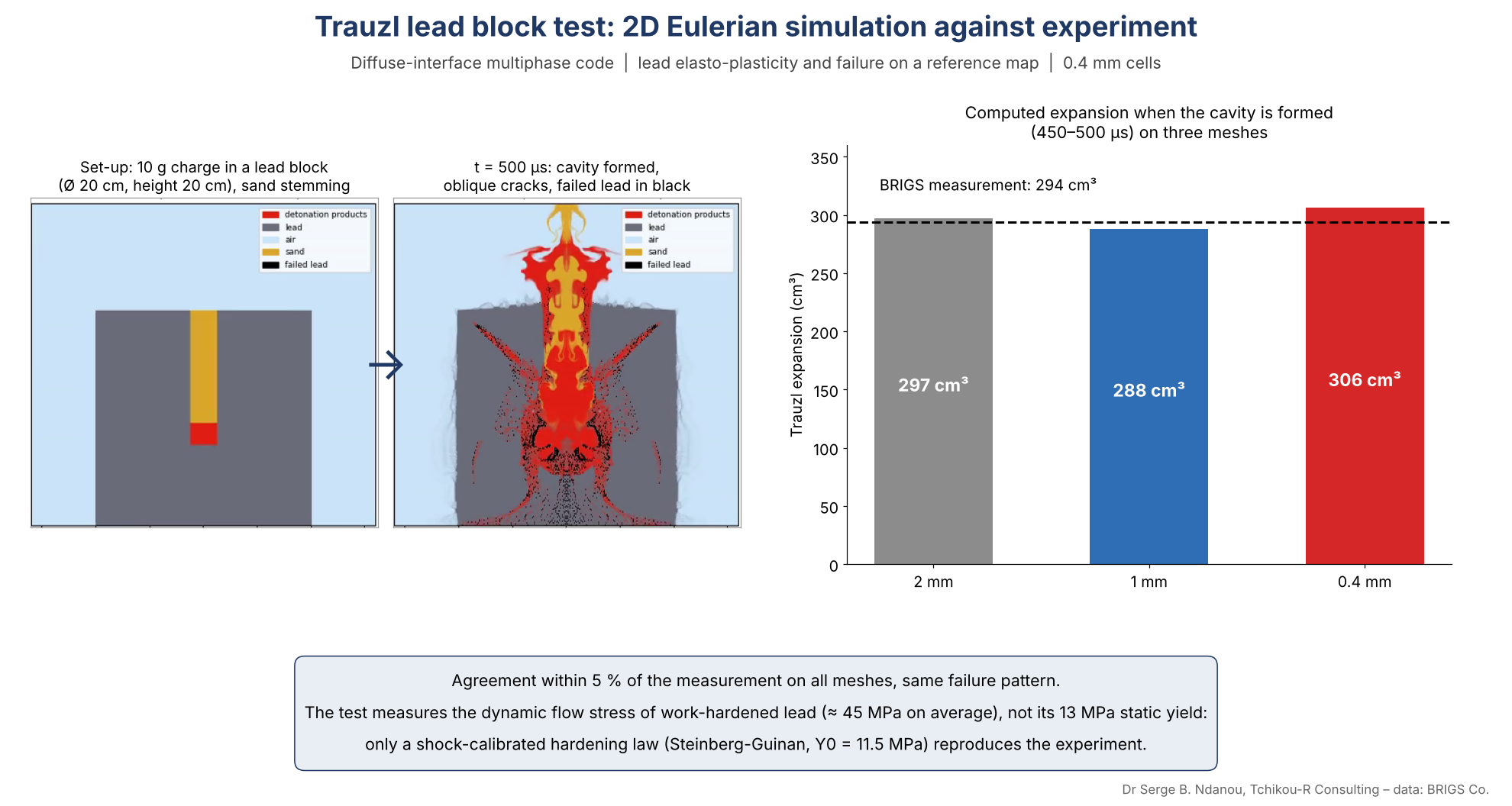
The Trauzl test is one of the oldest ways to rate the strength of an explosive. A charge is fired in a bore drilled in a cylindrical lead block, the bore is filled with water before and after the shot, and the enlargement of the cavity is the result.
It is simple and widely used, but what the number actually measures depends on the explosive and on the dynamic behaviour of the lead, which makes it a demanding test case for a simulation code.
The case studied here follows the test data provided by BRIGS Co.: a 10 g charge at the bottom of a 25 mm bore, in a lead block 20 cm in diameter and 20 cm high, closed with sand stemming. The measured expansion is 294 cm³.
2. The Model
The simulation uses a two-dimensional axisymmetric Eulerian code developed at TCHIKOU-R CONSULTING. Four materials share the same fixed grid through a diffuse-interface multiphase formulation: detonation products, lead, sand and air.
Each material has its own equation of state, and the pressures are relaxed to equilibrium in mixed cells. The solid is described by a hyperelastic model written with an elastic cobase, and a Riemann solver that accounts for shear waves gives the fluxes between cells. Interfaces are kept sharp with a THINC reconstruction.
The plastic history of the lead must follow the material through very large deformations. It is stored on an adaptive reference grid, in the initial configuration of the block, and linked to the current grid through a reference map that is transported with the flow.
Plastic relaxation, hardening (Steinberg-Guinan) and failure are computed on this reference grid. Several failure criteria are available: volumetric spall, principal stretch, ductile damage, Tuler-Butcher, and now the Gurson-Tvergaard-Needleman (GTN) porous damage model.
3. Results
On 0.4 mm cells, the detonation products, at close to 4 GPa, drive a compression wave into the lead at about 2.2 km/s. The cavity grows into a pear shape while the sand stemming is ejected as a jet.
In the tension that follows the reflections on the free surfaces, the lead fails: two oblique cracks run towards the top corners of the block and the lead below the charge fragments.
Animation of the Trauzl block simulation on 0.4 mm cells.
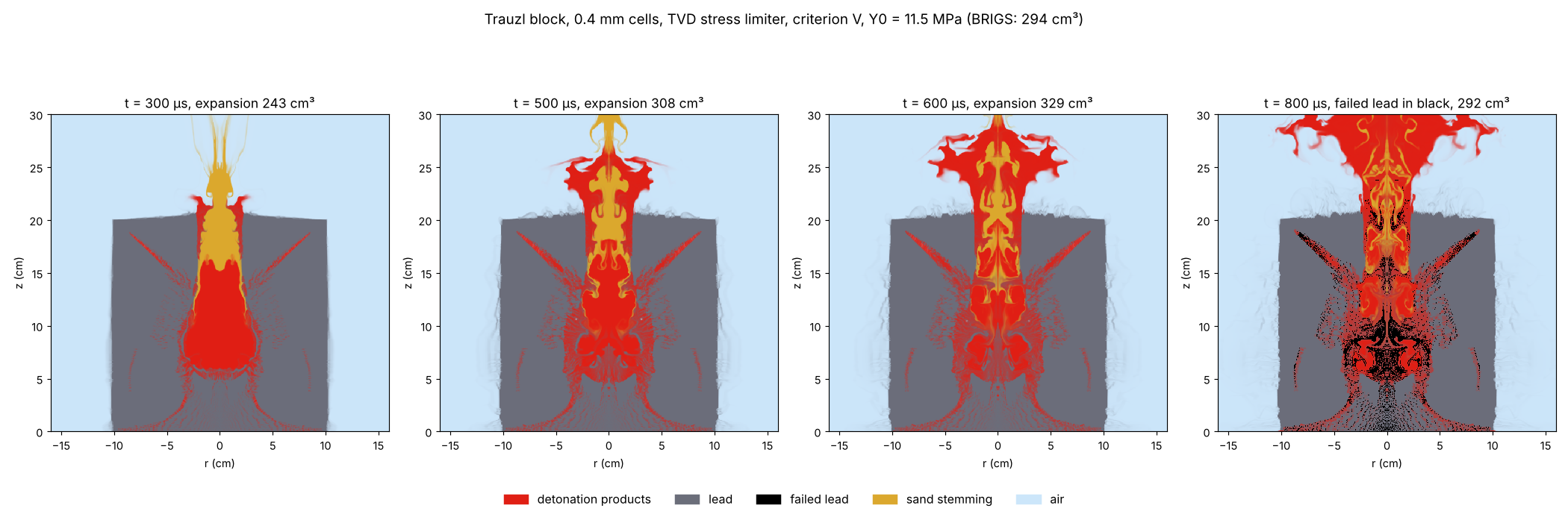
Figure 1 – Trauzl block on 0.4 mm cells at 300, 500, 600 and 800 µs; failed lead in black at 800 µs.
The same failure pattern is found on 2 mm, 1 mm and 0.4 mm cells. The computed expansion when the cavity is formed, between 450 and 500 µs, stays within 5 % of the measurement on all three meshes.
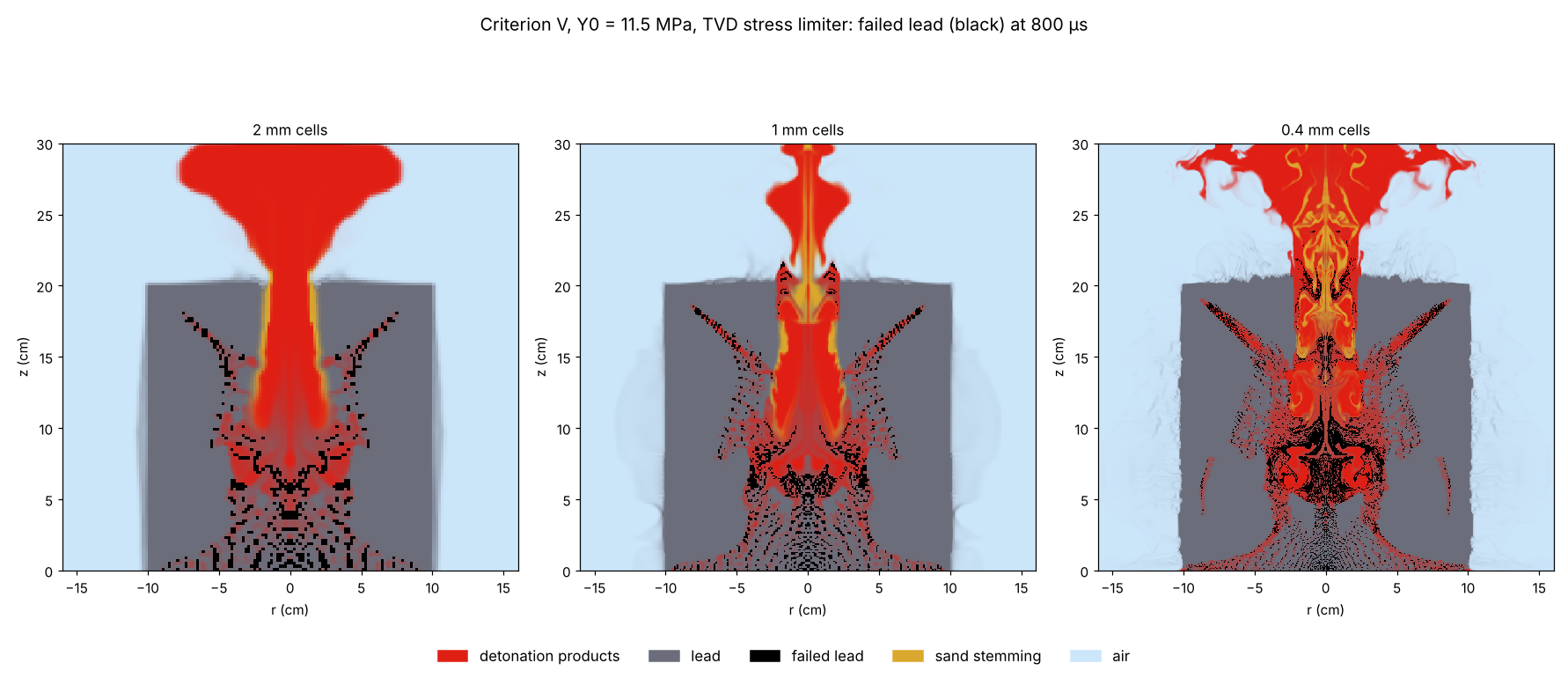
Figure 2 – Failed lead (black) at 800 µs on three meshes.
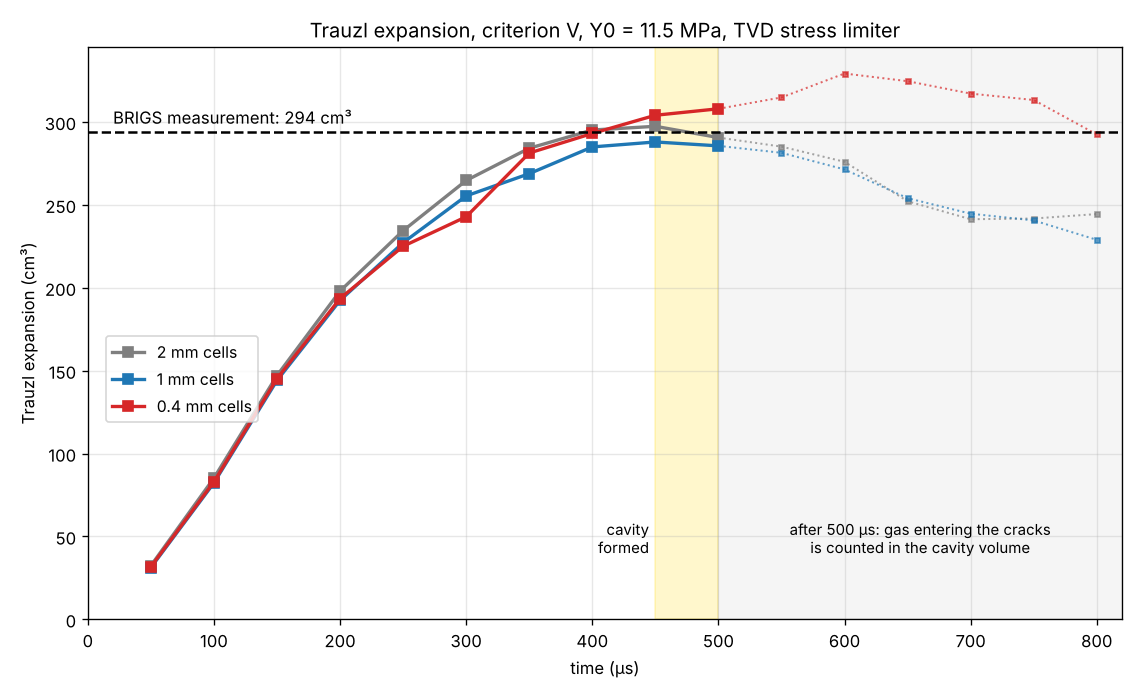
Figure 3 – Computed expansion against time on three meshes; BRIGS measurement dashed.
| Cells | 2 mm | 1 mm | 0.4 mm | BRIGS measurement |
|---|---|---|---|---|
| Expansion when the cavity is formed (cm³) | 297 | 288 | 304 – 308 | 294 |
Table 1 – Computed and measured Trauzl expansion.
After about 500 µs the detonation products flow into the cracks and the fragmented zone. The volume measured in the simulation then includes this gas, so the late values are not used for comparison. A cavity measurement that excludes the gas trapped in the cracks is the next step.
4. What the Test Measures
The yield stress of lead measured in a static test is 13.1 MPa (0.2 % offset). With this yield as input, the choice of hardening law decides the result.
Only a hardening law calibrated for shock loading (Steinberg-Guinan) reproduces the measured expansion. A Johnson-Cook law fitted on the quasi-static data gives about twice the volume, and a perfectly plastic lead would need a flow stress of 42 to 48 MPa to match the test.
The Trauzl test therefore measures the dynamic flow stress of strongly work-hardened lead, around 45 MPa on average, rather than its static yield. Adding GTN porous damage changes the volume by 4 to 15 % depending on the hardening law.
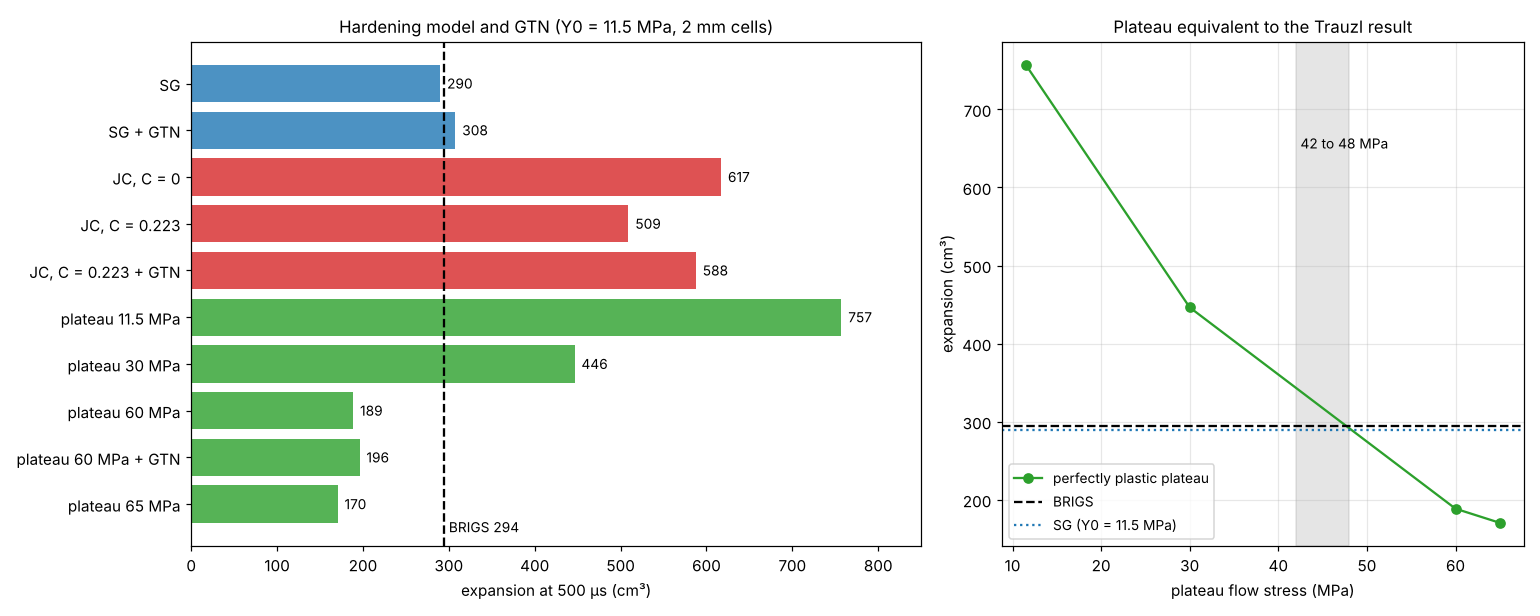
Figure 4 – Expansion at 500 µs for several hardening laws, with and without GTN damage (2 mm cells).
5. Outlook
The next steps are a cavity measurement that excludes the gas in the cracks, a non-local failure criterion with an internal length for a monotonic mesh convergence, and the extension to other explosives (RDX) and to other block materials.
The same code and approach apply to other problems that combine detonation products, solids and failure, such as fragmentation, cratering and protective structures.
6. Acknowledgements and Contact
We thank Joseph Backofen (BRIGS Co.) for the experimental data and for the discussions on the detonation stages.
Dr Serge B. Ndanou, TCHIKOU-R CONSULTING – [email protected]
Explore additional simulations, scientific investigations, and computational engineering projects in our Research & Projects collection.
