

Release wave in lead computed with the two codes, with commentary.
1. The Test
A block of lead is cut in two, and the two halves are pulled apart at ±10 m/s. Two release waves run outward from the separation plane: first a small elastic precursor, then the plastic front. Behind them the lead is brought to rest under a tension plateau close to the acoustic estimate ρcΔu ≈ 227 MPa.
The test is simple, but it is demanding for an Eulerian code. The solid must carry tension without opening spurious voids, the two waves must travel at the right speeds, and the energy given to the material must be accounted for exactly.
This benchmark was run before the copper Taylor anvil and after the Trauzl lead block simulation, to check how both codes handle tension in the same material.
2. The Codes
Two independent Eulerian codes developed at TCHIKOU-R CONSULTING are compared.
The first is a diffuse-interface multiphase code. Each material has its own equation of state, the pressures are relaxed to equilibrium in mixed cells, the solid is described by a hyperelastic model written with an elastic cobase, and the fluxes come from a Riemann solver that accounts for shear waves. It is run in its original 1D form and in its new 2D axisymmetric version.
The second is a reference-map Eulerian code. The plastic history of the solid is stored on an adaptive reference grid, in the initial configuration of the material, and linked to the current grid through a reference map transported with the flow.
The numerical settings are the same for all runs: CFL 0.3, Heun (RK2) time stepping, HLLC fluxes, MUSCL reconstruction with a minmod limiter (θ = 1). The diffuse-interface code adds THINC sharpening (β = 2.5) on the volume fractions.
Lead is modelled as a stiffened gas (γ = 4.716, P∞ = 9.676 GPa, ρ₀ = 11 340 kg/m³) with hyperelastic shear (μ = 8.6 GPa), a yield stress of 13.1 MPa and a spall strength of 1 GPa.
| Code | Initial mesh |
|---|---|
| Diffuse-interface code, 1D | 1000 cells of 0.1 mm |
| Diffuse-interface code, 2D | 1 × 1000 cells of 0.1 mm |
| Reference-map code, 2D | 4 × 1000 cells (0.5 × 0.1 mm) |
| Reference grid | 32 × 32 base cells, automatic refinement up to 6 levels (61 µm leaves), one cell image per leaf, 40 744 leaves at 20 µs |
Table 1 – Initial meshes.
3. Results
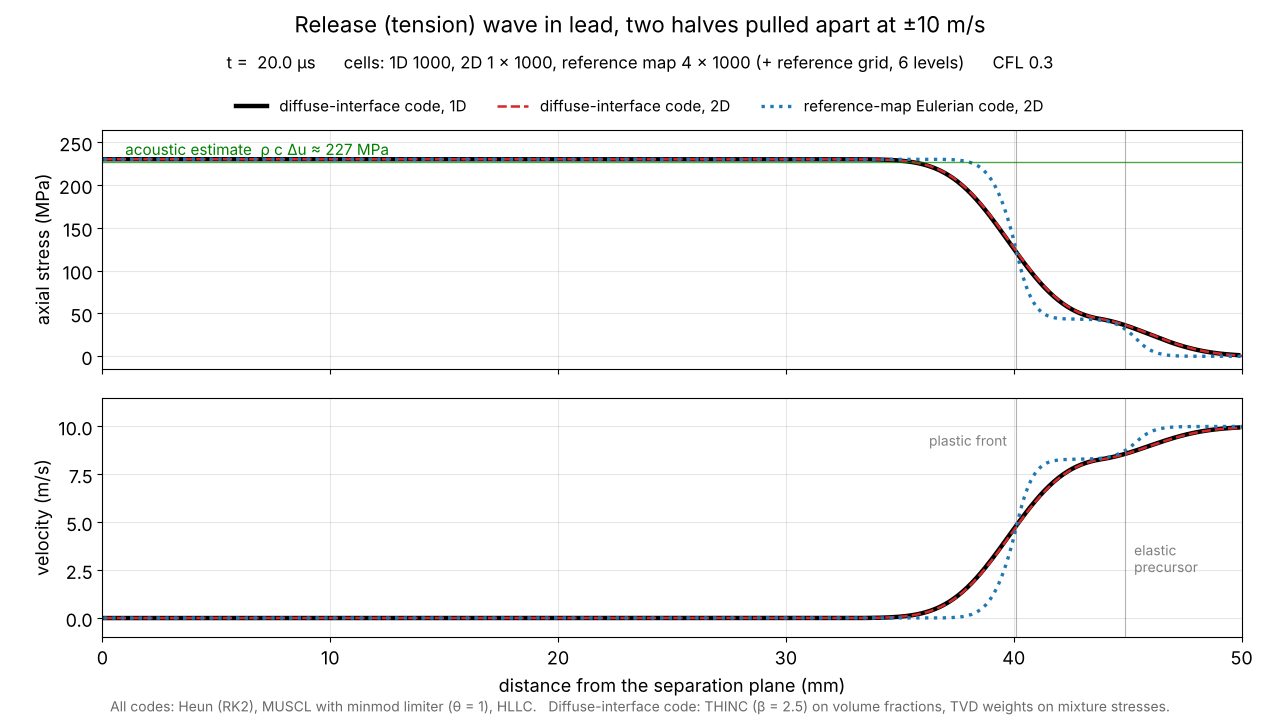
Figure 1 – Axial stress and velocity at 20 µs: diffuse-interface code in 1D (black) and 2D (red), reference-map code (blue).
At 20 µs the three runs give the same tension plateau, within 0.01 %.
| At 20 µs | Diffuse-interface 1D | Diffuse-interface 2D | Reference map 2D | Acoustic estimate |
|---|---|---|---|---|
| Tension plateau (MPa) | 230.37 | 230.37 | 230.35 | ≈ 227 |
Table 2 – Tension plateau behind the release waves.
The plastic front is at 40.1 mm and the elastic precursor at 44.9 mm, as given by the bulk (2005 m/s) and longitudinal (2244 m/s) sound speeds of lead. The precursor carries about 43 MPa, the theoretical value. The 1D and 2D diffuse-interface runs lie exactly on top of each other. The reference map keeps both fronts noticeably sharper, which is what the method is designed for.
4. What Had to Be Fixed
Reaching this agreement required two corrections in the diffuse-interface model, both checked first in 1D:
- an energy-conserving treatment of cavitation: on a lead plate impact test, the total energy is now conserved to 5 × 10⁻⁷ of the impact kinetic energy over 80 µs, instead of about 10⁻³ before;
- a tensile strength threshold: the solid now carries tension and spalls only beyond its spall strength, instead of cavitating as soon as the pressure becomes negative.
5. Outlook
With both codes now treating tension the same way, the next comparison is the copper Taylor anvil at 227 m/s, against the reference solution of the rod impact benchmark.
6. Contact
Dr Serge B. Ndanou, TCHIKOU-R CONSULTING – [email protected]
Explore additional simulations, scientific investigations, and computational engineering projects in our Research & Projects collection.
