Course Overview: Cybersecurity Automation with Python
Automate Cybersecurity Tasks with Python is the seventh course in the Google Cybersecurity Professional Certificate program.
The course introduces Python programming and explains how automation can support cybersecurity operations.
Learners develop foundational programming skills and explore practical techniques for working with security-related data.
The curriculum emphasizes task automation, data processing, file management, regular expressions, and code debugging.
By combining programming fundamentals with cybersecurity scenarios, the course provides a foundation for developing efficient and repeatable technical workflows.
Python Programming Fundamentals
Understanding the role of Python in cybersecurity automation.
Working with variables, data types, and operators.
Writing conditional statements to control program behavior.
Using for loops and while loops to process information.
Creating and calling user-defined functions.
Understanding function parameters, arguments, and return values.
Applying built-in functions and importing reusable Python libraries.
Developing readable and maintainable scripts.
Strings, Lists, and Regular Expressions
Understanding how Python strings and lists can represent security-related information.
Using indexing, slicing, and string methods to process text.
Creating and modifying lists to organize data.
Developing simple algorithms for extracting and filtering information.
Using regular expressions to search for patterns within text.
Applying pattern matching to identify relevant entries in security logs or other technical datasets.
These skills provide a foundation for structured text analysis and data extraction.
File Processing and Security Task Automation
Using Python to open, read, and process text files.
Importing and parsing file contents to extract useful information.
Developing scripts that filter records and organize technical data.
Working with file input and output operations.
Understanding how Python algorithms can automate repetitive security tasks.
Applying automation to examples such as access-list updates, text processing, and security-related record management.
Recognizing how repeatable scripts can improve the consistency and efficiency of routine operations.
Debugging, Code Quality, and Professional Application
Identifying common syntax, runtime, and logic errors in Python programs.
Applying systematic debugging strategies.
Testing scripts and examining their outputs to identify unexpected behavior.
Improving code clarity through meaningful variable names, reusable functions, and readable structure.
Using Python automation to support reliable technical workflows.
For scientific computing and HPC environments, these programming concepts are relevant to log processing, automated checks, data preparation, and repetitive computational tasks.
The training complements scientific software development expertise with cybersecurity-oriented automation practices.
Course Information and Certificate Verification
Course Title:
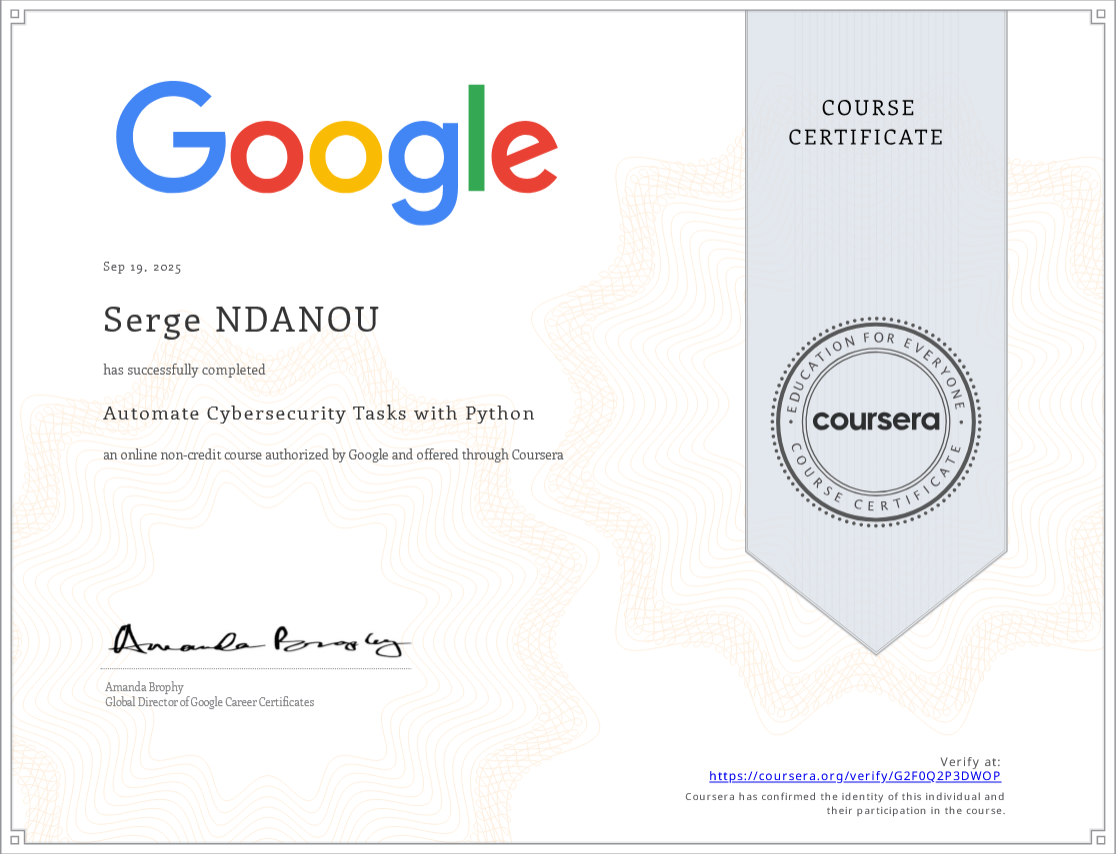
Automate Cybersecurity Tasks with Python
Training Provider:
Google Career Certificates
Learning Platform:
Coursera
Program:
Google Cybersecurity Professional Certificate
Course Position:
Seventh course in the nine-course program.
Learning Modules:
Four.
Core Topics:
Python Programming, Functions, Loops, Lists, Strings, Regular Expressions, File Processing, Security Automation, and Debugging.
Individual Course Certificate:
https://www.coursera.org/account/accomplishments/verify/G2F0Q2P3DWOP
Official Course Information:
https://www.coursera.org/learn/automate-cybersecurity-tasks-with-python
Google Cybersecurity Professional Certificate:
https://www.coursera.org/account/accomplishments/professional-cert/IIBK4WHVC342
This course forms part of a broader professional training program and does not constitute an independent professional license.