Course Overview: Cybersecurity Risk Management
Play It Safe: Manage Security Risks is the second course in the Google Cybersecurity Professional Certificate program.
The course introduces core principles used by organizations to identify, evaluate, and manage cybersecurity risks.
It examines how security frameworks, policies, and technical controls help protect business operations and information assets.
Learners explore risk assessment, security audits, monitoring technologies, and structured incident response procedures.
The course establishes a foundation for understanding cybersecurity governance and supporting security-conscious technical operations.
Security Domains and Risk Assessment
Understanding the eight security domains commonly associated with the CISSP framework.
Identifying cybersecurity threats, risks, and vulnerabilities affecting organizational systems and business operations.
Recognizing how cyber incidents can affect information confidentiality, integrity, and availability.
Understanding the difference between threats, vulnerabilities, and security risks.
Introducing risk assessment principles and the NIST Risk Management Framework.
Recognizing the importance of prioritizing risks according to their potential consequences.
These concepts support a structured understanding of organizational cybersecurity exposure.
Security Frameworks, Controls, and Compliance
Understanding the role of cybersecurity frameworks in defining security practices and organizational responsibilities.
Exploring the NIST Cybersecurity Framework and its relationship to cybersecurity risk management.
Understanding the confidentiality, integrity, and availability triad.
Recognizing administrative, technical, and physical security controls.
Introducing OWASP principles and their relevance to application security.
Understanding how policies, procedures, and controls support the protection of organizational systems.
Learning the objectives of security audits and how findings can support improvements to security practices.
Security Monitoring and SIEM Technologies
Understanding the purpose of Security Information and Event Management systems.
Learning how SIEM platforms collect and organize security-related information.
Recognizing the importance of logs, events, and alerts in cybersecurity monitoring.
Exploring how analysts use security dashboards to identify potentially suspicious activity.
Understanding the role of log analysis in supporting incident investigation.
Introducing common SIEM concepts and security monitoring workflows.
These skills provide foundational knowledge of tools used to support organizational threat detection.
Incident Response Playbooks and Security Audits
Understanding the role of incident response playbooks in security operations.
Recognizing how standardized procedures help teams respond consistently to security events.
Identifying the steps required to assess, report, escalate, and respond to potential incidents.
Understanding the importance of documented responsibilities and communication channels.
Exploring the preparation and execution of organizational security audits.
Reviewing security practices to identify gaps, risks, and opportunities for improvement.
These approaches contribute to better coordination, accountability, and operational security awareness.
Professional Application and Certificate Verification
The course strengthens foundational knowledge of cybersecurity governance, risk management, and organizational security practices.
These concepts are relevant to technical environments involving software development, computational infrastructure, research data, and scientific computing systems.
The training complements expertise in computational mechanics and high-performance computing by improving awareness of cybersecurity risks and protective controls.
Course Title:
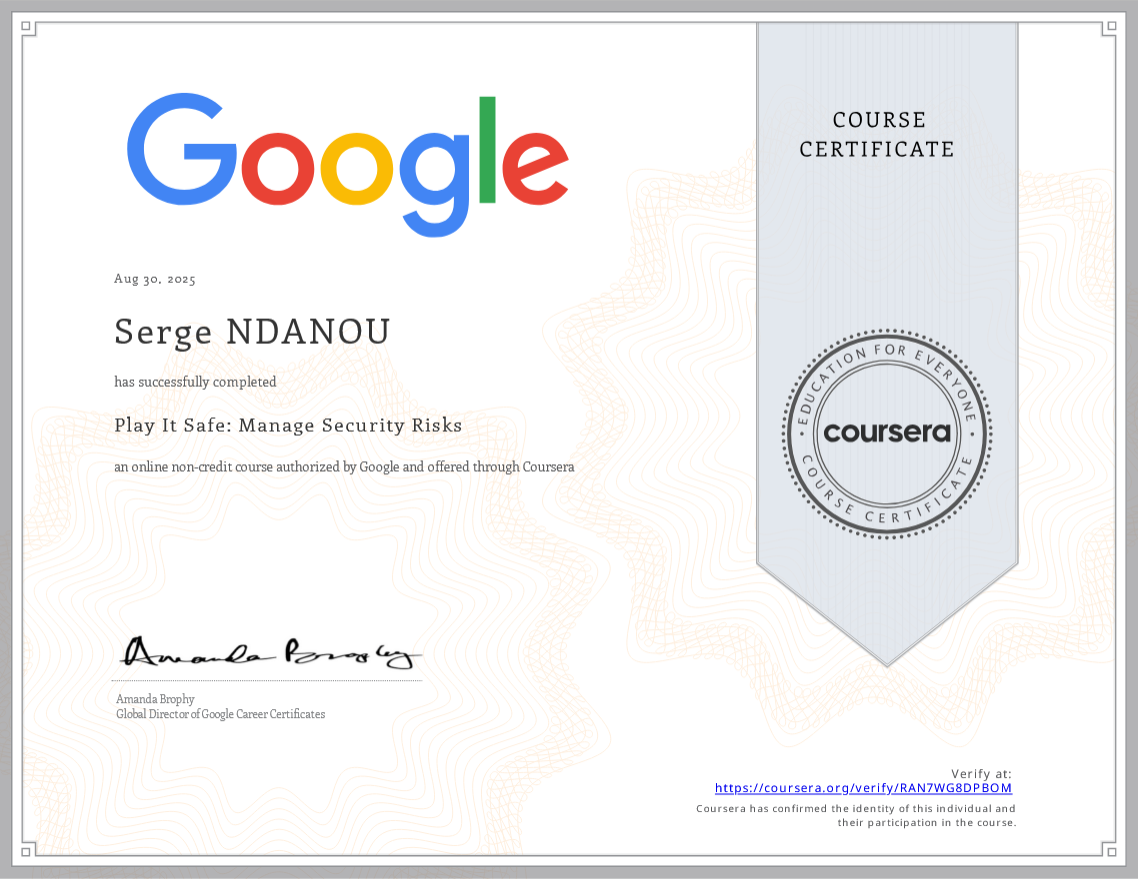
Play It Safe: Manage Security Risks
Training Provider:
Google Career Certificates
Learning Platform:
Coursera
Program:
Google Cybersecurity Professional Certificate
Course Position:
Second course in the nine-course program.
Learning Modules:
Four.
Core Topics:
Cybersecurity Risk Management, Security Domains, NIST Frameworks, Security Controls, SIEM, Security Audits, and Incident Response Playbooks.
Individual Course Certificate:
https://www.coursera.org/account/accomplishments/verify/RAN7WG8DPBOM
Official Course Information:
https://www.coursera.org/learn/manage-security-risks
Google Cybersecurity Professional Certificate:
https://www.coursera.org/account/accomplishments/professional-cert/IIBK4WHVC342
This course forms part of a broader professional training program and does not constitute an independent professional license.