

1. Introduction to High-Speed Impact Simulation
High-speed impact simulation is an important field of computational mechanics dedicated to understanding the dynamic response of materials and structures subjected to rapid mechanical loading.
Under extreme loading conditions, materials can experience highly localized stresses, large deformations, rapid pressure variations, and complex wave propagation phenomena.
These effects are particularly relevant to the study of protective materials, aerospace structures, impact-resistant components, and advanced engineering systems.
This research project explores the numerical challenges associated with transient impact dynamics, nonlinear material behavior, and the evolution of mechanical fields during short-duration loading events.
By combining computational solid mechanics, numerical simulation, and nonlinear constitutive modeling, advanced computational frameworks can provide insight into complex deformation mechanisms that are difficult to observe directly.
The objective is to investigate the physical behavior of materials subjected to dynamic loading and to assess the numerical methods required to represent these phenomena reliably.
2. Physical Principles of Impact Dynamics
A. Transient Mechanical Loading
High-speed impact events are characterized by rapidly changing mechanical loads and strong interactions between inertia, material resistance, and deformation.
Unlike quasi-static loading, where structural response can often be evaluated without considering significant inertial effects, dynamic impact requires explicit consideration of the evolution of stresses and motion over time.
The mechanical response depends on the material properties, geometry, loading conditions, and relevant physical timescales.
B. Shockwave and Stress-Wave Propagation
Rapid loading can generate stress waves that propagate through a material and interact with boundaries or interfaces.
Under sufficiently intense conditions, compressive disturbances may develop into shock waves, depending on the material response and governing physical model.
Important quantities in numerical analysis include:
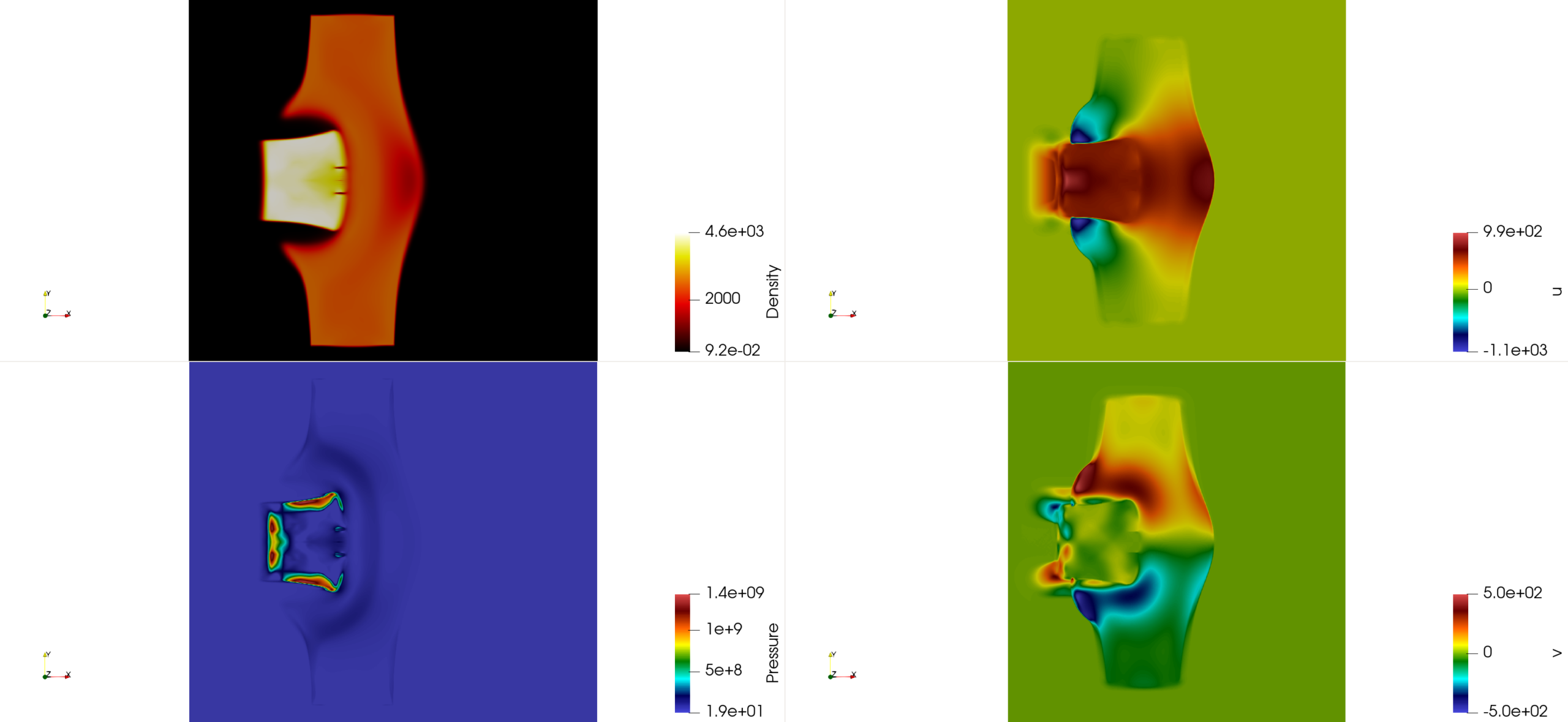
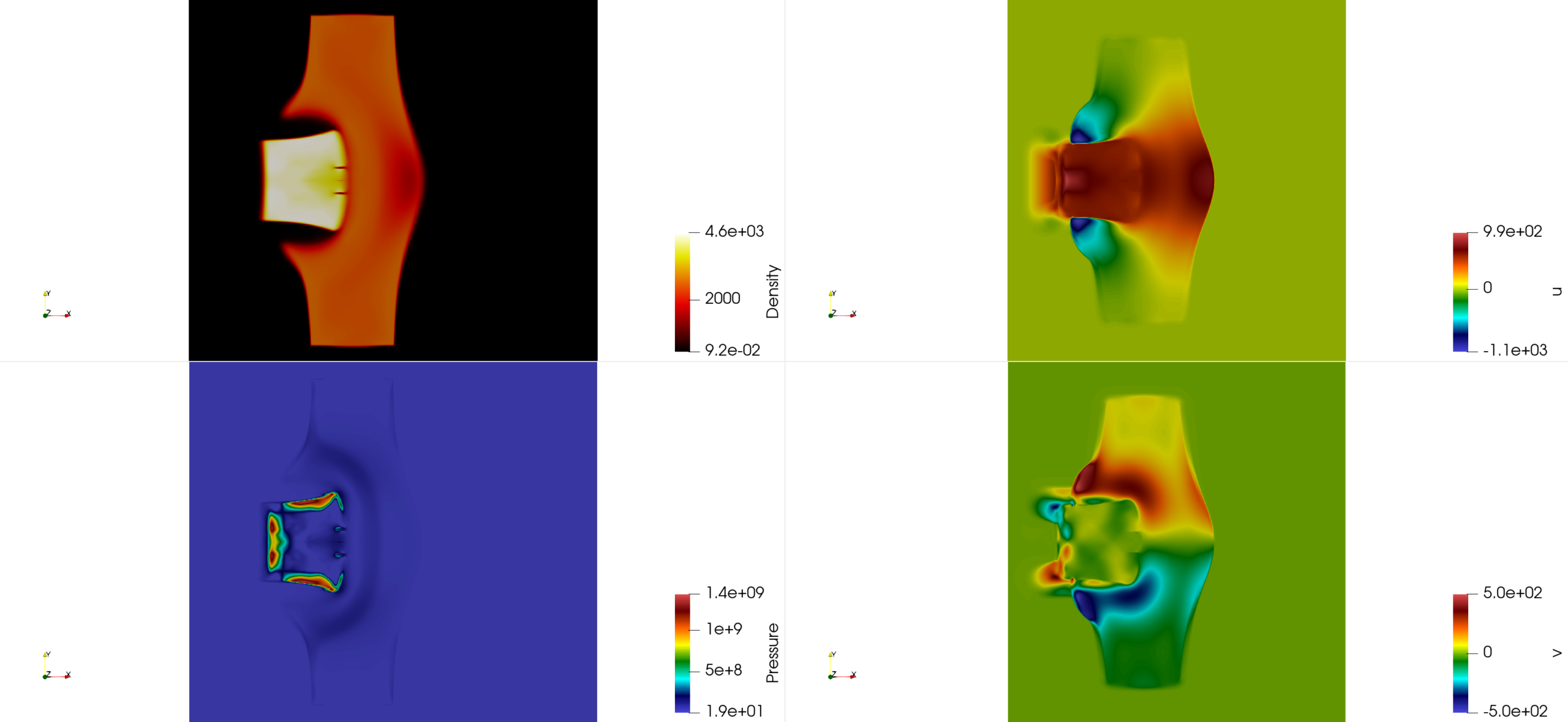
- Pressure (p): Representing local compressive loading where pressure is defined by the model.
- Stress tensor: Describing the internal mechanical forces acting within the material.
- Velocity field: Characterizing material motion during the transient response.
- Density: Describing changes in material compression when relevant.
- Deformation: Representing the evolution of material shape and strain.
Analyzing these quantities helps researchers understand how dynamic disturbances evolve within complex materials and structures.
C. Nonlinear Material Response
Materials subjected to rapid mechanical loading may exhibit nonlinear elastic behavior, plastic deformation, strain-rate sensitivity, or damage.
Different constitutive models are required to represent these responses according to the material and loading regime.
Reliable simulations therefore depend on selecting an appropriate material description and calibrating its parameters using relevant experimental information.
3. Main Computational Challenges
A. Resolving Sharp Wave Fronts
One of the main challenges in high-speed impact simulation is the numerical representation of rapidly propagating waves and steep mechanical-field gradients.
Inadequate numerical resolution may introduce artificial oscillations or excessive numerical diffusion.
Computational methods must therefore provide a suitable balance between stability, conservation, and accuracy.
These considerations are especially important for transient simulations involving strong pressure variations and material discontinuities.
B. Large Deformation and Material Interfaces
Impact loading can produce significant changes in material geometry.
Large deformations introduce numerical difficulties associated with mesh distortion, material-interface representation, and the evolution of mechanical boundaries.
Depending on the problem, numerical frameworks may require techniques capable of representing moving interfaces and strongly deforming materials.
The objective is to maintain a physically meaningful computational representation throughout the transient event.
C. Rapid Transient Dynamics
Dynamic simulations often require fine temporal resolution to capture rapid changes in velocity, stress, and deformation.
The appropriate time step depends on the spatial discretization, material properties, numerical formulation, and physical timescales.
Numerical stability and temporal accuracy must be assessed carefully to avoid misleading predictions.
D. Conservation and Numerical Robustness
Reliable impact simulations require consistent treatment of the governing conservation equations.
Important considerations include:
- Consistency of mass conservation.
- Appropriate treatment of momentum balance.
- Monitoring of energy transfer and numerical dissipation.
- Stable integration of nonlinear material equations.
- Reliable representation of material boundaries.
- Assessment of numerical convergence.
These aspects provide a foundation for evaluating the quality of computational impact models.
4. Numerical Modeling and Validation
A. Computational Mechanics Framework
Advanced computational methods make it possible to investigate transient solid deformation and dynamic mechanical interactions.
Depending on the physical problem, simulations may employ finite element, finite volume, or other numerical formulations suitable for the governing equations.
The choice of numerical approach depends on the required physical fidelity, constitutive behavior, and deformation characteristics.
B. Material Characterization
Material response under dynamic loading can differ substantially from behavior measured under quasi-static conditions.
Predictive numerical modeling therefore requires material parameters appropriate to the relevant loading regime.
Experimental characterization and constitutive model selection are important elements of reliable simulation development.
C. Verification and Validation
Numerical simulations must be evaluated before their predictions can be used to support engineering decisions.
Important assessment activities include:
- Mesh convergence: Evaluating the influence of spatial discretization.
- Temporal convergence: Examining sensitivity to the selected time step.
- Material model assessment: Verifying the suitability of the constitutive formulation.
- Conservation checks: Monitoring numerical consistency.
- Reference comparisons: Comparing results with appropriate analytical or published benchmarks.
- Experimental validation: Comparing numerical predictions with measured responses when suitable data are available.
These procedures are essential for distinguishing physically meaningful predictions from numerical artifacts.
Actual ballistic performance, impact resistance, and protective capability cannot be established from numerical visualization alone.
5. Engineering and Protective Applications
The numerical methods associated with impact dynamics have potential applications across several engineering and research fields.
A. Aerospace Engineering
Aerospace components may experience rapid mechanical loading during operation or accidental impact events.
Computational mechanics can contribute to understanding the response of structural materials under transient loads and supporting broader structural safety assessments.
B. Protective Materials Research
Research into protective materials requires an understanding of their mechanical response under dynamic loading.
Numerical simulations can support fundamental studies of deformation, stress propagation, and material behavior.
Protective performance must ultimately be evaluated through appropriate physical testing and applicable standards.
C. Industrial Structural Safety
Impact-related numerical methods are also relevant to industrial safety and engineering applications.
Potential research areas include:
- Mechanical response to accidental impact.
- Dynamic loading of industrial components.
- Transient deformation of structural materials.
- Assessment of material models under rapid loading.
- Investigation of structural behavior during short-duration mechanical events.
D. Scientific Software Development
Numerical impact problems provide challenging test cases for computational mechanics software.
They require accurate representation of transient physical processes, nonlinear constitutive behavior, and potentially large material deformations.
These challenges support research into numerical algorithms, computational efficiency, and simulation reliability.
6. Conclusion and Research Perspectives
High-speed impact simulation provides valuable insight into the complex mechanical response of materials subjected to rapid dynamic loading.
The interaction between stress-wave propagation, nonlinear constitutive behavior, material deformation, and transient motion creates significant challenges for numerical modeling.
Understanding these phenomena requires computational methods capable of representing rapidly evolving mechanical fields while maintaining appropriate numerical accuracy and stability.
Such investigations are relevant to aerospace engineering, protective materials research, structural safety, and the development of scientific computing methods.
Future research may focus on improved material characterization, numerical verification, and comparisons between computational predictions and experimental observations.
TCHIKOU-R CONSULTING brings expertise in computational physics, solid mechanics, numerical methods, and advanced scientific simulation to the investigation of complex engineering problems.
Discover additional computational research, numerical simulations, and engineering investigations in our Research & Projects collection.
