Course Overview: Assets, Threats, and Vulnerabilities
Assets, Threats, and Vulnerabilities is the fifth course in the Google Cybersecurity Professional Certificate program.
The course focuses on protecting organizational information systems by identifying important assets, understanding security risks, and evaluating potential threats.
The curriculum introduces cybersecurity risk management principles, security controls, asset classification, attack surfaces, and vulnerability assessment.
Learners also explore how attackers identify weaknesses and how organizations can reduce their exposure to common cyber threats.
The training provides a practical foundation for understanding asset protection and threat management.
Asset Identification, Classification, and Protection
Understanding the difference between digital and physical assets.
Identifying organizational information assets and their business importance.
Classifying assets according to sensitivity, confidentiality, and protection requirements.
Exploring cybersecurity risk management through the NIST Cybersecurity Framework.
Understanding appropriate data handling procedures and the principles of information privacy.
Introducing security controls, encryption, hashing, authentication, authorization, and the principle of least privilege.
These topics establish a foundation for protecting information and reducing organizational risk.
Attack Surface and Vulnerability Assessment
Understanding the concept of an attack surface and its importance in cybersecurity risk analysis.
Identifying possible entry points across applications, operating systems, networks, and connected technologies.
Introducing vulnerability management and the identification of common security weaknesses.
Understanding Common Vulnerabilities and Exposures (CVE) and the importance of security updates.
Exploring vulnerability scanning, defense-in-depth strategies, and penetration testing concepts.
Developing a structured approach to recognizing and prioritizing security weaknesses.
Threat Identification and Threat Modeling
Recognizing common cybersecurity threats, including social engineering, phishing, malware, and web-based exploits.
Understanding how malicious actors identify and exploit vulnerabilities.
Learning to examine security scenarios from an attacker-oriented perspective.
Identifying likely attack vectors and potential impacts on organizational assets.
Introducing threat modeling and the Process for Attack Simulation and Threat Analysis (PASTA).
Understanding how structured threat modeling supports informed security planning and risk mitigation.
Risk Management and Professional Application
Understanding how asset classification supports the prioritization of cybersecurity controls.
Recognizing relationships among assets, vulnerabilities, threats, and business risks.
Evaluating security risks according to their potential likelihood and impact.
Applying security awareness to software development, computing infrastructure, and technical operations.
For scientific computing and HPC environments, these concepts are relevant to the protection of research data, computational resources, software repositories, and connected infrastructure.
The training complements computational science expertise with foundational knowledge of cybersecurity risk management and vulnerability awareness.
Course Information and Certificate Verification
Course Title:
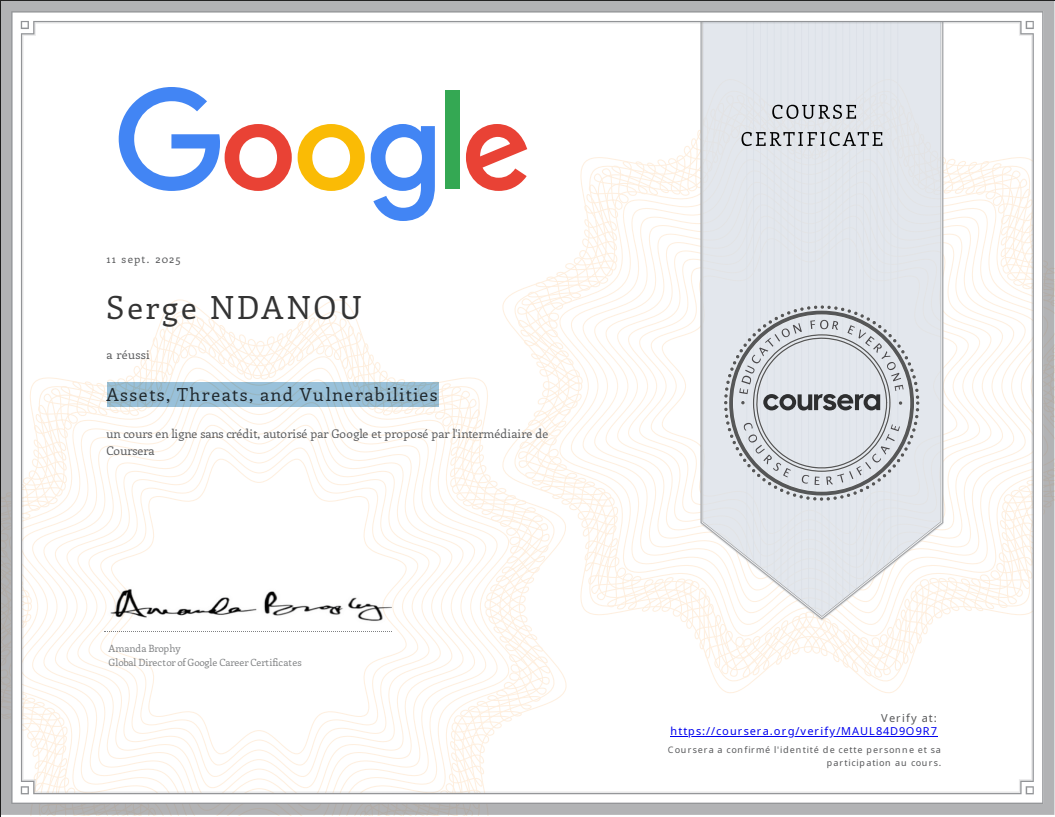
Assets, Threats, and Vulnerabilities
Training Provider:
Google Career Certificates
Learning Platform:
Coursera
Program:
Google Cybersecurity Professional Certificate
Course Position:
Fifth course in the professional certificate program.
Course Structure:
Four learning modules.
Core Topics:
Asset Security, Cybersecurity Risk Management, Vulnerability Assessment, Attack Surface Analysis, Security Controls, Authentication, Encryption, and Threat Modeling.
Individual Course Certificate:
https://www.coursera.org/account/accomplishments/verify/MAUL84D9O9R7
Google Cybersecurity Professional Certificate:
https://www.coursera.org/account/accomplishments/professional-cert/IIBK4WHVC342
This course is part of a broader professional training program and does not constitute an independent professional license.