

1. Introduction to Anisotropic Mesh Refinement
Anisotropic mesh refinement is an advanced computational technique used to improve the accuracy and efficiency of numerical simulations involving complex fluid motion, moving boundaries, and fluid-structure interaction (FSI).
In computational fluid dynamics (CFD), the quality of the computational mesh plays a fundamental role in determining how accurately velocity, pressure, and stress fields can be resolved.
Conventional uniform mesh refinement increases numerical resolution throughout the computational domain, often introducing substantial computational costs.
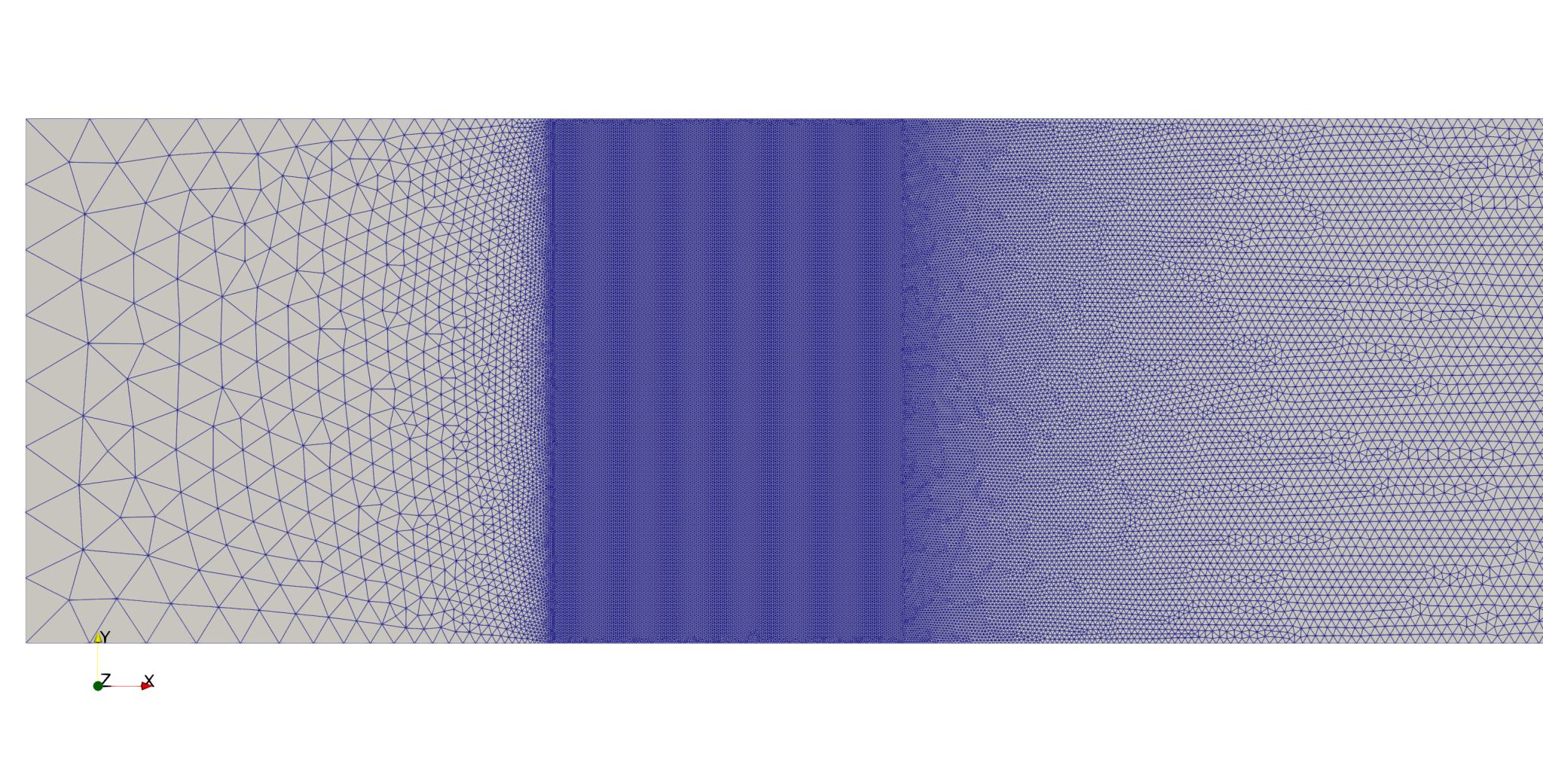
In contrast, anisotropic mesh adaptation allows elements to be refined and oriented according to local solution characteristics, such as velocity gradients, material interfaces, and stress concentrations.
This project investigates the use of dynamic anisotropic mesh adaptation for simulating moving geometric obstacles within viscoelastic fluid flows.
The numerical framework considers the challenges of tracking moving boundaries, transferring physical fields between successive meshes, and maintaining reliable numerical solutions during transient simulations.
These developments are relevant to scientific computing, computational rheology, numerical fluid mechanics, and advanced industrial simulation.
2. Anisotropic Mesh Adaptation in CFD
A. Why Mesh Adaptation Matters
Complex fluid flows frequently contain localized physical structures requiring high numerical resolution.
Examples include thin shear layers, steep stress gradients, moving interfaces, and regions of rapid variation in velocity or pressure.
Uniformly refining the entire computational mesh can become expensive, particularly for transient three-dimensional simulations.
Anisotropic mesh refinement provides an alternative by concentrating computational resolution where it is most useful.
Rather than applying identical element sizes in every direction, anisotropic methods allow elements to adapt to the orientation and intensity of local solution features.
B. Directional Refinement
Directional mesh refinement is particularly useful when flow structures exhibit strong gradients in one direction but relatively smooth variations in another.
For example, a thin boundary layer may require fine resolution across its thickness while allowing longer mesh elements along the layer.
Appropriate anisotropic adaptation can therefore support:
- Improved resolution of localized velocity gradients.
- Accurate representation of thin shear layers.
- Better spatial resolution of viscoelastic stress concentrations.
- More efficient representation of moving fluid interfaces.
- Reduced unnecessary refinement in relatively smooth regions.
Actual gains in accuracy and computational efficiency depend on the adaptation criteria, mesh quality, and numerical solver.
3. Dynamic Remeshing and Numerical Field Transfer
A. Adapting the Computational Domain
In simulations involving moving objects, the computational geometry may evolve continuously over time.
Examples include translating cylinders, rotating components, and rectangular obstacles following prescribed trajectories.
The computational framework must maintain an appropriate representation of the fluid domain as the solid boundaries move.
Dynamic remeshing provides a strategy for updating the computational discretization as the geometry and local flow structures evolve.
The objective is to preserve adequate numerical resolution while avoiding excessive mesh distortion.
B. Mesh-to-Mesh Projection
One of the main computational challenges associated with adaptive remeshing is the transfer of numerical solutions between successive computational meshes.
After generating a new mesh, the existing solution must be transferred consistently from the previous discretization.
Important physical quantities include:
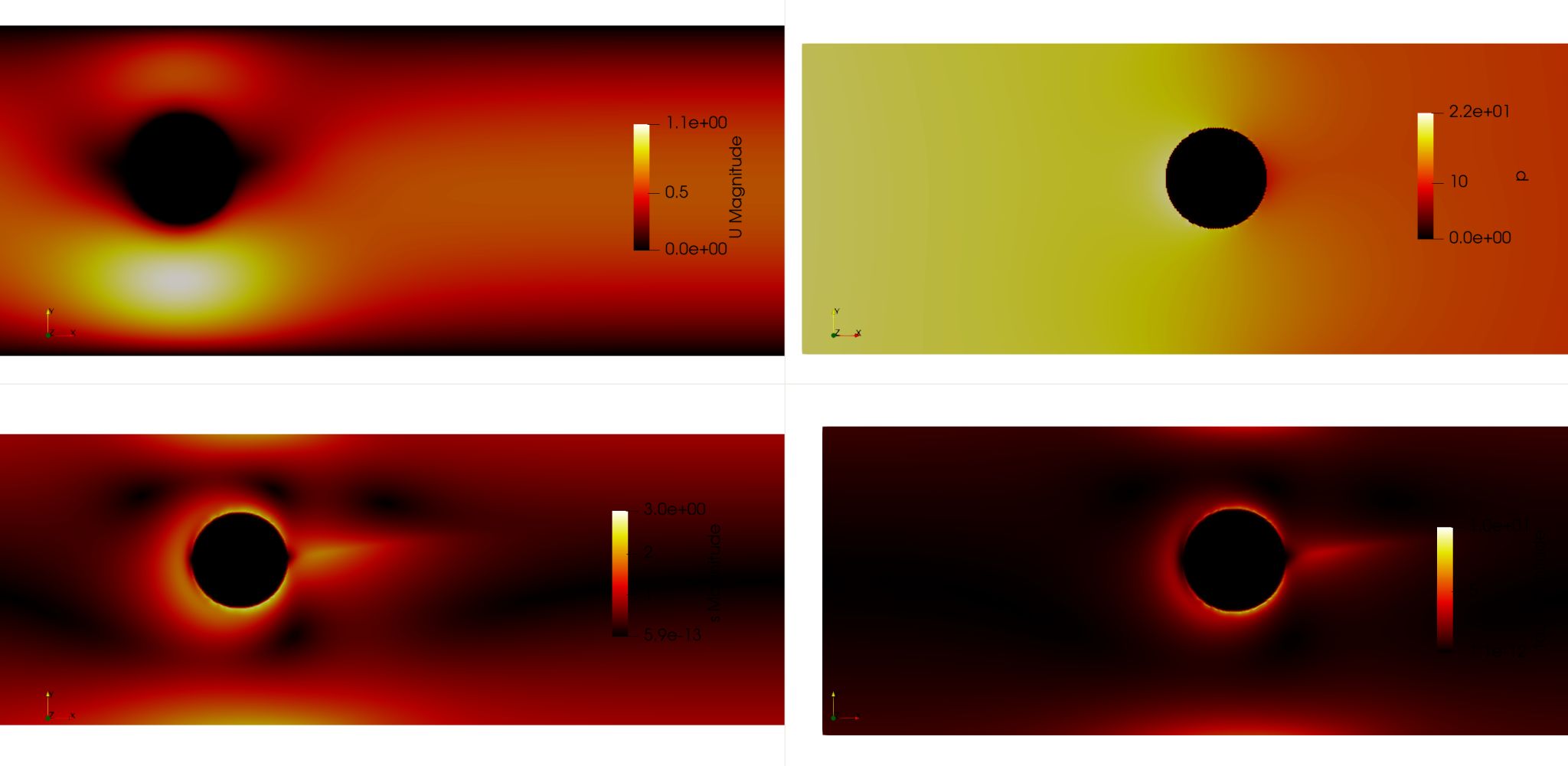
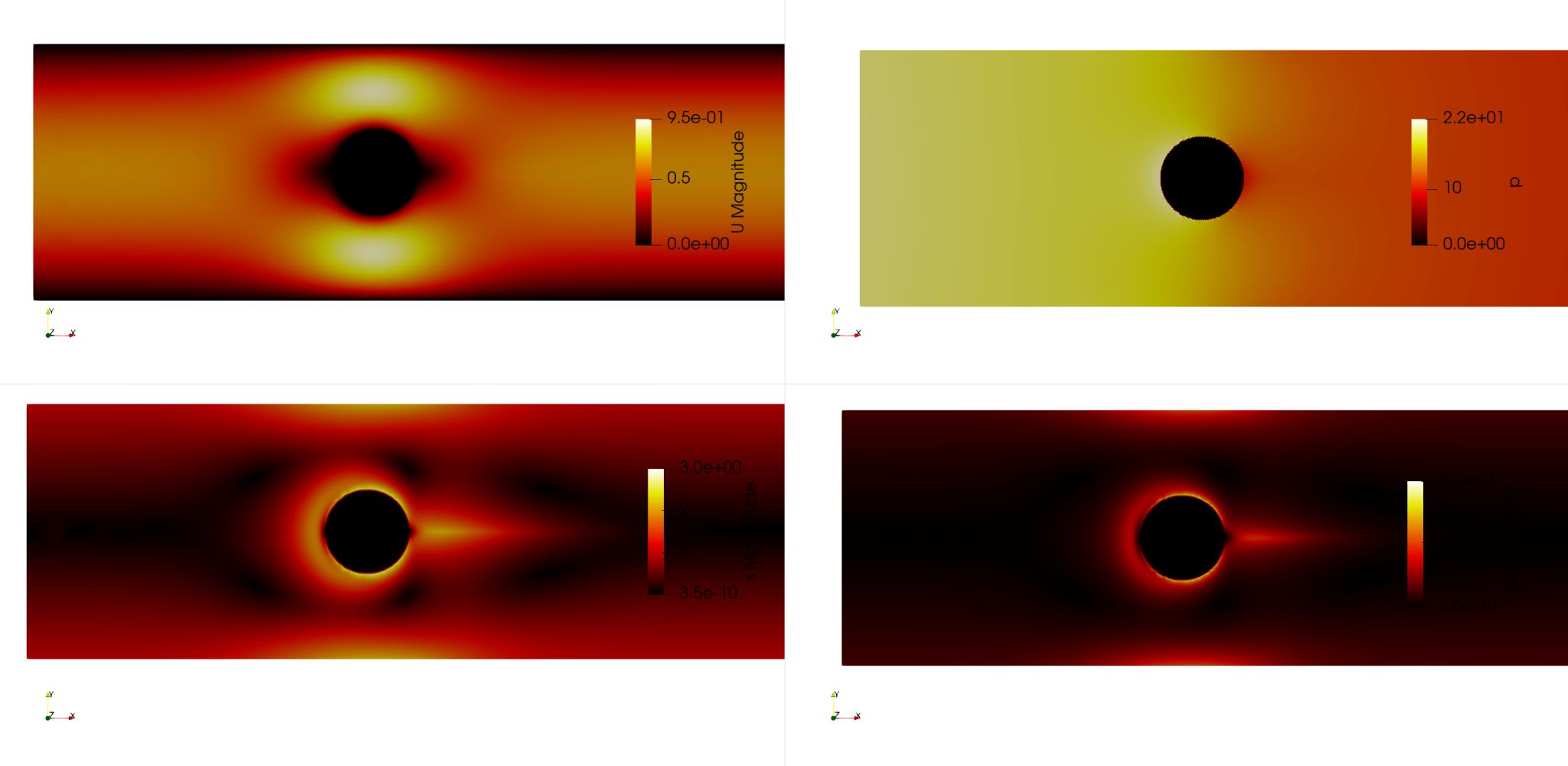
- Velocity field (U): Describing fluid motion and transport.
- Pressure field (p): Representing pressure variations within the fluid domain.
- Extra-stress tensor (tau): Describing the additional stresses associated with viscoelastic material behavior.
- Material interfaces: Identifying the boundaries between moving solids and fluid regions.
Inaccurate field transfer may introduce numerical errors, disturb physical balances, or compromise solver stability.
The projection strategy must therefore be designed and evaluated carefully.
C. Conservation and Numerical Consistency
Maintaining physical consistency during mesh adaptation is an important objective of numerical simulation.
In particular, remeshing and field projection should be assessed for their influence on mass conservation, momentum balance, and the evolution of viscoelastic stresses.
Exact conservation is not automatically guaranteed by interpolation or mesh adaptation.
Conservative transfer methods, appropriate numerical constraints, and verification procedures may be required depending on the computational formulation.
These considerations are essential when developing reliable transient CFD software.
4. Moving Boundaries and Fluid-Structure Interaction
A. Moving Geometric Obstacles
The benchmark considers the motion of geometric obstacles, including cylindrical and rectangular shapes, within a viscoelastic fluid domain.
As an obstacle moves, it modifies the surrounding velocity field and creates time-dependent changes in fluid deformation and stress distribution.
Accurately representing these interactions requires numerical methods capable of updating boundary positions and resolving the evolving flow.
B. Viscoelastic Stress Evolution
Viscoelastic fluids exhibit both viscous and elastic responses, introducing additional complexity into moving-boundary simulations.
Material relaxation, elastic memory, and nonlinear constitutive behavior may influence the flow near moving surfaces.
The computational model must resolve the coupling between fluid motion and the evolution of internal stresses.
These effects become particularly challenging when strong gradients develop near moving boundaries or within downstream wake structures.
C. From Prescribed Motion to Fluid-Structure Interaction
Prescribed moving-boundary simulations provide an important foundation for studying more complex fluid-structure interaction problems.
When the movement of a solid is imposed, the fluid responds to the prescribed boundary motion.
In fully coupled fluid-structure interaction, the solid deformation or displacement also depends on the forces exerted by the surrounding fluid.
Extending a moving-boundary numerical framework toward fully coupled FSI requires additional mechanical equations and appropriate coupling procedures.
These capabilities are relevant to multiphysics simulation and the development of advanced computational mechanics software.
5. Numerical Challenges and Validation
A. Mesh Quality and Solver Stability
Dynamic mesh adaptation introduces numerical challenges associated with element quality, geometric representation, and solver convergence.
Rapidly changing boundaries and localized flow structures can require frequent mesh updates.
The numerical method must maintain an appropriate balance between geometric accuracy, discretization quality, and computational expense.
B. Viscoelastic Field Accuracy
The representation of nonlinear viscoelastic stresses can be particularly sensitive to spatial resolution and numerical transfer procedures.
High stress gradients may develop near solid interfaces, especially under strong deformation conditions.
Adaptive mesh methods can help provide additional resolution in these regions, but the actual improvement must be established through numerical verification.
C. Verification and Benchmarking
A reliable anisotropic mesh refinement framework should be evaluated using systematic numerical tests.
Important verification criteria include:
- Mesh convergence: Assessing sensitivity to spatial resolution.
- Field transfer accuracy: Measuring errors introduced by mesh-to-mesh projection.
- Mass conservation: Evaluating consistency during remeshing.
- Momentum balance: Monitoring conservation properties of the numerical formulation.
- Stress resolution: Examining the representation of localized viscoelastic gradients.
- Computational efficiency: Comparing numerical accuracy and resource requirements.
- Solver robustness: Assessing stability over successive adaptation steps.
Comparisons with fixed-mesh or uniformly refined simulations can provide useful reference cases for evaluating adaptive strategies.
Measured performance improvements should be reported only after appropriate numerical benchmarking.
6. Industrial and Scientific Applications
Dynamic mesh adaptation and moving-boundary CFD techniques are relevant to many scientific and industrial applications.
A. Polymer Extrusion and Processing
Polymer processing equipment often combines complex fluid rheology with moving mechanical components.
Advanced mesh adaptation may support the numerical investigation of flow behavior in extrusion and related manufacturing processes.
B. Mixing and Agitation Systems
Industrial mixing equipment contains moving elements that generate complex flow structures.
Adaptive CFD methods can help investigate local velocity gradients, material deformation, and stress distributions around moving components.
C. Industrial Valves and Moving Components
Numerical simulation of moving boundaries is relevant to valves and mechanical systems involving changes in fluid-domain geometry.
Such investigations can contribute to the understanding of transient flow behavior and fluid-solid interactions.
D. Multiphase and Interface-Tracking Problems
Adaptive mesh techniques can also be useful when accurate representation of moving material interfaces is important.
Potential research applications include multiphase transport, deformable materials, and selected fluid-structure interaction problems.
E. Scientific Software Development
The integration of anisotropic refinement, dynamic remeshing, and field-transfer methods represents an important area of computational software development.
These capabilities can support the creation of flexible numerical frameworks for increasingly complex engineering simulations.
7. Conclusion and Research Perspectives
Anisotropic mesh refinement in fluid-structure interaction simulations provides a promising computational approach for studying complex flows involving moving boundaries, localized gradients, and nonlinear material behavior.
By adapting computational resolution to the evolving physical solution, anisotropic methods can improve the representation of important flow structures without requiring uniform refinement of the entire computational domain.
However, reliable implementation depends on robust remeshing algorithms, accurate field transfer, suitable conservation properties, and systematic numerical verification.
The combination of dynamic mesh adaptation, moving-boundary tracking, and viscoelastic CFD provides a valuable foundation for further research into complex fluid mechanics and multiphysics simulation.
TCHIKOU-R CONSULTING applies expertise in computational physics, adaptive numerical methods, fluid dynamics, and scientific software development to investigate challenging engineering problems.
Discover more scientific investigations, numerical simulations, and advanced computational engineering applications in our Research & Projects collection.
