Course Overview: Detection and Incident Response
Sound the Alarm: Detection and Response is part of the Google Cybersecurity Professional Certificate program.
The course introduces fundamental practices used to identify, investigate, document, and respond to cybersecurity incidents.
It explores how security teams monitor systems and networks, evaluate security alerts, and investigate suspicious activities.
The curriculum also introduces common tools used for incident detection, including packet analysis utilities, intrusion detection systems, and SIEM platforms.
The training emphasizes structured response procedures, effective communication, and accurate documentation throughout an incident investigation.
Incident Response Lifecycle and Procedures
Understanding the incident response lifecycle and the responsibilities of cybersecurity response teams.
Identifying potential security incidents and evaluating the information needed for investigation.
Recognizing the importance of detection, analysis, containment, eradication, and recovery.
Understanding the use of incident response plans, security playbooks, and escalation procedures.
Documenting significant events and maintaining clear communication throughout the incident lifecycle.
Reviewing incidents and identifying opportunities to improve security processes.
Network Monitoring and Traffic Analysis
Understanding network monitoring and the role of traffic analysis in detecting suspicious activities.
Examining network packets and interpreting communication protocols.
Identifying unusual traffic patterns that may indicate security threats.
Learning how packet capture and inspection tools support incident investigations.
Exploring practical network analysis techniques using tools such as Wireshark and tcpdump.
Developing a structured approach to interpreting network evidence and supporting cybersecurity investigations.
Intrusion Detection Systems and SIEM Tools
Understanding intrusion detection systems and their role in identifying suspicious network activity.
Interpreting detection signatures, security events, alerts, and log records.
Examining the concepts and basic operation of network intrusion detection systems.
Learning how security information and event management platforms collect and organize information from multiple sources.
Exploring event investigation and search queries within SIEM environments.
The course introduces technologies such as Suricata, Splunk, and Google SecOps to illustrate security monitoring and analysis workflows.
Incident Investigation, Documentation, and Professional Application
Investigating security events through the review of network activity, system logs, and other technical evidence.
Recognizing indicators of compromise and assessing suspicious activities.
Understanding the importance of reliable documentation and evidence handling.
Using structured incident records, event timelines, and response playbooks.
Communicating investigation findings and supporting coordinated security responses.
For scientific computing environments, these concepts contribute to greater awareness of cybersecurity risks affecting research systems, computational infrastructure, and technical workflows.
Course Information and Certificate Verification
Course Title:
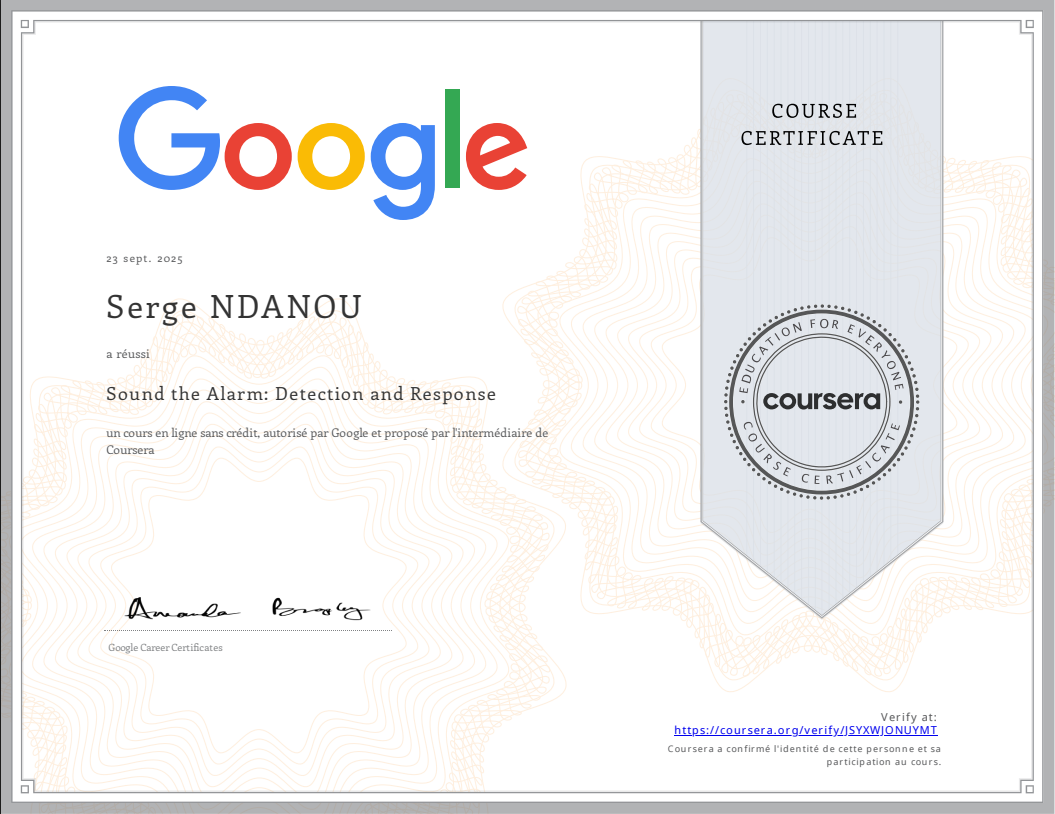
Sound the Alarm: Detection and Response
Training Provider:
Google Career Certificates
Learning Platform:
Coursera
Program:
Google Cybersecurity Professional Certificate
Course Position:
Sixth course in the professional certificate program.
Course Structure:
Four learning modules.
Topics:
Incident Response, Network Traffic Analysis, Intrusion Detection, SIEM, Threat Investigation, Security Logs, Incident Documentation.
Individual Course Certificate:
https://www.coursera.org/account/accomplishments/verify/JSYXWJONUYMT
Google Cybersecurity Professional Certificate:
https://www.coursera.org/account/accomplishments/professional-cert/IIBK4WHVC342
This course forms part of a broader professional training program and is not an independent professional license.