

1. Introduction to Laminar and Turbulent Viscoelastic Flow
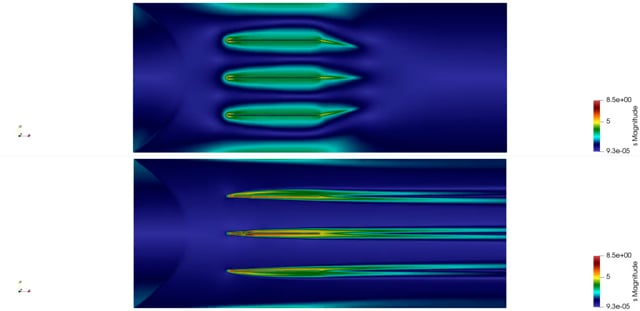
This study examines laminar vs. turbulent viscoelastic flow through a side-by-side CFD visualization of fluid motion around an array of fins. It focuses on how the time-dependent stress-related field changes between the two simulated flow conditions.
Viscoelastic fluids combine viscous and elastic responses. Their stress distributions depend not only on the instantaneous deformation rate but also on material relaxation and deformation history.
When such fluids move around obstacles, strong velocity gradients, wakes, and local changes in deformation can make the stress response particularly complex.
The numerical study uses the Giesekus constitutive model to represent nonlinear viscoelastic behavior. The accompanying video presents the reference case in the upper panel and the case described as turbulent in the lower panel.
The lower simulation is reported at a Reynolds number of Re = 1000. The Reynolds number of the upper simulation and the complete numerical settings are not specified in the original description.
The principal purpose of this project is to compare the spatial patterns and temporal evolution of the visualized stress field, rather than to claim a quantified difference in turbulence intensity or industrial performance.
2. Numerical Configuration and Side-by-Side Comparison
A. Viscoelastic Flow Around Fins
The computational geometry contains an array of fin-like obstacles positioned within the flow. These fins affect the local motion of the fluid and may generate strong shear layers and downstream wake structures.
Depending on the geometry, inlet conditions, Reynolds number, and viscoelastic properties, the flow can display different degrees of temporal variation and structural complexity.
B. Upper Panel: Laminar Reference Flow
The upper visualization shows the flow described as laminar or without turbulence. This case serves as the visual reference for the comparison.
Laminar behavior does not necessarily imply that every quantity is constant in time. A time-dependent laminar solution can still exhibit transient changes without being turbulent.
C. Lower Panel: Case Reported as Turbulent
The lower visualization shows the case presented as turbulent, with Re = 1000. The video is intended to illustrate differences in the evolving stress-related patterns near and downstream of the fins.
A Reynolds number of 1000 does not by itself prove that the computed flow is turbulent. Confirming turbulence would require additional information about the geometry, flow statistics, resolved fluctuations, and numerical methodology.
D. Interpreting the Visual Comparison
The laminar vs. turbulent viscoelastic flow comparison is best interpreted as a qualitative visualization of two reported numerical configurations.
To isolate the effect of a flow regime quantitatively, the cases would need clearly documented material parameters, compatible reference scales, boundary conditions, and visualization ranges.
3. Giesekus Constitutive Modeling
A. Representing Nonlinear Polymer Rheology
The Giesekus model is used in computational rheology to describe selected nonlinear features of viscoelastic fluid behavior. Depending on the model parameters, it can represent shear-thinning, elastic memory, and normal stress effects.
These properties are relevant to polymer solutions and melts subjected to nonuniform deformation around internal obstacles.
B. Coupling Motion and Constitutive Stress
A viscoelastic CFD formulation couples fluid conservation equations to constitutive equations that evolve the polymeric extra stresses.
As the flow deforms around the fins, the local material response depends on the velocity gradients and the relevant relaxation times. In turn, constitutive stresses contribute to the momentum balance.
Accurate numerical treatment is important because errors in either the flow solution or constitutive calculation can affect the reported stress distribution.
C. Constitutive Model Versus Turbulence Treatment
The Giesekus law is a constitutive model, not a turbulence closure. The original project does not specify whether the flow equations were treated through direct numerical resolution, filtered equations, or another numerical strategy.
For this reason, the laminar vs. turbulent viscoelastic flow study is described according to the two conditions reported by Serge, without assigning an unsupported turbulence model or claiming experimental validation.
4. Logarithmic Stress Field and Temporal Evolution
A. The Displayed Stress-Related Quantity
The video displays a field described in the original project as the logarithm of the stress tensor, labeled s. This logarithmic representation is used to visualize the temporal evolution of stress-related quantities around the fins.
The source description does not provide the exact mathematical definition of s. It would therefore be premature to identify it as a specific log-conformation variable or to infer the tensor transformation employed.
B. Stress Concentrations Around the Fins
Fin surfaces and nearby flow passages may produce substantial velocity gradients and localized stress variations. Their evolution is influenced by the geometry and nonlinear rheology of the fluid.
Examining successive video frames can help locate regions where the visualized field changes over time, including areas adjacent to the fins and within their downstream wakes.
C. Comparing the Two Video Panels
The laminar vs. turbulent viscoelastic flow video offers a visual comparison of the displayed stress patterns in the upper and lower panels.
Differences in appearance should be interpreted carefully unless the color scales, model parameters, geometric configuration, and temporal sampling are known to be directly comparable.
Claims about stress amplification or reduction require corresponding quantitative results, not only a qualitative inspection of colors and patterns.
5. Numerical Challenges and Verification
A. Resolving Unsteady Flow Around Obstacles
Flow around fins may involve sharp gradients and evolving wake structures. Numerically representing these features requires suitable spatial discretization and time-step selection.
The demands increase when the solver must also resolve the nonlinear constitutive equations of a viscoelastic fluid.
B. Constitutive Solver Stability
Large viscoelastic stresses and strong deformation gradients can make numerical convergence difficult. Solver reliability depends on the constitutive formulation, numerical algorithms, discretization, and operating conditions.
Important checks include conservation of mass, monitoring of residuals, resolution of the stress field, and the sensitivity of results to spatial and temporal refinement.
C. Establishing Whether a Flow Is Turbulent
A rigorous laminar vs. turbulent viscoelastic flow assessment would benefit from diagnostics such as time histories of velocity, spatial and temporal fluctuations, flow statistics, and reproducible numerical settings.
These diagnostics can help distinguish sustained turbulent behavior from transient or periodic flow instabilities. The information supplied for this project does not document those additional tests.
D. Reproducible Visualization
Using consistent color limits and field definitions is essential when comparing two simulation panels. Shared visualization conventions make it easier to distinguish real numerical differences from differences introduced by plotting settings.
For additional verification, a future technical report could provide the dimensionless parameters, computational mesh, time-step strategy, and definition of the displayed logarithmic quantity.
6. Research and Industrial Relevance
A. Polymer Processing
Viscoelastic fluids are encountered in selected polymer extrusion, coating, and manufacturing operations. Their nonlinear stress response can influence transport through restricted or obstacle-containing geometries.
Understanding the relationship between flow conditions and material stresses is relevant to the development and evaluation of computational processing models.
B. Complex Internal Flows
Fins and similar internal components modify fluid motion and may create localized deformation and wake structures. Computational analysis helps researchers examine the behavior of complex fluids in these configurations.
C. Flow Modeling and Scientific Software
The laminar vs. turbulent viscoelastic flow problem is useful for evaluating numerical strategies that combine unsteady CFD, nonlinear constitutive models, and stress visualization.
Potential applications include solver benchmarking, scientific visualization, and computational studies of rheological behavior. Predictive industrial conclusions require validation under the relevant material and operating conditions.
7. Conclusion and Future Research
This laminar vs. turbulent viscoelastic flow comparison illustrates two simulated flow conditions around an array of fins using the Giesekus constitutive model.
The upper panel represents the case described as laminar, while the lower panel represents the case reported as turbulent at Re = 1000. Both are presented through the temporal evolution of a logarithmic stress-related field, s.
The video provides a useful qualitative demonstration of how viscoelastic stress patterns can evolve in flows around complex geometry.
A future quantitative study could document the flow regimes, numerical resolution, stress-field definition, and differences in selected velocity and stress statistics.
TCHIKOU-R CONSULTING applies expertise in computational fluid dynamics, nonlinear constitutive modeling, numerical methods, and scientific software development to complex engineering research.
Discover more simulations and numerical research in our Research & Projects collection.
